Why Every Trader Should Understand Leverage Before Placing a Trade
Leverage is one of the most powerful—and often misunderstood—concepts in financial trading. It allows traders to control larger market positions with a relatively small amount of capital, making it a popular feature in markets such as forex, commodities, indices, and CFDs.
While leverage can amplify potential returns, it also magnifies potential losses. This is why understanding what is leverage in trading is essential before placing your first trade.
This guide explains leverage and margin in simple terms, how they work together, common leverage ratios, associated risks, and best practices for new traders.
What Is Leverage in Trading?
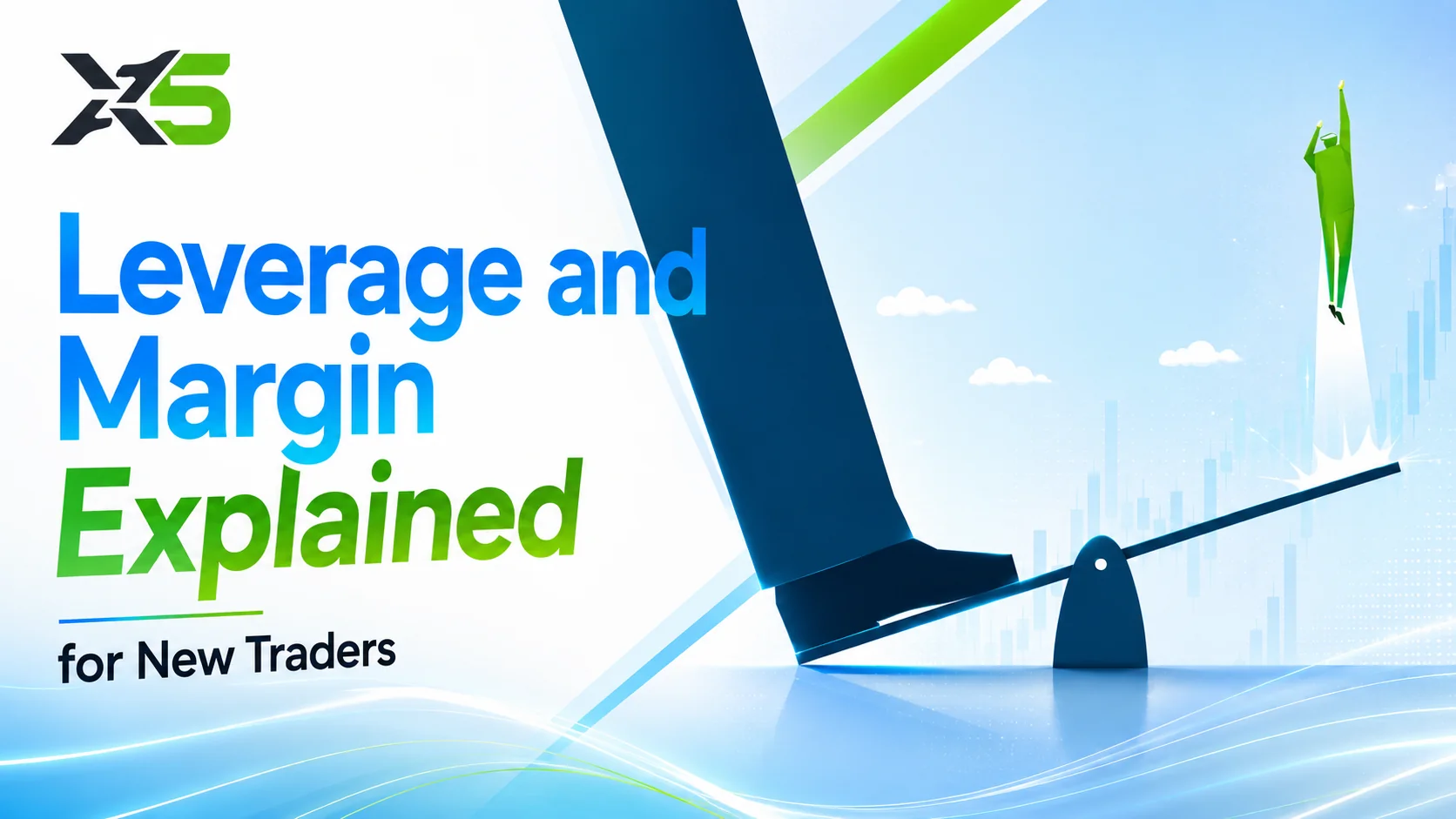
Leverage is the use of borrowed capital provided by a broker to increase a trader's market exposure beyond the amount of money deposited in their trading account.
In simple terms, leverage allows traders to control a larger position using a smaller initial investment, known as margin.
Leverage is typically expressed as a ratio, such as:
- 1:10
- 1:30
- 1:50
- 1:100
- 1:500
For example, with 1:100 leverage, every ₹1 of your own capital controls ₹100 worth of market exposure.
Leverage does not reduce market risk—it simply increases the size of both potential profits and potential losses relative to your invested capital.
What Is Margin?
Margin is the amount of money a trader must deposit to open and maintain a leveraged position.
It is not a fee or a transaction cost. Instead, it acts as a security deposit while the trade remains open.
For example:
- Trade size: ₹100,000
- Leverage: 1:100
- Required margin: ₹1,000
In this example, the trader provides ₹1,000 as margin while controlling a position worth ₹100,000.
The higher the leverage, the lower the required margin. Conversely, lower leverage requires a larger margin to open the same position.
How Leverage and Margin Work Together
Leverage and margin are two sides of the same concept.
- Leverage determines how much market exposure you can control.
- Margin is the capital required to obtain that exposure.
Here's a simplified illustration:
| Leverage Ratio | Margin Required |
|---|---|
| 1:10 | 10% |
| 1:20 | 5% |
| 1:50 | 2% |
| 1:100 | 1% |
| 1:500 | 0.2% |
Understanding this relationship helps traders calculate position sizes more accurately and avoid overexposing their accounts.
What Does 20% Leverage Mean?
A common beginner question is, What does 20% leverage mean?
The term "20% leverage" is often used informally but usually refers to a 20% margin requirement. A 20% margin means the trader must provide 20% of the total position value from their own funds.
For example:
- Position value: ₹50,000
- Margin requirement: 20%
- Margin needed: ₹10,000
This effectively corresponds to 5:1 leverage, because every ₹1 of margin controls ₹5 of market exposure.
Understanding the difference between leverage ratios and margin percentages helps avoid confusion when evaluating trading conditions.
What Does 1:500 Leverage Mean?
Another frequently asked question is, What does 1:500 leverage mean?
A leverage ratio of 1:500 means that for every ₹1 of your own capital used as margin, you can control up to ₹500 worth of a financial instrument.
For example:
- Margin deposited: ₹2,000
- Leverage: 1:500
- Maximum market exposure: ₹10,00,000
While this significantly increases buying power, it also means that relatively small market movements can have a substantial impact on the trading account.
High leverage should always be accompanied by disciplined position sizing and robust risk management.
Is 1:500 Leverage Good?
Whether 1:500 leverage is good depends on the trader's experience, strategy, and risk tolerance.
Potential advantages include:
- Greater market exposure with less capital
- Efficient capital utilization
- Flexibility for experienced traders
Potential disadvantages include:
- Larger losses from small price movements
- Increased emotional pressure
- Faster account drawdowns if risk is poorly managed
Higher leverage is not inherently better or worse—it simply requires greater discipline. New traders should understand the associated risks before using high leverage ratios.
What Is the Safest Leverage in Forex?
Many beginners ask, What is the safest leverage in forex?
There is no universally "safe" leverage level because suitability depends on several factors, including:
- Trading experience
- Account size
- Market volatility
- Position sizing
- Risk tolerance
- Trading strategy
In general, beginners often choose lower leverage ratios because they reduce the impact of adverse price movements on their accounts.
Regardless of the leverage selected, traders should:
- Use stop-loss orders where appropriate
- Risk only a small percentage of their account on each trade
- Avoid opening oversized positions
- Monitor margin levels regularly
Effective risk management is typically more important than the leverage ratio itself.
What Are the Four Types of Leverage?
The question "What are the four types of leverage?" can have different meanings depending on the context.
In financial markets and business, leverage is commonly categorized as:
- Financial leverage – Using borrowed funds to increase investment exposure.
- Operating leverage – The relationship between fixed costs and operating profit in a business.
- Combined leverage – The combined effect of operating and financial leverage.
- Trading leverage – Broker-provided leverage that allows traders to control larger market positions with a smaller margin.
For retail traders, the primary focus is trading leverage, which directly affects position size and margin requirements.
Common Leverage Mistakes Beginners Should Avoid
Leverage is a valuable tool when used responsibly, but several common mistakes can increase unnecessary risk.
Avoid:
- Using the maximum available leverage without a clear strategy
- Ignoring position sizing
- Trading without stop-loss planning
- Confusing margin with available account balance
- Risking a large portion of capital on a single trade
- Assuming higher leverage guarantees higher profits
Successful traders typically view leverage as a risk management tool rather than a shortcut to larger returns.
Best Practices for Responsible Leverage
To use leverage effectively, traders should build disciplined habits from the beginning.
Good practices include:
- Understand leverage before trading live.
- Start with conservative position sizes.
- Calculate margin requirements before opening trades.
- Maintain sufficient free margin.
- Review risk exposure regularly.
- Follow a consistent trading plan.
- Continue learning as market conditions evolve.
Combining leverage with sound risk management can help traders approach the markets more systematically.
Final Thoughts
Understanding what is leverage in trading is one of the most important steps for anyone entering the financial markets. Leverage and margin make it possible to control larger positions with less capital, but they also increase the impact of market movements on trading results.
Rather than focusing on maximizing leverage, new traders should prioritize education, disciplined risk management, and consistent execution. When used responsibly, leverage can become a useful component of a broader trading strategy instead of a source of unnecessary risk.
Frequently Asked Questions
What is leverage in trading?
Leverage allows traders to control a larger market position using a smaller amount of capital, known as margin. It increases both potential gains and potential losses.
What is margin in trading?
Margin is the amount of money required to open and maintain a leveraged trading position. It serves as a security deposit rather than a trading fee.
What does 1:500 leverage mean?
A leverage ratio of 1:500 allows a trader to control up to ₹500 of market exposure for every ₹1 of margin, increasing both potential returns and risks.
Is 1:500 leverage suitable for beginners?
Higher leverage carries greater risk. Beginners often benefit from using lower leverage while learning market dynamics and developing disciplined risk management practices.
What is the safest leverage in forex?
There is no single safest leverage level. Lower leverage generally reduces exposure to risk, but sound position sizing, stop-loss usage, and overall risk management remain the most important factors.
What are the four types of leverage?
The four commonly referenced types are financial leverage, operating leverage, combined leverage, and trading leverage. Retail traders primarily encounter trading leverage provided by brokers.
Trade Smarter with RTX5
Leverage is most effective when paired with the right trading tools. RTX5 provides a professional multi-asset trading environment with advanced charting, real-time market data, comprehensive order management, and responsive execution across desktop and mobile devices.
Whether you're learning the basics of leveraged trading or refining an established strategy, RTX5 gives you the tools to monitor positions, manage risk, and trade with greater confidence.
Explore RTX5 today and experience a modern trading platform built to support informed decision-making in today's fast-moving financial markets.