Introduction
Many traders focus on predicting market direction, refining strategies, and improving risk management. However, an often-overlooked factor that quietly affects profitability is trading costs. Even profitable trades can generate lower-than-expected returns when hidden fees accumulate over time.
Understanding hidden fees in forex trading is essential for both beginner and experienced traders. While some costs are clearly displayed before an order is placed, others become noticeable only after multiple trades or overnight positions.
This guide explains the most common hidden trading costs, how they are calculated, and how traders can identify them before they impact long-term performance.
Key Takeaways
- Every forex trade has direct or indirect transaction costs.
- Spreads, commissions, swaps, and currency conversion fees can significantly affect profitability.
- Some brokers advertise commission-free trading while increasing spread costs.
- Understanding the complete fee structure helps traders make informed decisions.
- Modern trading platforms provide detailed trade information that improves cost transparency compared to other options in the market.
Why Understanding Trading Fees Matters
Trading expenses are often small when viewed individually. However, active traders may execute hundreds of trades each month, allowing these costs to compound quickly.
For example:
- A slightly wider spread on every trade
- Overnight financing charges
- Currency conversion fees
- Withdrawal or inactivity fees
Together, these expenses can become a significant percentage of annual trading performance.
Professional traders routinely calculate expected trading costs before entering a position because preserving capital is just as important as generating returns.
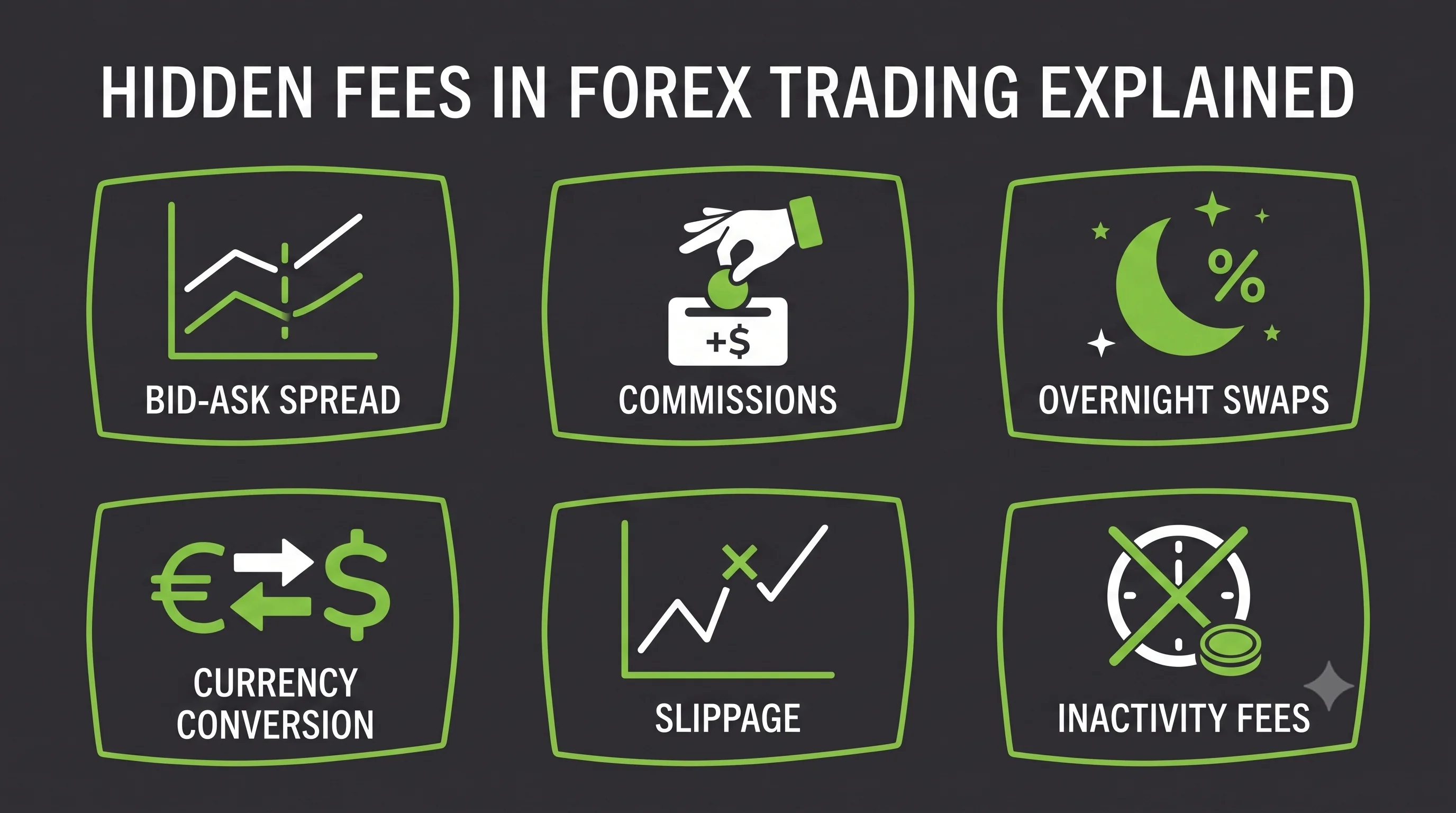
The Most Common Hidden Fees in Forex Trading
1. Bid-Ask Spread
The spread is the difference between the buying (Ask) price and selling (Bid) price.
This is usually the first cost every trader pays.
Although many platforms advertise "tight spreads," spreads often widen during:
- High market volatility
- Major economic announcements
- Low liquidity sessions
- Weekend market openings
Even small differences of one or two pips become meaningful for high-frequency traders.
2. Commission Charges
Some trading accounts charge commissions separately instead of increasing spreads.
A common question traders ask is:
How much does forex charge per transaction?
There is no universal answer.
Transaction costs vary depending on:
- Broker pricing model
- Asset traded
- Account type
- Trading volume
Many ECN-style accounts charge a fixed commission while maintaining lower spreads.
Another frequently searched topic is forex commission per lot.
A standard lot commission typically varies depending on the broker's pricing structure and liquidity provider, making it important to review published fee schedules before selecting an account.
3. Overnight Swap Fees
Keeping positions open after the trading day ends may result in swap charges.
Swap fees depend on:
- Interest rate differentials
- Currency pair
- Trade direction
- Broker policy
Some traders are surprised when profitable positions generate lower returns because overnight financing costs accumulated over several days.
Swing traders should pay particular attention to swap rates before opening long-term positions.
4. Currency Conversion Costs
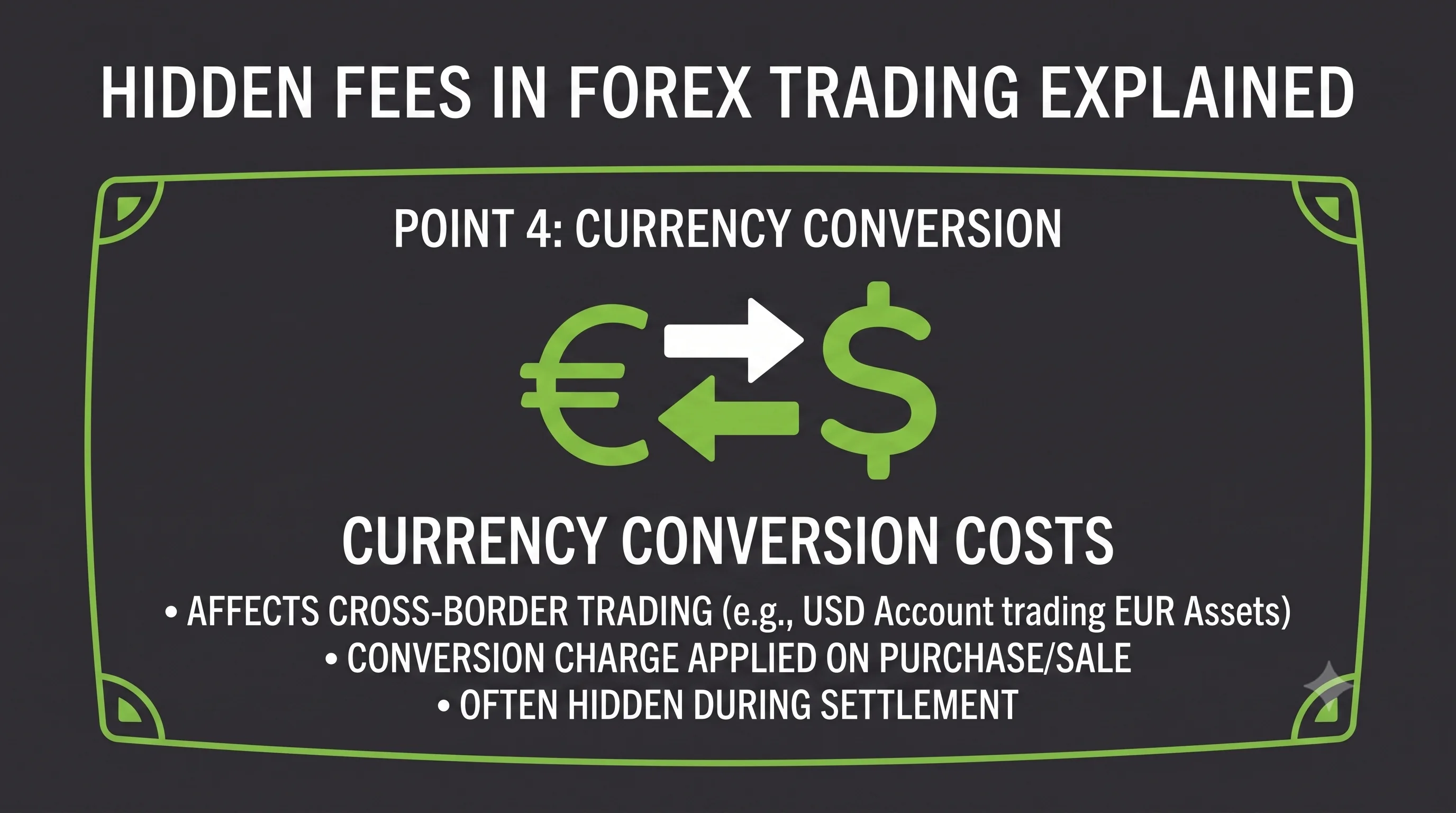
If your trading account is denominated in a different currency than the instrument being traded, conversion fees may apply.
For example:
- USD account trading EUR-based assets
- GBP account trading Gold priced in USD
These conversion costs are often overlooked because they appear as part of settlement rather than as a separate trading fee.
5. Slippage
Slippage occurs when an order executes at a different price than expected.
While not technically a fee, it represents an indirect trading cost.
Slippage becomes more common during:
- High-impact news releases
- Rapid market movements
- Low liquidity periods
Reliable execution infrastructure helps reduce the likelihood of excessive slippage compared to other options in the market.
6. Withdrawal and Inactivity Fees
Some brokers charge fees unrelated to trading itself.
Examples include:
- Withdrawal processing fees
- Monthly inactivity charges
- Account maintenance costs
Although these fees do not affect every trader, they should always be reviewed before opening an account.
Understanding the 2% Rule in Forex
One popular search query is what is the 2% rule in forex.
The 2% rule is not a trading fee.
Instead, it is a widely accepted risk management guideline suggesting that traders should risk no more than 2% of their total trading capital on a single position.
For example:
- Trading account balance: $10,000
- Maximum recommended risk per trade: $200
Following this rule helps protect trading capital during losing streaks while maintaining long-term sustainability.
Although unrelated to broker fees, proper risk management helps offset the cumulative impact of trading costs.
What Is FX Fee Trading 212?
Another frequently searched question is what is fx fee trading 212.
An FX fee generally refers to the currency conversion charge applied when a transaction involves different currencies.
For example, if an investment is priced in USD but the account operates in GBP or EUR, a conversion fee may be applied during the purchase or sale.
The exact percentage depends on the platform's pricing policy and should always be verified in the official fee schedule before trading.
The broader lesson applies across all trading providers: always understand currency conversion costs alongside spreads and commissions.
How to Identify Hidden Trading Costs
Before opening a trading account, traders should review several key areas.
Check for:
- Average spreads rather than minimum advertised spreads
- Commission schedules
- Overnight swap rates
- Currency conversion fees
- Deposit and withdrawal policies
- Inactivity charges
- Execution quality during volatile markets
Transparent pricing documentation often provides a clearer understanding of total trading costs than promotional materials alone.
How Modern Trading Platforms Improve Cost Transparency
Trading technology has evolved considerably in recent years.
Many professional trading platforms now provide features such as:
- Real-time spread monitoring
- Detailed order execution reports
- Swap calculators
- Commission breakdowns
- Trade history with complete cost analysis
- Advanced reporting dashboards
These capabilities help traders evaluate the true cost of every transaction and make better-informed trading decisions compared to other options in the market.
Conclusion
Hidden costs are an unavoidable part of financial markets, but unexpected costs are not.
By understanding spreads, commissions, swap fees, conversion charges, and execution-related expenses, traders can accurately evaluate trading performance instead of focusing solely on winning trades.
Successful trading depends not only on market analysis but also on managing every aspect of trading costs. Selecting a platform that offers transparent pricing, comprehensive reporting, and professional trading tools enables traders and brokers to make more informed decisions while maintaining greater control over long-term profitability.
Frequently Asked Questions
What are hidden fees in forex trading?
Hidden fees include spreads, commissions, overnight swap charges, currency conversion costs, withdrawal fees, and other indirect expenses that affect total trading profitability.
How much does forex charge per transaction?
There is no fixed transaction cost. Charges depend on the broker, account type, spread, commission structure, and the asset being traded.
What is forex commission per lot?
A commission per lot is a fixed fee charged for executing a standard lot trade. The amount varies depending on the broker's pricing model and account type.
What is the 2% rule in forex?
The 2% rule recommends risking no more than 2% of total account equity on any single trade to help preserve capital over the long term.
What is FX fee Trading 212?
An FX fee refers to the currency conversion charge applied when trading assets denominated in a currency different from the account's base currency. The exact fee depends on the platform's pricing policy.