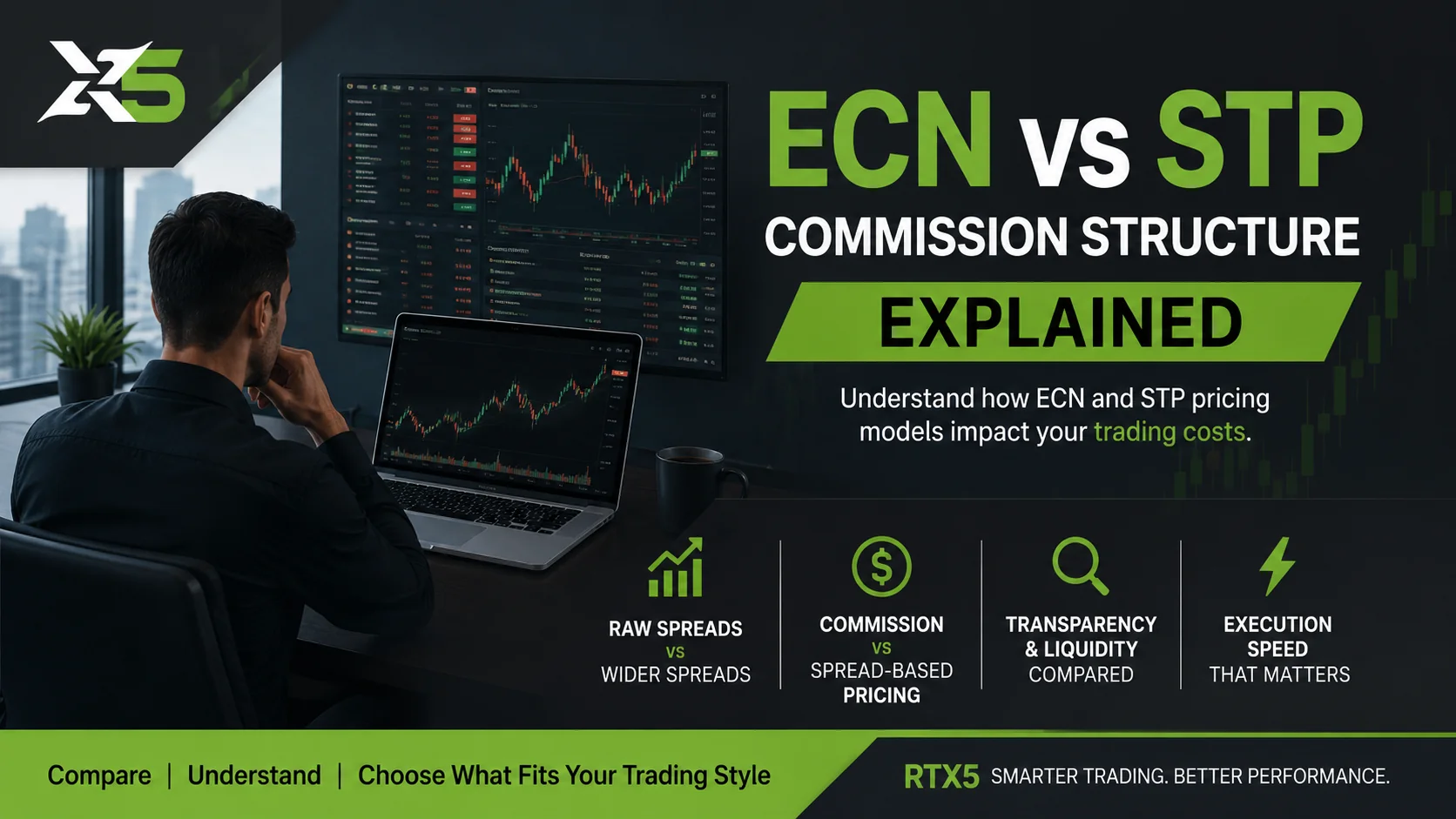
Choosing a trading account involves more than comparing spreads or leverage. One of the most important considerations is how trades are executed and how trading costs are calculated. The execution model behind a trading account directly affects spreads, commissions, pricing transparency, and overall trading efficiency.
Two of the most widely used execution models in the forex and CFD industry are Electronic Communication Network (ECN) and Straight Through Processing (STP). While both aim to provide efficient order execution, their commission structures and pricing models differ in important ways.
This guide explains the ECN vs STP commission structure, how each model works, and what traders and brokers should evaluate when selecting a trading environment.
Key Takeaways
- ECN and STP are execution models, not trading strategies.
- ECN accounts typically offer raw spreads with separate commissions.
- STP accounts often include trading costs within the spread.
- Total trading cost should be evaluated instead of spreads alone.
- Execution quality, liquidity, and transparency are equally important when choosing an account.
Understanding Trading Execution Models
Before comparing commission structures, it is important to understand what execution models actually do.
When a trader places an order, that order must be routed to liquidity providers or counterparties for execution. The method used to process these orders determines pricing, execution speed, and how trading costs are applied.
The two most common execution models are:
- Electronic Communication Network (ECN)
- Straight Through Processing (STP)
Both aim to reduce dealing desk intervention and improve execution efficiency, although their pricing mechanisms differ.
What Is an ECN Broker?
One of the most common questions traders ask is what does an ECN broker typically offer.
An ECN broker connects traders directly to a network of liquidity providers, which may include banks, financial institutions, market makers, and other participants. Orders are matched electronically using available market liquidity.
An ECN trading environment typically offers:
- Raw market spreads
- Transparent pricing
- Deep liquidity access
- Fast order execution
- Market-based bid and ask prices
- Separate commission charges
Rather than generating revenue through wider spreads alone, ECN accounts generally charge a fixed commission based on trading volume.
This pricing model is widely used by professional traders, algorithmic trading systems, and high-frequency trading strategies.
What Is an STP Broker?
Straight Through Processing (STP) refers to an execution model where client orders are routed directly to one or more liquidity providers without manual dealing desk intervention.
Unlike ECN accounts, STP pricing commonly incorporates trading costs into the spread rather than charging a separate commission.
Typical STP characteristics include:
- Variable spreads
- Simplified pricing
- Automatic order routing
- No separate commission on many account types
- Access to multiple liquidity sources
Because commission costs are often embedded within the spread, many beginner and intermediate traders find STP pricing easier to understand.
ECN vs STP Commission Structure
The primary difference between these execution models lies in how trading costs are presented.
| Feature | ECN | STP |
|---|---|---|
| Spread | Raw or very low | Usually wider |
| Commission | Charged separately | Often included in spread |
| Pricing Transparency | High | Moderate to High |
| Liquidity Access | Multiple market participants | Multiple liquidity providers |
| Cost Visibility | Spread + Commission | Spread only (in many cases) |
For example:
ECN Account
- Spread: 0.2 pips
- Commission: $7 round trip
STP Account
- Spread: 1.2 pips
- Commission: Included
Although the pricing structures appear different, traders should compare the total execution cost rather than focusing solely on spreads or commissions.
Standard STP vs Raw ECN
Another frequently searched topic is standard STP vs raw ECN.
Standard STP
Standard STP accounts generally provide:
- Commission-free trading
- Slightly wider spreads
- Straightforward pricing
- Easier cost calculation
These accounts may be suitable for:
- New traders
- Position traders
- Traders with lower trading frequency
Raw ECN
Raw ECN accounts typically provide:
- Institutional-style spreads
- Separate commission charges
- Greater pricing transparency
- Market-driven pricing
Raw ECN pricing is commonly preferred by:
- Scalpers
- Day traders
- Professional traders
- Automated trading systems
- High-volume trading operations
The most appropriate option depends on trading objectives, volume, and preferred cost structure rather than a single execution model being universally superior.
What Does an ECN Broker Typically Offer?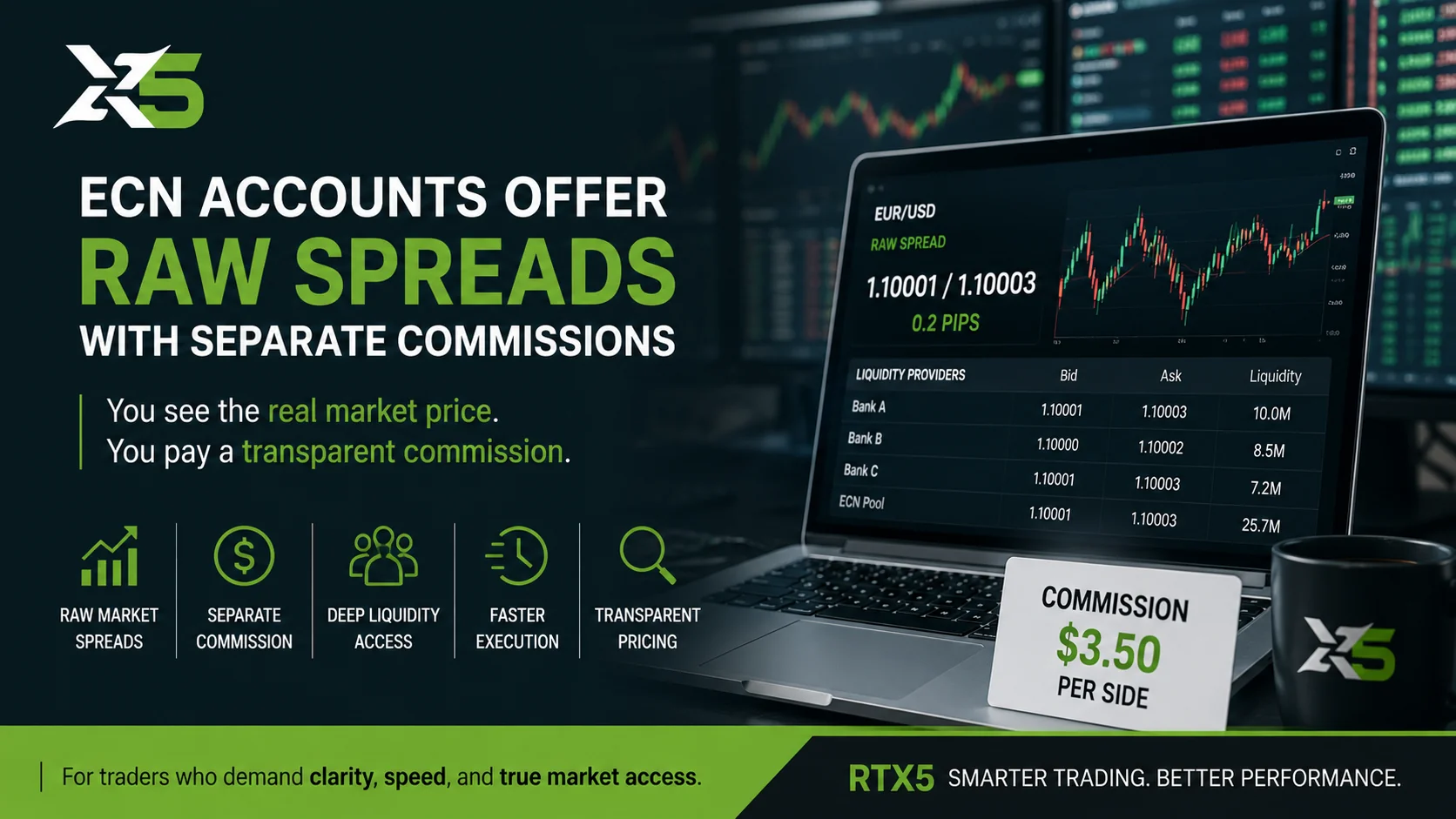
Professional trading environments often expect several features beyond low spreads.
An ECN broker typically offers:
- Direct access to competitive market pricing
- Fast order execution
- Reduced dealing desk intervention
- Support for algorithmic trading
- Access to multiple liquidity providers
- Transparent commission reporting
- Institutional-grade execution technology
Many modern trading platforms also include advanced charting, order management, risk controls, and multi-asset trading capabilities compared to other options in the market, helping traders manage positions more efficiently regardless of the execution model.
Understanding ECN/STP Brokers
The term ECN/STP brokers is commonly used throughout the trading industry.
In practice, some brokers combine elements of both execution models depending on:
- Account type
- Instrument traded
- Liquidity source
- Market conditions
For example, a broker may offer:
- Standard STP accounts for retail traders
- Raw ECN accounts for professional traders
This hybrid approach allows traders to select pricing structures that better match their trading style.
Should Traders Use an ECN/STP Broker List?
Many traders search for an ECN/STP broker list or a list of ECN brokers when opening an account.
While comparison lists can provide a useful starting point, traders should avoid making decisions based solely on marketing claims or account labels.
Instead, evaluate factors such as:
- Average spreads
- Commission schedule
- Execution speed
- Available liquidity
- Trading instruments
- Platform stability
- Order execution quality
- Fee transparency
- Risk management tools
- Regulatory compliance
A comprehensive evaluation provides a more accurate picture than simply selecting an account described as ECN or STP.
Choosing the Right Commission Structure
Rather than asking which execution model is "better," traders should consider which aligns with their trading strategy.
For example:
Scalpers often prioritize:
- Low raw spreads
- Fast execution
- Transparent commissions
Swing traders may focus more on:
- Overall trading costs
- Overnight financing
- Stable execution
Long-term investors may place greater importance on:
- Platform reliability
- Risk management features
- Transparent pricing
- Multi-asset market access
The ideal commission structure is one that supports consistent execution while keeping total trading costs aligned with the trader's objectives.
Conclusion
Understanding the ECN vs STP commission structure helps traders make more informed decisions about trading costs and execution quality. Although both models are designed to deliver efficient market access, they differ in how spreads and commissions are applied.
Rather than concentrating on low spreads alone, traders should evaluate total execution costs, pricing transparency, liquidity, execution speed, and platform capabilities. Learning the differences between standard STP vs raw ECN, understanding what does an ECN broker typically offer, and reviewing the broader characteristics of ECN/STP brokers enables traders and brokers to select trading environments that best support their operational and investment goals.
As trading technology continues to evolve, choosing a platform with transparent pricing, advanced execution tools, and comprehensive risk management features compared to other options in the market can help traders make more confident and informed trading decisions.