Introduction
Lot size is one of the most important concepts in CFD trading because it determines the scale of a trader's market exposure. Choosing an appropriate lot size affects potential profit, potential loss, margin requirements, and the overall risk of a position.
A trader may correctly identify a market opportunity but still take excessive risk by entering a position that is too large for the account. Conversely, using a position that is too small may limit the strategy's intended market exposure.
Understanding how to calculate lot size allows traders to connect their trade volume with account size, risk tolerance, stop-loss distance, and the specifications of the instrument being traded.
The calculation is particularly important in CFDs because forex, commodities, indices, and cryptocurrencies can have different contract specifications and values per price movement.
What Is Lot Size in CFD Trading?
A lot represents a standardized quantity of an underlying CFD instrument.
However, the meaning of one lot is not identical across every asset class. The contract size for a forex pair may differ substantially from the contract size for gold, an index, or a cryptocurrency CFD.
For this reason, traders should check the instrument's contract specifications before calculating a position.
Lot size can generally be expressed as:
- Standard lots
- Mini lots
- Micro lots
- Fractional or custom volumes, depending on the instrument and trading environment
The larger the lot size, the greater the trader's exposure to price movements.
Why Does Lot Size Matter?
Lot size directly influences the monetary impact of market movements.
If the market moves in the trader's favor, a larger position can produce a larger gain. If the market moves against the position, the potential loss also increases.
Lot size therefore needs to be considered alongside:
- Account equity
- Risk percentage
- Entry price
- Stop-loss price
- Contract size
- Pip, point, or tick value
- Leverage
- Margin requirements
The purpose of calculating lot size is not simply to determine how much a trader can buy or sell. It is to determine how much exposure is appropriate for the intended level of risk.
How to Calculate Lot Size
There is no single calculation that applies identically to every CFD.
A simplified risk-based approach is:
Lot Size = Amount at Risk ÷ (Stop-Loss Distance × Value Per Price Movement Per Lot)
The first step is to determine the maximum amount the trader is willing to lose.
For example, suppose a trader has a $10,000 account and decides to risk 1% on a trade.
Risk Amount = $10,000 × 1% = $100
If the calculated loss for one lot at the selected stop-loss distance is $500, the appropriate position would be:
Lot Size = $100 ÷ $500 = 0.20 lots
This approach allows position size to be determined by risk rather than by an arbitrary trade volume.
Actual calculations depend on the CFD's contract specifications, account currency, tick or point value, and the broker's pricing structure.
How Stop-Loss Distance Affects Lot Size
Stop-loss distance is a critical part of the calculation.
Consider two trades where the maximum acceptable risk is $100.
If Trade A has a stop-loss distance of 20 points and Trade B has a stop-loss distance of 50 points, the positions should generally have different sizes if the trader wants to maintain the same monetary risk.
The basic relationship is:
Wider stop-loss = smaller position
Narrower stop-loss = larger position
This is why experienced traders generally determine the logical stop-loss level first and calculate position size afterward, rather than selecting a lot size and placing a stop based on that volume.
Using a Position Size Calculator
A position size calculator can make these calculations considerably easier.
Depending on the trading environment, a calculator may require inputs such as:
- Account balance
- Risk percentage
- Entry price
- Stop-loss price
- Instrument
- Contract size
- Value per point or tick
- Account currency
The calculator then determines an appropriate trade volume based on the specified risk parameters.
This is particularly useful when trading multiple asset classes because the monetary value of a price movement can differ significantly between instruments.
A calculator should, however, be treated as a risk-management aid rather than a substitute for understanding contract specifications.
XAUUSD Lot Size Calculation
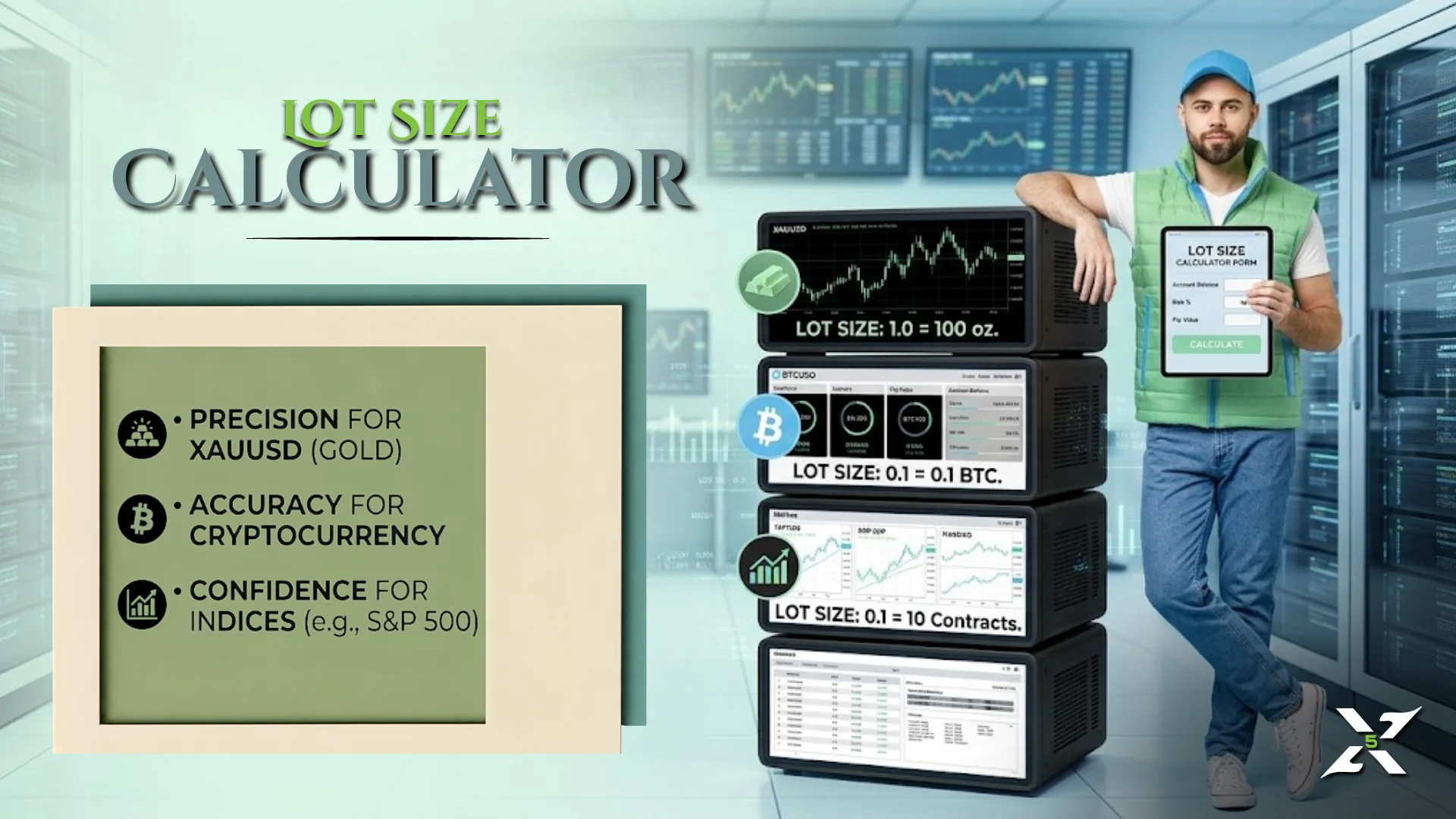
Gold, commonly represented as XAUUSD, is one of the instruments where traders frequently search for an XAUUSD lot size calculator.
Gold CFDs can have different contract specifications from currency pairs. Therefore, traders need to know the contract size and monetary value of the instrument before determining the appropriate volume.
For example, a trader may define:
- Account equity: $10,000
- Maximum risk: 1%
- Maximum loss: $100
- Entry price: $2,500
- Stop-loss: $2,490
The $10 price difference represents the trade's stop-loss distance. The final lot size depends on the contract value specified for that particular XAUUSD CFD.
This illustrates why simply applying a forex lot-size calculation to gold can produce an incorrect result.
Crypto Lot Size Calculation
Cryptocurrency CFDs introduce another layer of complexity because different platforms and liquidity providers can use different contract specifications.
A crypto lot size calculator may therefore require:
- Cryptocurrency symbol
- Contract size
- Entry price
- Stop-loss price
- Account currency
- Risk amount
For highly volatile assets, position sizing becomes particularly important. A relatively small percentage movement in the underlying cryptocurrency can create a substantial monetary change when leverage and large trade volumes are involved.
Traders should also account for the possibility of rapid price movements and execution differences during volatile market conditions.
Indices Lot Size Calculation
Indices CFDs, such as major equity indices, are commonly quoted in points.
An indices lot size calculator can help determine how much capital is exposed to each point of movement.
The calculation requires the trader to understand the monetary value assigned to each point for the selected contract.
For example, if one lot has a value of $10 per index point and the stop-loss is 25 points away, the theoretical risk for one lot would be:
25 × $10 = $250
If the trader's maximum acceptable loss is $100:
Lot Size = $100 ÷ $250 = 0.40 lots
The actual tradable volume depends on the instrument's minimum and increment size.
Lot Size, Leverage and Margin Are Different
Lot size should not be confused with leverage or margin.
Lot size determines the volume of the position.
Leverage determines how much market exposure can be controlled relative to the capital allocated.
Margin represents the amount of capital required to open and maintain a leveraged position.
A highly leveraged trade may require relatively little margin while still carrying significant market risk. Traders should therefore calculate risk based on potential price movement and stop-loss distance rather than simply asking how much margin is required.
Common Lot Size Mistakes
Several mistakes can result in excessive exposure.
Using the Same Lot Size for Every Asset
A 1-lot position in one CFD does not necessarily represent the same monetary exposure as 1 lot in another instrument.
Ignoring Contract Specifications
Contract size, tick value, point value, and minimum volume can vary between instruments.
Choosing Lot Size Before Stop-Loss
The stop-loss should normally be determined according to the trading setup before position size is calculated.
Relying Only on Available Margin
Having sufficient margin to open a position does not mean the position is appropriately sized for the account.
Ignoring Trading Costs
Spread, commission, swaps, and other costs can affect the final outcome. These should be considered when assessing the realistic risk and potential return of a position.
How Trading Technology Can Support Position Sizing
Modern trading platforms can make position management more transparent by providing detailed information about order volume, margin, exposure, execution, and open positions.
Clear trade information and risk-management functionality can help traders make more informed decisions compared to other options in the market.
For brokers, providing traders with accessible position and contract information can also support a more structured trading environment.
Conclusion
Understanding how to calculate lot size is fundamental to responsible CFD trading.
The appropriate position size depends on more than account balance. Traders need to consider their maximum acceptable risk, stop-loss distance, contract size, and the monetary value of each price movement.
Whether calculating an XAUUSD position, using a crypto lot size calculator, assessing an indices CFD, or trading forex, the underlying principle remains consistent: position size should reflect the risk being taken.
A position size calculator can simplify the mathematics, but traders who understand the calculation itself are better equipped to evaluate their exposure and make disciplined trading decisions.
In CFD trading, the question should not simply be, "How much can I trade?"
It should be, "How much can I reasonably afford to risk?"