Introduction
Trading risk is rarely determined by whether a trade looks attractive. It is determined by how much capital is exposed if the market moves against the position.
For forex and commodity traders, calculating risk per trade is therefore a fundamental part of position management. A well-defined risk framework helps traders determine how much they can afford to lose before entering a position, rather than making that decision after the trade is already open.
The calculation becomes particularly important when trading leveraged instruments such as forex, gold, commodities, indices, and other CFDs. Different instruments have different contract specifications, price movements, and monetary values, meaning the same position size does not necessarily represent the same level of risk.
This guide explains how traders can calculate, optimize, and apply risk per trade using a structured and data-driven approach.
What Does Risk Per Trade Mean?
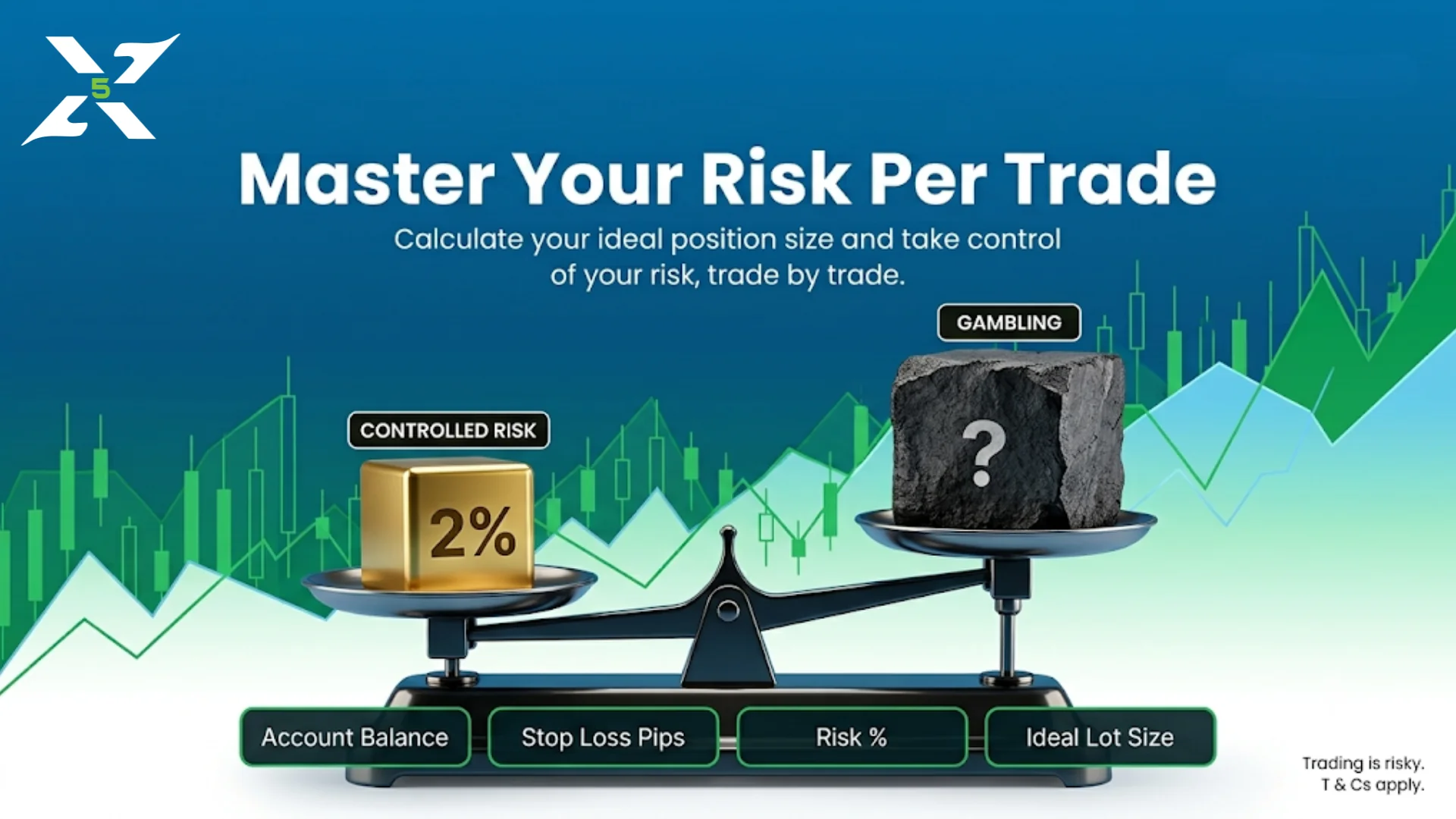
Risk per trade is the maximum amount of capital a trader is prepared to lose if a particular trade reaches its stop-loss.
It can be expressed either as a percentage of account equity or as a monetary amount.
For example, a trader with a $10,000 account may establish a maximum risk of 1% per trade:
$10,000 × 1% = $100
The trader's planned maximum loss is therefore $100 before considering factors such as slippage, spread, and commissions.
The percentage itself is not universal. Some traders may use 0.5%, while others may use 1% or 2%. The appropriate level depends on strategy characteristics, account size, trading frequency, drawdown tolerance, and individual risk objectives.
The important point is consistency.
The Risk Per Trade Formula
A basic risk per trade formula can be expressed as:
Risk Amount = Account Equity × Risk Percentage
Once the maximum monetary risk has been established, the trader can determine the appropriate position size based on the stop-loss distance and the value of the instrument.
A simplified position-sizing calculation is:
Position Size = Risk Amount ÷ (Stop-Loss Distance × Value Per Unit)
For example:
- Account equity: $10,000
- Risk per trade: 1%
- Maximum risk: $100
- Stop-loss distance: 50 pips
- Pip value at one lot: $10
The calculation becomes:
Position Size = $100 ÷ (50 × $10)
Position Size = 0.20 lots
This approach connects the trade volume directly to the amount of capital being risked.
Why Calculating Risk Before Entering a Trade Matters
One common mistake is deciding position size first and calculating risk afterward.
A trader might think, "I normally trade 1 lot," and use that volume regardless of the market setup. But if one trade has a 20-pip stop-loss and another requires a 100-pip stop-loss, the monetary risk can be dramatically different.
A more structured process is:
- Determine account equity.
- Define the maximum risk percentage.
- Calculate the monetary risk.
- Identify the technically appropriate stop-loss.
- Determine the value per pip, point, or tick.
- Calculate the appropriate position size.
- Check the resulting margin and exposure.
- Execute the trade only if it remains within the predefined risk limit.
This makes position size a consequence of risk management rather than emotion.
How to Optimize Risk Per Trade
Optimization does not necessarily mean increasing the percentage being risked.
It means finding a risk level that allows a strategy to operate effectively while keeping drawdowns manageable.
Several factors should be considered.
Account Size
A fixed percentage is generally more adaptable than a fixed monetary amount.
For example, risking 1% of a $5,000 account means $50, while 1% of a $20,000 account means $200. The proportional risk remains consistent as account equity changes.
Trading Frequency
A strategy generating several trades per day may require a different risk framework from a strategy generating only a few trades per month.
More frequent trading can result in more opportunities for consecutive losses, making cumulative exposure an important consideration.
Historical Drawdown
Past performance can provide useful information about potential losing streaks.
If a strategy historically experiences several consecutive losses, the trader should ensure that the chosen risk percentage does not create an unacceptable drawdown during a similar sequence in the future.
Market Volatility
Risk calculations should also reflect the instrument's current volatility.
A stop-loss that is appropriate under normal conditions may be too tight during an unusually volatile market. If the stop distance needs to increase, the position size should generally decrease if the monetary risk is to remain unchanged.
Using a Risk Calculator
A risk calculator can simplify the process by automating calculations that would otherwise need to be performed manually.
Typical inputs include:
- Account balance
- Risk percentage
- Entry price
- Stop-loss price
- Instrument
- Position size
- Pip, point, or tick value
- Contract specifications
A well-designed calculator can then estimate the potential monetary loss and appropriate position size.
This is especially useful for traders who operate across multiple asset classes, where contract specifications and price increments may differ.
However, a calculator is only as accurate as the information entered into it. Traders should verify the contract size, tick value, account currency, and other instrument specifications before relying on the output.
XAUUSD and Risk Calculation
Gold is one of the instruments where risk calculations require particular attention.
Traders frequently search for an XAUUSD lot size calculator because gold CFDs do not necessarily follow the same contract conventions as forex pairs.
Suppose a trader has:
- Account equity: $10,000
- Risk: 1%
- Maximum loss: $100
- XAUUSD entry: $3,400
- Stop-loss: $3,390
The stop-loss distance is $10. The final lot size depends on the contract specification and monetary value assigned to each $1 move for the particular XAUUSD CFD.
The key principle remains unchanged: calculate the monetary loss at the stop-loss and adjust the position size until the intended risk limit is respected.
Using a Lot Size Calculator App
A lot size calculator app can make risk management more practical for traders who monitor markets away from their desktop.
A useful calculator should ideally allow traders to enter the instrument, account size, risk percentage, entry price, and stop-loss level and then determine an appropriate position size.
Mobile access can be particularly useful when market conditions change quickly and a trader needs to reassess an existing setup before placing an order.
However, convenience should not replace verification. Instrument specifications and trading costs should always be checked against the actual trading environment.
Risk Per Trade and Leverage
Leverage can make risk calculations appear deceptively simple.
A trader may have sufficient margin to open a large position, but available margin does not indicate that the position is appropriately sized.
For risk management purposes, traders should focus on:
- Potential loss at the stop-loss
- Position size
- Stop-loss distance
- Instrument volatility
- Trading costs
- Overall account exposure
Leverage determines how much market exposure can be controlled with a given amount of margin. It does not determine how much a trader should risk.
Common Risk Calculation Mistakes
Risking a Fixed Number of Lots
Using the same lot size on every trade ignores differences in stop-loss distance and instrument volatility.
Moving the Stop-Loss Without Recalculating Risk
If the stop-loss is moved farther away, the potential loss increases unless position size is reduced.
Ignoring Costs
Spread, commission, swaps, and slippage can affect the actual outcome. A calculation based only on the theoretical entry and stop-loss may underestimate the final cost.
Increasing Risk After Losses
Increasing position size to recover previous losses can turn a normal losing streak into a substantial drawdown.
Treating Margin as Risk
The amount required to open a position is not the same as the amount that can ultimately be lost.
How Trading Technology Can Support Risk Management
Modern trading platforms can make risk management more transparent by providing information about position size, margin, open exposure, order levels, and trading history.
Access to detailed position and order information allows traders to review their exposure before and after execution. These risk-management and monitoring capabilities can provide greater operational visibility compared to other options in the market.
For brokers, providing traders with clear execution and position information can also support more structured risk-management practices.
Conclusion
Calculating risk per trade should be completed before entering a position, not after the market has already moved.
The process begins with account equity and a predefined risk percentage. The trader then determines the monetary risk, identifies an appropriate stop-loss, calculates the value of the expected price movement, and adjusts position size accordingly.
A risk calculator, XAUUSD lot size calculator, or lot size calculator app can make the mathematics faster, but understanding the underlying risk per trade formula remains essential.
The goal is not to eliminate losing trades. It is to ensure that individual losses remain controlled enough for the trading strategy to withstand inevitable periods of adverse performance.
Good trading is not simply about finding the next opportunity. It is about knowing exactly how much capital should be exposed to it.