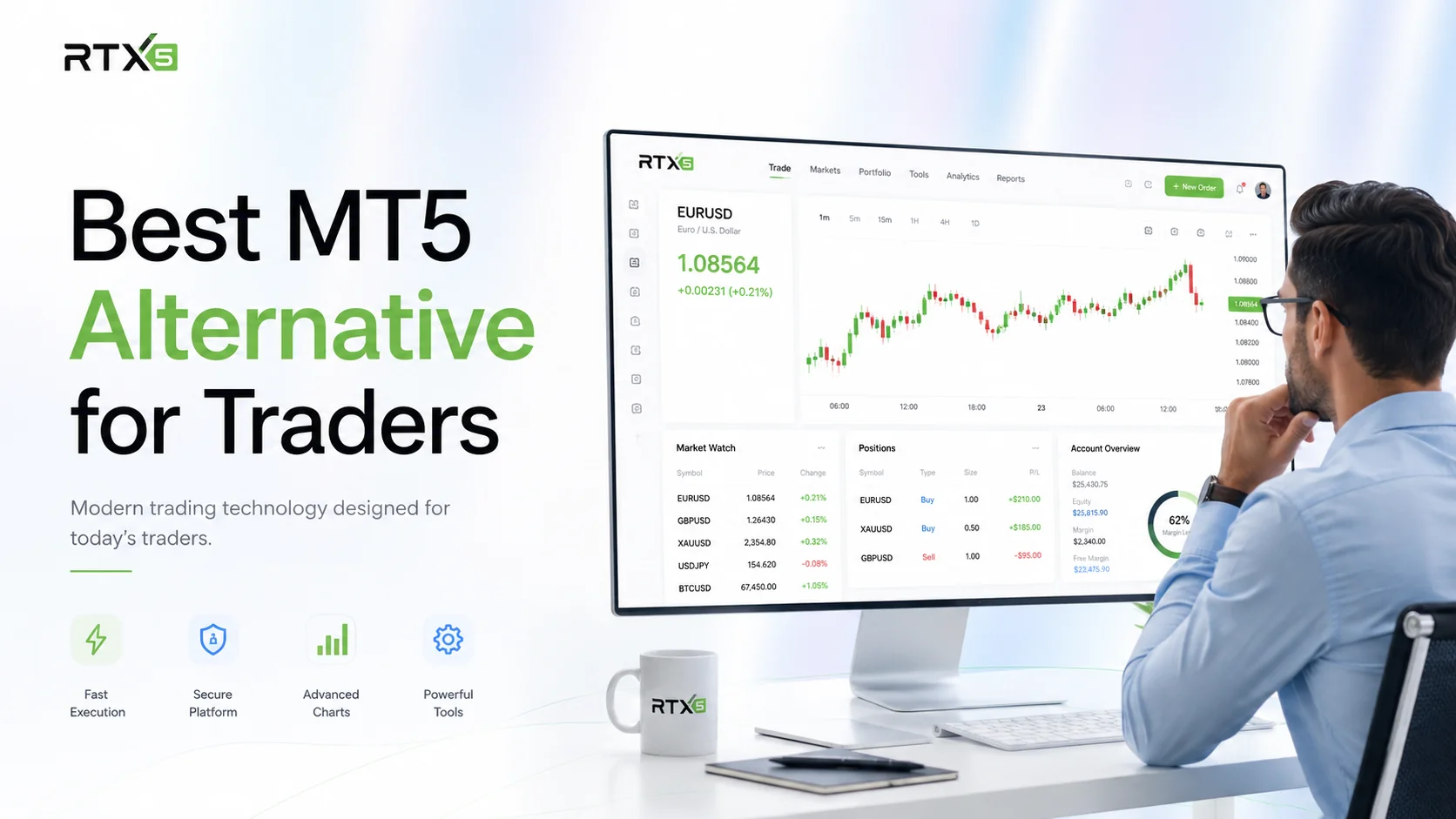
Why More Traders Are Looking Beyond MT5
For years, MetaTrader 5 (MT5) has been one of the most widely used trading platforms in retail markets. Its broad broker adoption, algorithmic trading capabilities, and familiarity have made it the default choice for many traders.
However, as trading technology evolves, a growing number of intermediate and advanced traders are questioning whether MT5 still aligns with modern market demands.
Today's traders expect:
-
Faster execution environments
-
Advanced analytics
-
Multi-asset access
-
Flexible chart management
-
Better integration with external tools
-
Modern user experiences
As a result, the search for the best MT5 alternative has accelerated among traders seeking more efficient workflows and institutional-grade functionality.
The Growing Gap Between MT5 and Modern Trading Requirements
While MT5 remains capable, many traders encounter limitations as their experience level increases.
The platform was originally designed around a broker-centric ecosystem, which often means that execution quality, liquidity visibility, and advanced functionality depend heavily on the broker's infrastructure.
Several challenges have become increasingly noticeable:
-
Limited integration with modern quantitative workflows
-
Restricted compatibility with external analytics frameworks
-
Inconsistent implementation of advanced features across brokers
-
Aging user interface design
-
Limited native support for certain asset classes
For traders expanding beyond traditional retail forex strategies, these constraints can become meaningful obstacles.
Where MT5 Falls Short for Advanced Traders
One of MT5's strongest features is its MQL5 programming language. However, many modern traders prefer open development environments that connect easily with broader technology stacks.
Some commonly cited limitations include:
Development Restrictions
-
Closed ecosystem architecture
-
Limited external library flexibility
-
Additional complexity when integrating advanced analytics
Data Processing Constraints
-
Tick data handling can be restrictive
-
Less flexibility for high-frequency research
-
Challenges with large-scale quantitative testing
Execution Transparency
Many traders seek:
-
Real-time depth-of-market visibility
-
Transparent liquidity aggregation
-
Institutional-style order routing
These capabilities often require additional broker-specific plugins within MT5.
Why User Experience Matters More Than Ever
Trading performance is influenced not only by strategy but also by workflow efficiency.
MT5's traditional multi-window design can feel outdated when compared with modern trading platforms.
Common usability concerns include:
-
Limited workspace flexibility
-
Complex chart organization
-
Less intuitive order management
-
Increased learning curve for advanced functionality
Modern traders increasingly favor platforms that provide:
-
Detachable charts
-
Multi-monitor support
-
Customizable layouts
-
Simplified execution workflows
As markets move faster, platform efficiency becomes a competitive advantage.
cTrader vs MT5: A Modern Alternative Worth Considering
Among the various alternatives available today, cTrader consistently ranks as one of the strongest competitors to MT5.
Its architecture was designed with transparency, flexibility, and professional execution in mind.
For traders comparing cTrader vs MT5, several distinctions immediately stand out.
Execution Transparency and Market Depth
One of cTrader's most recognized advantages is its emphasis on execution visibility.
The platform offers enhanced depth-of-market tools and more transparent order flow information.
Benefits include:
-
Detailed Level II market depth
-
Greater visibility into available liquidity
-
Enhanced execution transparency
-
More precise control over order handling
For traders who prioritize execution quality, this transparency can be highly valuable.
Algorithmic Trading with C#
Unlike MT5's MQL5 environment, cTrader uses C# for algorithm development.
This offers several advantages:
-
Access to the .NET ecosystem
-
More advanced programming capabilities
-
Easier integration with external tools
-
Greater flexibility for custom research
For traders building proprietary indicators, automation systems, or statistical models, C# often provides a more scalable development environment.
A More Flexible Trading Workspace
Modern traders frequently operate across multiple monitors and analyze several markets simultaneously.
cTrader's workspace design addresses these needs through:
-
Detachable charts
-
Flexible layouts
-
Improved chart management
-
Better mobile-to-desktop consistency
This flexibility allows traders to build workflows that align with professional market analysis practices.
Potential Trade-Offs When Switching
No platform is perfect.
While cTrader offers several advantages, traders should also consider potential drawbacks.
These may include:
-
Smaller third-party marketplace
-
Fewer community-developed tools
-
Migration effort for existing MT5 users
-
Code conversion requirements for custom indicators
For traders heavily invested in MQL5 development, transitioning may require additional resources.
Which Traders Benefit Most from cTrader?
cTrader may be particularly suitable for traders who prioritize:
-
Market depth analysis
-
Algorithmic trading flexibility
-
Professional execution tools
-
Transparent order routing
-
Modern platform design
Meanwhile, traders deeply integrated into the MT5 ecosystem may find fewer reasons to migrate immediately.
The decision ultimately depends on trading style, workflow requirements, and long-term platform objectives.
Key Takeaways
-
MT5 remains a powerful platform but shows signs of architectural aging.
-
Modern traders increasingly demand flexibility, transparency, and multi-asset support.
-
User experience and workflow efficiency have become major platform selection factors.
-
cTrader offers stronger execution transparency and modern workspace management.
-
C# development provides broader integration possibilities than MQL5.
-
Traders should evaluate migration costs before changing platforms.
-
The best MT5 alternative depends on individual trading goals and operational needs.
Frequently Asked Questions
What is the best MT5 alternative for traders?
cTrader is widely regarded as one of the strongest alternatives due to its execution transparency, modern interface, and advanced algorithmic trading capabilities.
Is cTrader better than MT5?
Neither platform is universally better. cTrader excels in transparency and flexibility, while MT5 benefits from broader broker support and a larger community ecosystem.
Can I use automated trading on cTrader?
Yes. cTrader supports algorithmic trading through C#, allowing traders to build and deploy custom trading systems and indicators.
Why are traders moving away from MT5?
Many traders seek improved workflows, modern interfaces, deeper market visibility, and better integration with external analytical tools.
Is switching from MT5 difficult?
The difficulty depends on how heavily a trader relies on MT5-specific indicators, expert advisors, and custom scripts. Migration may require redevelopment of certain tools.
Start Your Trading Journey With RTX5