Introduction
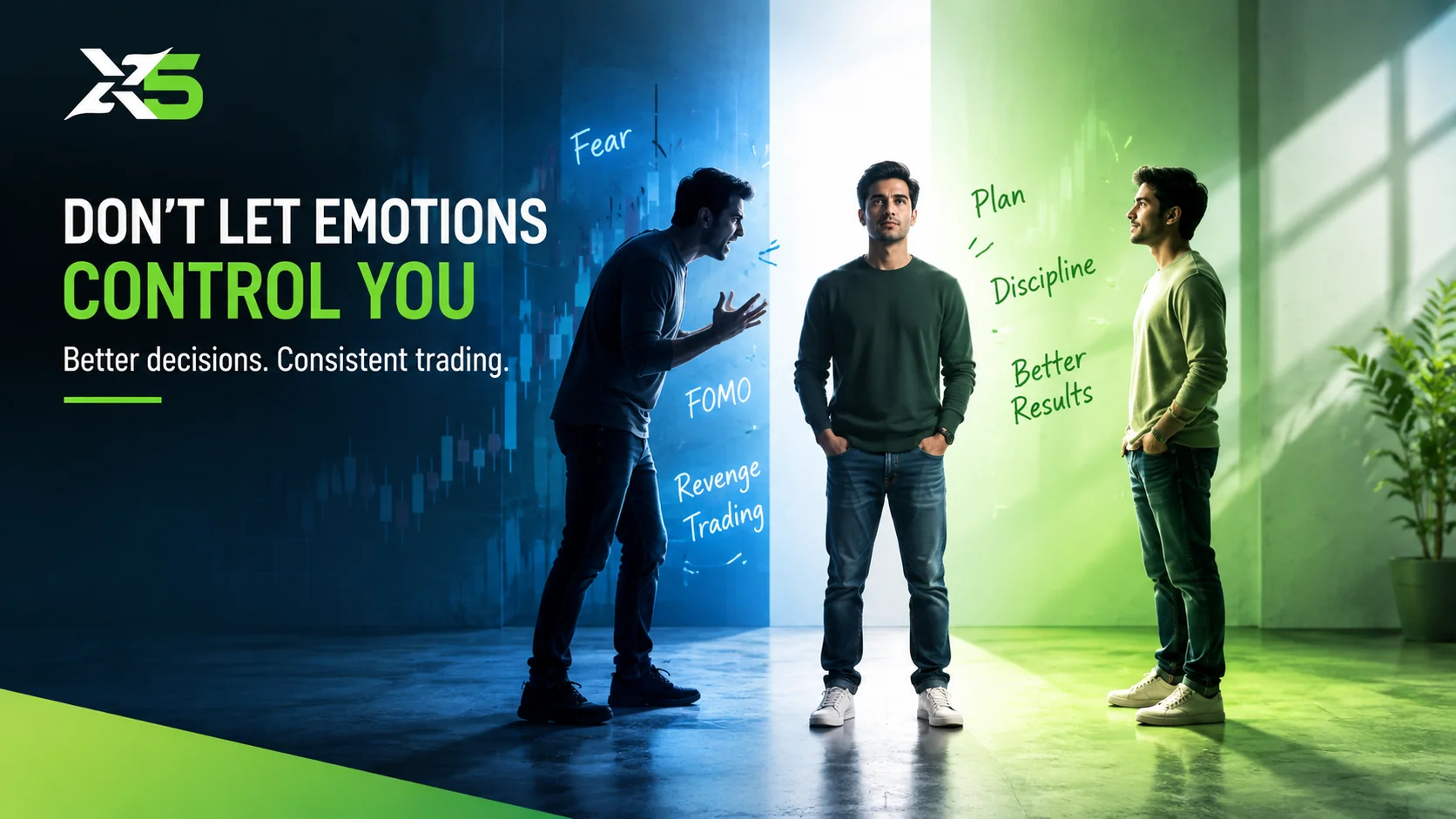
The idea of emotionless trading is often misunderstood. Traders are human, and fear, excitement, frustration and greed cannot simply be switched off. The more practical objective is to prevent emotions from controlling trading decisions.
This is where trading psychology becomes as important as technical and fundamental analysis. A trader may have a well-tested strategy, but entering trades impulsively, moving stop-losses or increasing position size after a loss can undermine that strategy.
Learning to control your emotions while trading therefore means building a process that continues to function even when market conditions become stressful.
Why Emotions Affect Trading Decisions
Financial markets continuously create uncertainty. A profitable position can reverse within minutes, while a carefully planned setup can reach its stop-loss without invalidating the broader strategy.
Several emotional responses commonly appear:
- Fear: Closing positions too early or avoiding valid setups.
- FOMO: Entering after a significant price move because of the fear of missing an opportunity.
- Greed: Increasing position size because a trade is performing well.
- Frustration: Taking another trade immediately after a loss.
- Overconfidence: Increasing risk after a series of successful trades.
These reactions are not necessarily signs of poor market knowledge. They are natural responses to financial uncertainty. The problem occurs when they replace a predefined trading process.
How to Control Your Emotions While Trading
1. Define Risk Before Entering
Risk should be established before the order is placed.
Determine the maximum amount or percentage of account equity that can be lost, then calculate the appropriate position size and stop-loss accordingly.
When risk is known in advance, a single trade becomes one event within a larger trading plan rather than a decision that needs to be emotionally defended while the market is moving.
2. Create Rules for Entry and Exit
A written trading plan removes much of the decision-making pressure during live market conditions.
The plan can define:
- Entry conditions
- Stop-loss placement
- Profit-taking conditions
- Maximum risk per trade
- Maximum daily loss
- Conditions for stopping a trading session
The more clearly these conditions are defined beforehand, the less opportunity there is for emotions to alter them during execution.
3. Use a Trading Journal
A trading journal should record more than entry and exit prices.
Recording the emotional state behind each decision can reveal recurring patterns. For example, a trader may discover that FOMO trades consistently occur after unusually large market movements, or that position sizes increase following consecutive losses.
Reviewing these patterns turns emotional behaviour into something measurable and actionable.
Managing Emotions in Options Trading
The same principles apply to emotions in options trading, although options can introduce additional complexity through leverage, time decay and changing volatility.
A rapidly moving options position can encourage traders to make decisions based solely on short-term price fluctuations.
Predefined risk limits, entry criteria and exit rules can help prevent impulsive adjustments. Traders should also understand the characteristics of the specific options strategy before committing capital.
The objective remains the same: allow the trading plan, rather than the immediate emotional response to market movement, to determine the next action.
Can Applications Help Control Trading Emotions?
Technology cannot eliminate emotions, but emotion controls by application can help reduce the number of decisions a trader has to make manually.
Modern trading platforms can provide features such as:
- Position-size and risk calculations
- Stop-loss and take-profit orders
- Account and exposure monitoring
- Trade-history analysis
- Trading-session controls
- Automated or rule-based execution
These functions create a layer of structure between the trader's emotional reaction and the final order decision. Such risk-management and execution features can provide greater operational control compared to other options in the market.
However, technology should support discipline rather than encourage excessive trading. A sophisticated trading interface cannot compensate for undefined risk rules or an inconsistent strategy.
The Goal Is Controlled Trading, Not Emotionless Trading
Trying to become completely emotionless can itself become counterproductive.
Professional trading is better understood as controlled decision-making under uncertainty. Fear may still appear after a losing trade. Excitement may still appear after a profitable position. What matters is whether those emotions change the predefined rules.
A trader who can recognize an emotional impulse, pause, and return to the trading plan has already created an important psychological safeguard.
Conclusion
True emotionless trading is not about eliminating human emotions. It is about creating a trading process that prevents emotions from becoming the primary decision-maker.
Risk management, predefined rules, journaling and appropriate technology can all contribute to this process. Traders who consistently apply these principles can focus more closely on execution quality instead of reacting to every movement in the market.
The objective is not to trade without emotion. It is to trade without allowing emotion to control the decision.