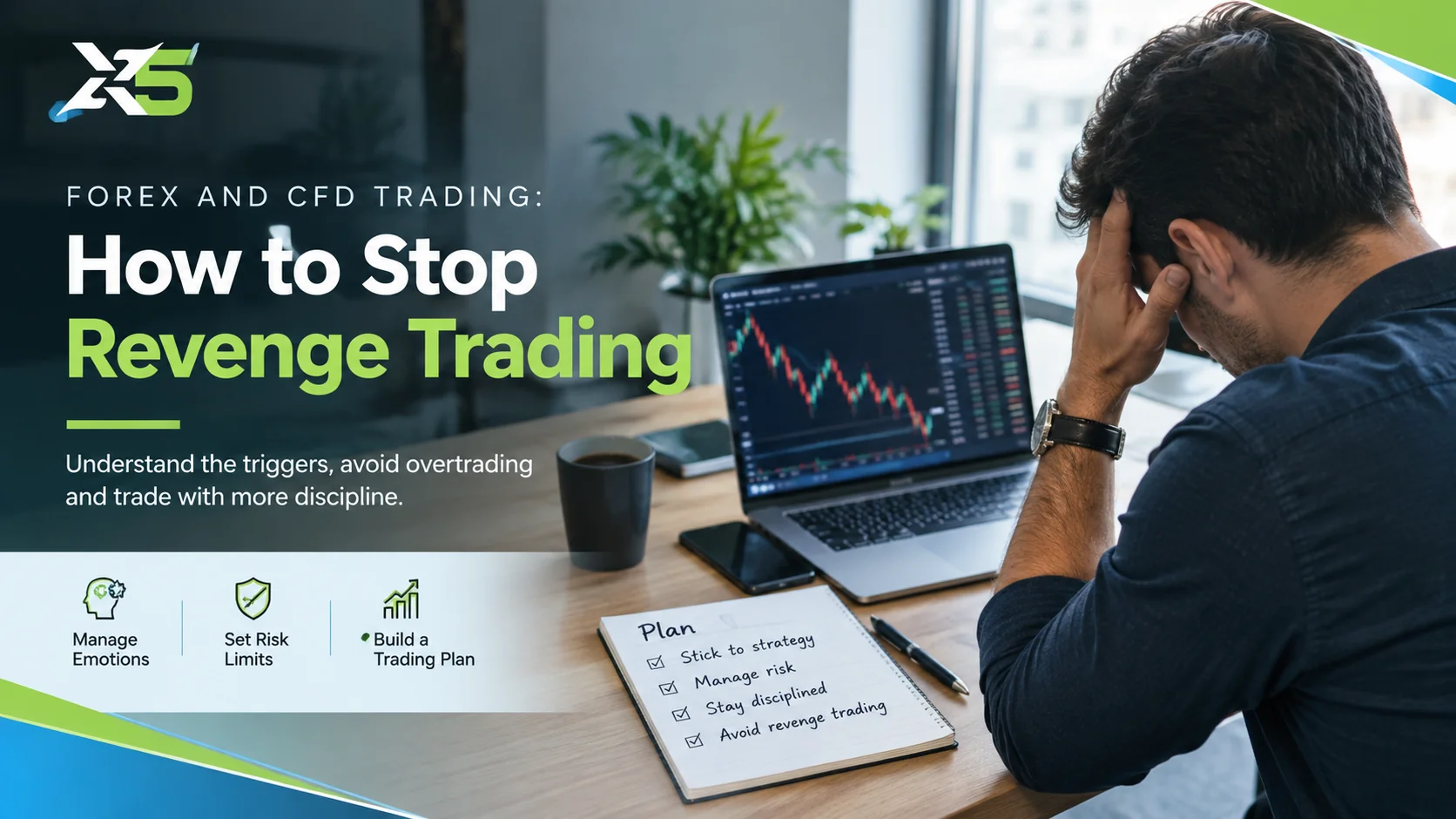
A losing trade is a normal part of forex and CFD trading. The problem begins when a trader tries to immediately recover that loss by increasing position size, entering more trades or abandoning an established strategy. This behaviour is commonly known as revenge trading.
Learning how to stop revenge trading is therefore less about predicting the next market move and more about controlling decisions after a loss. A structured trading plan, predefined risk limits and objective execution conditions can help prevent one losing position from turning into a sequence of emotionally driven trades.
What Is Revenge Trading?
Revenge trading occurs when a trader makes a new trading decision primarily to recover a previous loss rather than because a valid trading setup exists.
For example, a trader loses $100 on a EUR/USD position. Instead of accepting the loss as part of normal trading, the trader immediately opens a larger position attempting to make the $100 back. If that trade also loses, another position may follow.
The cycle can quickly become:
Loss → frustration → larger position → another loss → increased risk → further losses.
The important distinction is that revenge trading is driven by the emotional response to the previous trade, not by a statistically justified trading opportunity.
Why Does Revenge Trading Happen?
Several factors can contribute to revenge trading:
Loss aversion: The trader focuses more on recovering the loss than following the original plan.
Overconfidence: A trader may believe the next position will inevitably recover previous losses.
Fear of missing out: Rapid market movements can encourage impulsive entries.
Overtrading: Too many positions can dilute the quality of decision-making.
Poor risk management: Without predefined limits, position sizes may increase after losses.
Trading technology cannot remove these psychological factors, but structured order management, charts, risk controls and trading records can help create a more disciplined execution process.
What Is the 3-5-7 Rule in Trading?
The 3-5-7 rule is a trading guideline discussed in some trading communities rather than a universally accepted financial-market standard.
Different traders use variations of the rule, so it should not be treated as an official formula or guaranteed method for preventing losses. The broader principle is more useful: establish predetermined limits for trades, risk exposure and trading activity instead of making decisions reactively.
For example, a trader might define:
A maximum number of trades per session.
A maximum percentage of capital at risk.
A daily loss limit.
A mandatory break after a specified number of consecutive losses.
The exact numbers should be based on the trader's strategy, account size and risk tolerance.
Why Do 90% of Day Traders Lose?
The frequently repeated claim that 90% of day traders lose money is often presented as a universal statistic. In reality, the outcome varies by market, jurisdiction, product, time period and methodology.
The important lesson is not the exact percentage. Active trading is difficult because transaction costs, leverage, market volatility, inconsistent execution and behavioural mistakes can all affect results.
A trader should therefore focus less on whether a particular “90% rule” is true and more on measurable factors such as:
Average risk per trade.
Win rate and average reward-to-risk ratio.
Maximum drawdown.
Trading costs.
Number of trades.
Performance during different market conditions.
These measurements provide a more useful basis for evaluating a trading process.
How to Stop Revenge Trading
The most effective approach is to make the trading process more systematic.
1. Define risk before entering
Decide the maximum acceptable loss before placing an order. Position sizing should be calculated from the predefined risk rather than from the amount the trader wants to recover.
2. Use a daily loss limit
A daily loss limit creates a hard stopping point. Once reached, trading stops until the next planned session.
3. Take a break after a significant loss
Leaving the screen for a defined period can prevent an emotional response from becoming another position.
4. Never increase size simply to recover
Position size should come from the trading plan, not from the size of the previous loss.
5. Maintain a trading journal
Record the reason for entry, position size, exit, result and emotional state. Patterns of overtrading and revenge trading become easier to identify when decisions are documented.
6. Use objective execution conditions
Charts, technical indicators, alerts and predefined order conditions can help traders follow their strategy instead of reacting to every short-term price movement. Modern trading platforms can provide these tools as part of a structured trading workflow compared to other options in the market.
Revenge Trading vs. Disciplined Trading
The difference is primarily in the decision-making process.
| Revenge Trading | Disciplined Trading |
|---|---|
| Reacts to previous losses | Follows predefined conditions |
| Increases risk emotionally | Calculates position size |
| Trades to recover money | Trades only when a setup exists |
| May overtrade | Respects trading limits |
| Focuses on individual outcomes | Evaluates long-term performance |
A disciplined trader does not need every trade to be profitable. The objective is to maintain a process where individual losses remain controlled and do not materially damage the trading account.