Accountable publisher
Published under the RTX5 Editorial Team byline. It identifies the responsible publishing organization; it does not imply that a named lawyer, regulator, financial adviser, or licensed expert approved this page.
Forex glossary
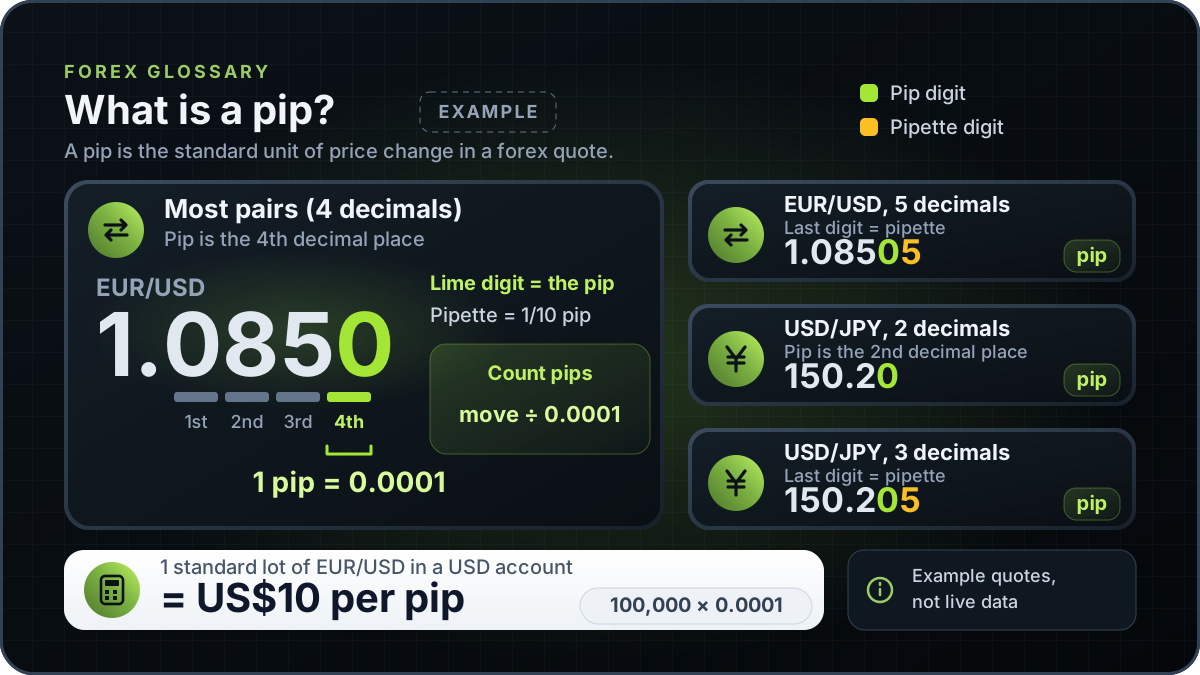
A pip in forex trading is the standard unit used to measure a change in an exchange rate. For most currency pairs, one pip is 0.0001, the fourth decimal place. For yen-quoted pairs it is 0.01, the second decimal place. Pip value then converts that move into money.
In brief
A pip is a small, standard price step. Here is how to read it, count it and turn it into money in your account currency.
The pip is a convention, not a legal unit. None of the official sources checked for this guide defines it, so treat it as market shorthand for the smallest standard step in a quote. Its size follows from how the price is written, which is why the same word can describe different distances on different instruments. For the wider market context, read what is forex trading.
MetaQuotes documentation describes the same idea through digits and tick size. Digits are the number of decimal places in a symbol's price, and tick size is the minimal price change. Your broker's symbol properties show which values apply to the instrument you trade.
| Quote type | Pip size | Where the pip sits | Example move |
|---|---|---|---|
| Most pairs, such as EUR/USD | 0.0001 | Fourth decimal place | 1.0850 to 1.0851 is 1 pip |
| Yen-quoted pairs, such as USD/JPY | 0.01 | Second decimal place | 150.20 to 150.21 is 1 pip |
| Pipette on a five-digit quote | 0.00001 (one tenth of a pip) | Fifth decimal place | 1.08500 to 1.08501 is 0.1 pip |
| Pipette on a three-digit yen quote | 0.001 (one tenth of a pip) | Third decimal place | 150.200 to 150.201 is 0.1 pip |
| Gold (XAU/USD) and other CFDs | Broker-defined | Set in the contract specification | Not comparable with a forex pip without the specification |
Pipette and fractional-pip conventions are not defined in the official sources checked here. The decimal places follow from the price format your platform displays.
To count pips, find the price difference between two points, then divide it by the pip size. Subtract the lower price from the higher price, write the result as a decimal, and divide by 0.0001 for most pairs or by 0.01 for yen pairs.
The count does not depend on whether you were long or short. Two worked counts show the method. In the first, EUR/USD moves from 1.0850 to 1.0875: the difference is 0.0025, and 0.0025 divided by 0.0001 is 25 pips. In the second, USD/JPY moves from 150.20 to 149.85: the difference is 0.35, and 0.35 divided by 0.01 is 35 pips.
| Pair | Start price | End price | Price change | Pips |
|---|---|---|---|---|
| EUR/USD | 1.0850 | 1.0875 | +0.0025 | 25 pips (0.0025 / 0.0001) |
| USD/JPY | 150.20 | 149.85 | -0.35 | 35 pips (0.35 / 0.01) |
Illustrative prices chosen for arithmetic. They are not forecasts or recent market data.
The sign of the price change shows direction only. A USD/JPY fall of 35 pips and a rise of 35 pips are both 35 pips of movement. Whether that movement helps or hurts your position depends on which way you were positioned.
Pip value turns a pip count into money. The formula is pip size multiplied by contract size, the number of lots, and the rate that converts the quote currency into your account currency. The forex pip calculator applies the same formula, so you can check the figures below for your own lot size and account currency.
Two rules hold for most pairs. Pip value scales with lot size, so a 0.10 lot is one tenth of a standard lot. When the quote currency is not your account currency, the pip value also moves with the exchange rate, so the same pair can be worth a different amount on a different day. For how a pip distance feeds into a trade size, read position sizing in forex.
| Pair and lot size | Pip size | Units in the position | Pip value (US$) |
|---|---|---|---|
| EUR/USD, 1 standard lot | 0.0001 | 100,000 | US$10.00 |
| EUR/USD, 0.10 lot | 0.0001 | 10,000 | US$1.00 |
| EUR/USD, 0.01 lot | 0.0001 | 1,000 | US$0.10 |
| USD/JPY at 150.00, 1 standard lot | 0.01 | 100,000 yen, converted at 1 / 150 | About US$6.67 (0.01 x 100,000 / 150) |
Illustrative figures for a US$ account, rounded to the cent. Your broker's contract size, pip size and conversion rate may differ. Gold and other CFDs are left out because their contract sizes are broker-defined.
To find pip value in another account currency, convert the US$ figure at the current exchange rate. For example, a pip worth US$10 in a US$ account becomes a euro amount at the current US dollar to euro rate on the day you trade. The euro figure changes when that rate changes, so check it on the day you trade.
Brokers and platforms also use points and ticks. They are not the same as a pip. A point is the symbol point value shown in the platform, and a tick is the minimal price change for the symbol. Either can differ from a pip, so do not assume one point or one tick equals one pip.
The MetaQuotes documentation defines these values through symbol properties rather than through the word pip. For each instrument, check the symbol's own specification before you work out a stop distance or a position size. To turn a pip distance into a trade size, use the position size calculator.
| Term | What it means | Where to check it |
|---|---|---|
| Pip | The market convention for a standard forex price step, as set out above. | Market convention, not an official unit |
| Point | The symbol point value (SYMBOL_POINT in MQL5). It is the price size of one point for that symbol. | Symbol properties in MetaTrader 5 or the broker's specification |
| Tick | The minimal price change (SYMBOL_TRADE_TICK_SIZE). Its money value is the tick value. | Symbol specification from your broker |
RTX5 is Orrnn's trading terminal and broker-technology product. Its Windows desktop client is in preview, and the web and mobile clients are planned. A Google Play listing for Android is published, but the mobile client has no approved release record yet; check the product-availability record and release notes before relying on any RTX5 feature. The pip figures on this page are illustrative and do not come from an RTX5 feature.
Check RTX5 product availabilityTrust and methodology
We want you to be able to identify who owns the page, inspect the evidence, understand how tools were used, and challenge anything that looks wrong or out of date.
Published under the RTX5 Editorial Team byline. It identifies the responsible publishing organization; it does not imply that a named lawyer, regulator, financial adviser, or licensed expert approved this page.
3 primary references are listed on this page with context about what each one supports. The source set was checked on .
Automation and AI may help organize research, outline a page, or edit language. They are not treated as sources, are not presented as human experts, and do not remove the publisher's responsibility for the final page.
If a statement is incomplete, unsupported, or outdated, send the exact URL, sentence, and supporting evidence through our contact route. Read the full editorial and corrections policy.
Sources were checked on 7 November 2026. They explain market rules and concepts; they do not certify RTX5 or provide individual financial advice.
No. Most pairs use 0.0001 as the pip, but yen-quoted pairs use 0.01. Gold, indices and other CFDs use sizes set by the broker, so the meaning of a pip changes by instrument. Check each contract specification before you set a stop loss or work out a position size, because the same number of pips can be a very different price distance on another instrument.
Subtract the lower price from the higher price, then divide the result by the pip size. From 1.0850 to 1.0875 on EUR/USD, the difference is 0.0025, and 0.0025 divided by 0.0001 gives 25 pips. From 150.20 to 149.85 on USD/JPY, the difference is 0.35, which is 35 pips at 0.01 per pip. The count ignores direction.
Pip value is the amount of money one pip is worth for a given position, in your account currency. It equals pip size multiplied by contract size, the number of lots, and the rate that converts the quote currency into your account currency. On EUR/USD in a US$ account, one standard lot is worth US$10 per pip. Your broker's figure may differ.
Not on its own. Profit or loss equals pips moved multiplied by pip value. Spreads, commissions, swaps, slippage and the conversion into your account currency all affect the final amount. A positive pip count can still produce a small or negative result after costs. This guide does not forecast any market move.
A pipette is a fractional pip, usually one tenth of a pip, shown by an extra decimal place on a five-digit or three-digit quote. For example, EUR/USD moving from 1.08500 to 1.08501 is a tenth of a pip. Not every platform shows pipettes, and the sources checked for this guide do not define the term, so confirm how your platform displays prices.