Accountable publisher
Published under the RTX5 Editorial Team byline. It identifies the responsible publishing organization; it does not imply that a named lawyer, regulator, financial adviser, or licensed expert approved this page.
Trading calculator
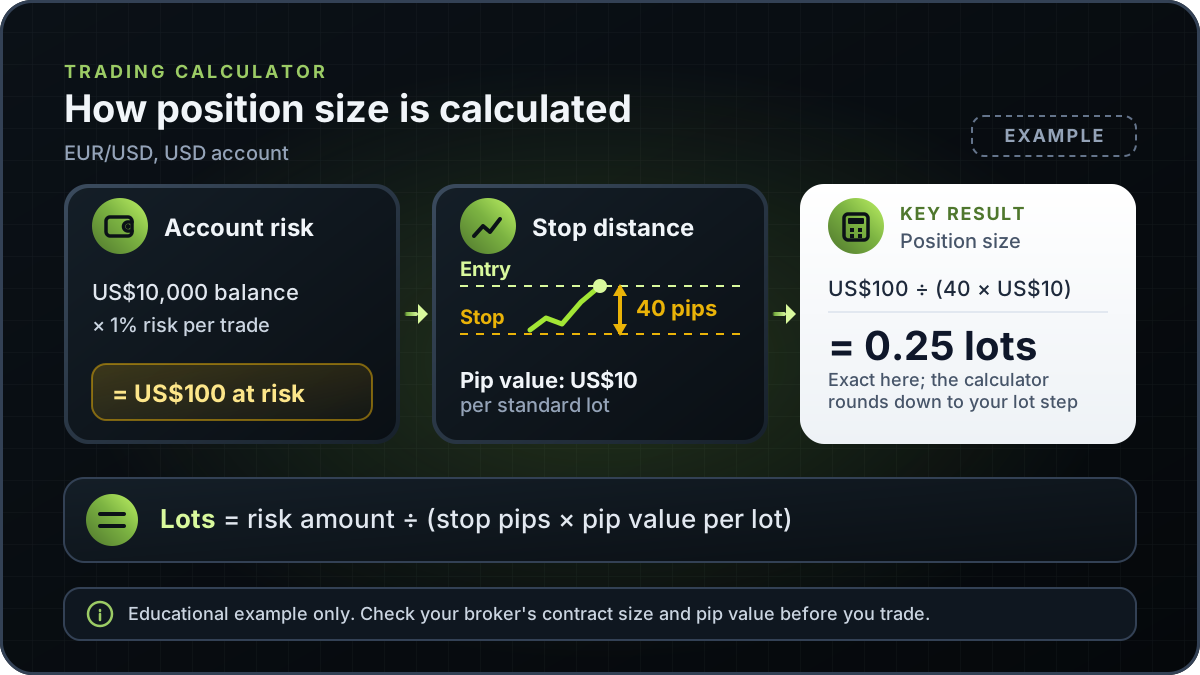
A position size calculator, also called a lot size calculator in forex, sizes a trade so the loss at your stop stays within the risk you choose. The risk amount is the account balance times the risk percentage. The lot size is that amount divided by the stop distance in pips times the value of one pip per standard lot.
In brief
Estimate how many forex lots or stock shares fit a risk amount you choose, with the formula shown and its limits stated.
Calculator
Formula version 2026-11-07. Results are estimates before spreads, commissions, financing and slippage.
About 10 for EUR/USD in a USD account. Use the forex pip calculator for other pairs.
Smallest lot increment your broker accepts, often 0.01.
Sizes are rounded down so the planned loss at the stop stays within your risk amount. Gaps, slippage, spreads, commissions and financing can make a real loss larger. Nothing you enter is sent to a server.
Start in the forex mode. It needs five inputs, and each one changes the result in a predictable way.
Enter every money value in your account currency. If your account is in euros, use euros for the balance and for the pip value. The calculator does not convert currencies for you.
The equity you are willing to size against, in your account currency. For the same risk percentage, a larger balance gives a larger risk amount and so a larger lot size.
The share of the balance you accept losing if the stop-loss is hit. The calculator multiplies the balance by this percentage to get the risk amount. It does not suggest a value.
How far price must move against you, in pips, before your planned exit. A wider stop means fewer lots for the same risk amount. Place the stop where your trade idea says it belongs, then measure the distance.
What one pip is worth on one standard lot, in your account currency. For EUR/USD in a US dollar account this is about US$10. Other pairs and account currencies differ, so check them with the forex pip calculator.
The smallest lot increment your broker accepts, often 0.01. The calculator rounds the lot size down to this step. Read your broker's contract specification, because the minimum and step can differ by instrument.
The result panel shows the lot size, the amount at risk and the loss at the stop with the rounded size. The loss at the stop is the figure that matches the size you will actually trade. The formula article explains each step in more depth.
The three examples below all use EUR/USD in a US dollar account, where one pip on one standard lot is worth US$10. They are illustrative arithmetic, not forecasts or recommendations, and the calculator returns the same figures when given the same inputs.
| Example | Risk amount | Lots (rounded down) | Loss at stop with rounded lots |
|---|---|---|---|
| US$5,000 account, 1% risk, 25-pip stop, EUR/USD | US$50 | 0.20 | US$50 |
| US$10,000 account, 1% risk, 40-pip stop, EUR/USD | US$100 | 0.25 | US$100 |
| US$25,000 account, 0.5% risk, 30-pip stop, EUR/USD | US$125 | 0.41 | US$123 |
The third row's unrounded size is 0.4167 lots. Rounding down to 0.01 gives 0.41 lots, so the planned loss at the stop is US$123 rather than the US$125 risk amount.
For the same risk amount, a narrower stop gives a larger lot size and a wider stop gives a smaller one.
Lot names are market conventions, and each broker defines its own contract sizes. Pairs quoted with fewer decimals, such as many yen pairs, use a different pip size, so check the pair first. For a deeper look at pip size, read what is a pip.
| Lot type | Units of base currency | Pip value for EUR/USD in USD (arithmetic) |
|---|---|---|
| Standard lot | 100,000 | About US$10 |
| Mini lot | 10,000 | About US$1 |
| Micro lot | 1,000 | About US$0.10 |
Pip value equals pip size times units, so 0.0001 multiplied by 100,000 gives US$10. Your broker's instrument specification is the reference, not this table.
Stock mode works differently. There is no pip. The risk per share is the gap between your entry price and your stop price. The calculator divides the risk amount by that gap and rounds down to whole shares. It takes the absolute gap, so a short trade with a stop above the entry works the same way.
Worked example (illustrative): a US$10,000 account, 1% risk, entry at US$50 and stop at US$48. The risk amount is US$100. The gap is US$2 per share, and US$100 divided by US$2 is 50 shares. The position value at entry is 50 multiplied by US$50, which is US$2,500. The planned loss at the stop is 50 multiplied by US$2, which is US$100.
The position value is not the amount at risk. Gaps, fees or a stop that fills below its level can make the real loss larger than US$100.
Rounding up can make the planned loss larger than the risk amount you chose, so the calculator rounds down: to your broker's lot step for forex, and to whole shares for stocks.
In the third worked example, the unrounded size is 0.4167 lots. Rounding to 0.42 would put the loss at a 30-pip stop at about US$126, which is above the US$125 risk amount. Rounding down to 0.41 keeps the planned loss at US$123.
This page does not recommend a risk percentage. The right figure depends on your balance, income, tolerance for loss and experience.
Some educational material discusses small, fixed percentages of the account per trade. That is a convention to research, not a rule this calculator enforces. Enter the figure you choose deliberately, not after a win or a loss.
Position size and leverage are separate questions. Your broker's leverage and margin rules can limit how large a position you may open, and those rules depend on where you live and which regulator oversees your broker.
For how day trading is structured, read day trading explained. These rules limit how much you can trade; the sizing arithmetic on this page still applies.
RTX5 is Orrnn's trading terminal and broker-technology product. Its Windows desktop client is in preview, and the web and mobile clients are planned. A Google Play listing for Android is published, but the mobile client has no approved release record yet; check the product-availability record and release notes before relying on any RTX5 feature. This calculator is an educational page on the RTX5 website, and it is not a trading service.
Check RTX5 product availabilityTrust and methodology
We want you to be able to identify who owns the page, inspect the evidence, understand how tools were used, and challenge anything that looks wrong or out of date.
Published under the RTX5 Editorial Team byline. It identifies the responsible publishing organization; it does not imply that a named lawyer, regulator, financial adviser, or licensed expert approved this page.
6 primary references are listed on this page with context about what each one supports. The source set was checked on .
Automation and AI may help organize research, outline a page, or edit language. They are not treated as sources, are not presented as human experts, and do not remove the publisher's responsibility for the final page.
If a statement is incomplete, unsupported, or outdated, send the exact URL, sentence, and supporting evidence through our contact route. Read the full editorial and corrections policy.
Sources were checked on 7 November 2026. They explain market rules and concepts; they do not certify RTX5 or provide individual financial advice.
No. It only does arithmetic on the inputs you enter. It cannot tell you whether price will reach your entry, target or stop, and it does not measure the quality of your analysis. A correct size limits the planned loss only if the stop fills at the planned level. Gaps and slippage can make the real loss larger.
Pip value depends on the pair, the lot size and the account currency. Use the forex pip calculator to work out the value of a pip for a pair in your account currency, then enter that figure here as pip value per standard lot. Check your broker's contract specification too.
In forex, the two usually mean the same thing: the number of lots you trade so that a stop-loss hit loses a chosen amount. For stocks, the output is a share count. In both cases the risk amount is divided by the loss per unit. Only the unit of size changes.
Because the lot size is rounded down to your broker's lot step, or the share count to whole shares. In the third worked example the risk amount is US$125, but 0.41 lots lose US$123 at a 30-pip stop. The difference comes from rounding, not from a fee or a profit.
No. The arithmetic uses only the stop distance and pip value you enter. Spreads, commissions, swap or financing charges, and slippage can all add to a real loss. Include them in your own plan, and check your broker's cost schedule before you trade.