Accountable publisher
Published under the RTX5 Editorial Team byline. It identifies the responsible publishing organization; it does not imply that a named lawyer, regulator, financial adviser, or licensed expert approved this page.
Trading styles
Day trading means buying and selling the same financial instrument within one trading day and closing every position before the session ends. Positions are not held overnight, so each day starts flat. Costs add up and risk limits matter. The SEC's investor bulletin, last modified in 2005, says day traders typically suffer severe losses in their first months of trading.
In brief
How one trading day works from preparation to review, which costs to check, and the margin and leverage rules in the US and UK, and the 2018 EU measures.
Day trading is a short-term style in which a trader buys and sells the same instrument on the same day. A trader might buy a share, a currency pair or a futures contract in the morning and sell it before the close. Because nothing is held overnight, the trader carries no exposure to news that breaks while the market is shut.
Day trading is not the same as investing, which usually holds positions for years, or swing trading, which holds them for days or weeks. It also differs from scalping, which uses even shorter holding times. For the wider vocabulary, start with what is trading.
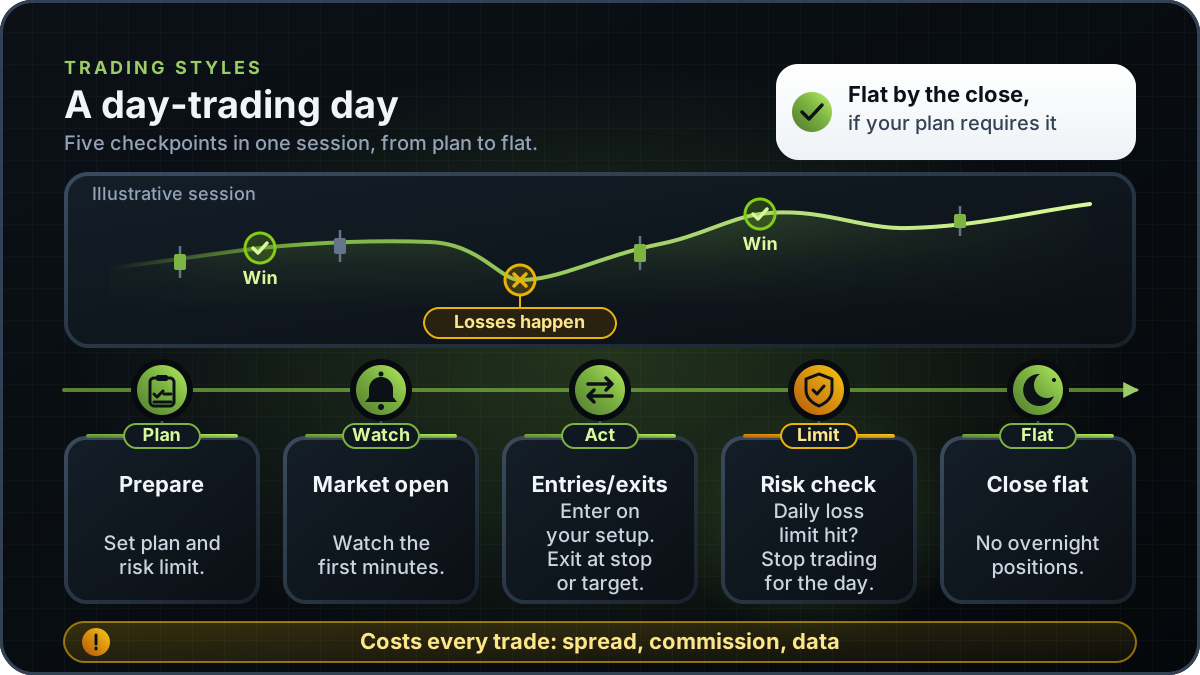
A day trading session is a repeatable routine. The steps below describe the workflow. They do not promise any result, and every step still depends on your own rules and discipline.
Check overnight news, the economic calendar and the state of the market you trade. Decide the maximum loss for the day before you place any order.
Choose a short list of instruments and the setups you will trade. Anything outside the list waits for another day.
Each entry needs a reason, a stop level and a target, all set before the order. Record the trade so you can review it later.
Close the position at your stop or target. Stop trading when the daily loss limit or a fixed number of losing trades is reached.
Close every position before the session ends if your plan requires it. Review each trade, its costs and whether you followed the plan.
Costs decide whether a small edge is worth trading at all. Each trade has to clear its own costs before it makes money. Use the table as a checklist against your broker's current schedule.
| Cost | What to check |
|---|---|
| Commissions | Per-trade or per-share fees, minimum charges, and whether a round trip is charged once or twice. |
| Spreads | The gap between buy and sell prices. Check typical spreads during the hours you trade, not only the headline figure. |
| Exchange and data fees | Market data subscriptions and exchange charges, and whether your broker passes them on. |
| Platform or charting subscriptions | Monthly fees for software, add-ons and advanced charting, and whether each one is optional. |
| Financing | Overnight or holding charges if a position is carried past the broker's cut-off time. |
| Taxes | How your country taxes trading gains and losses, and which records you must keep. |
Fee levels vary by broker, market and account type. This table lists what to check, not what to expect.
Software matters for reliable execution, but the detailed checks belong to a separate list.
The day trading platform checklist covers these requirements in full. The trading terminal guide explains what each core function does.
Rules change by country, by broker and by product, and they can change over time. The examples below cover the most common references for readers in the US, EU and UK. Check your own regulator's current pages before trading.
United States. FINRA Regulatory Notice 26-10, dated 20 April 2026, replaces the pattern day trader designation and the US$25,000 minimum equity requirement with new intraday margin standards in FINRA Rule 4210. The effective date is 4 June 2026, and firms that need more time can phase in until 20 October 2027. FINRA's investor page on day trading describes a US$2,000 minimum equity for margin accounts and notes that firms may set higher house requirements. The pattern day trader rule guide compares the former and current US rules.
European Union. ESMA introduced retail CFD leverage limits in 2018 as temporary EU-wide measures, stated on 27 March 2018: 30:1 for major currency pairs, 20:1 for non-major pairs, gold and major indices, 10:1 for other commodities and non-major equity indices, 5:1 for individual equities, and 2:1 for cryptocurrencies. ESMA can only apply such measures for three-month periods, so check ESMA's and your national regulator's current pages before trading.
United Kingdom. The FCA's permanent rules, published on 1 July 2019, limit leverage on retail CFDs to between 30:1 and 2:1. Firms must also show the share of their retail accounts that make losses.
Elsewhere. Other regulators set different margin, leverage and short-term trading rules. Your broker's terms and your regulator's website decide how these apply to your account.
Regulators are consistently cautious about day trading. The SEC's investor bulletin, last modified in 2005, says day traders typically suffer severe financial losses in their first months of trading, and that many never become profitable. It advises traders to risk only money they can afford to lose, and not to fund trading from money needed for living expenses or retirement.
ESMA reported in 2018 that 74-89% of retail CFD accounts typically lose money, based on national regulators' analyses across EU jurisdictions. That figure describes leveraged CFD products, not every form of day trading, but it shows how much leverage raises the stakes. For other markets, see what studies show about day-trading outcomes.
The UK's rules require the same kind of disclosure. Look for the share of losing accounts on any broker's CFD pages before you open an account.
Risk control is the part of day trading that most traders underestimate. Set the loss you will accept on one trade and on one day as a percentage of your account, then size each position to fit. The position size calculator converts that rule into units. For the wider framework, read risk management.
Take a 10,000 account in your account currency and a position worth 100,000, which is 10:1 leverage. A 5% move against the position costs 5,000, which is half the account. The same 5% move on a 10,000 position costs 500.
Losses grow faster than the position size suggests when leverage is high. Set the stop before the order, and do not move it to avoid a loss.
RTX5 is Orrnn's trading terminal and broker-technology product. Its Windows desktop client is in preview, and the web and mobile clients are planned. A Google Play listing for Android is published, but the mobile client has no approved release record yet. Check the product-availability record and release notes before relying on any RTX5 feature. RTX5 is licensed to brokers, is not a broker and does not hold client money.
Check RTX5 product availabilityTrust and methodology
We want you to be able to identify who owns the page, inspect the evidence, understand how tools were used, and challenge anything that looks wrong or out of date.
Published under the RTX5 Editorial Team byline. It identifies the responsible publishing organization; it does not imply that a named lawyer, regulator, financial adviser, or licensed expert approved this page.
6 primary references are listed on this page with context about what each one supports. The source set was checked on .
Automation and AI may help organize research, outline a page, or edit language. They are not treated as sources, are not presented as human experts, and do not remove the publisher's responsibility for the final page.
If a statement is incomplete, unsupported, or outdated, send the exact URL, sentence, and supporting evidence through our contact route. Read the full editorial and corrections policy.
Sources were checked on 9 November 2026. They explain market rules and concepts; they do not certify RTX5 or provide individual financial advice.
Rules depend on your country, your broker and the product you trade. The US, EU and UK each set margin or leverage rules that affect day trading, and some brokers add their own requirements. Check your regulator's current pages and your broker's terms before you place an order. This guide is educational and does not confirm that any activity is permitted for you.
Not under FINRA's rule effective 4 June 2026. FINRA's amended Rule 4210 replaced the pattern day trader designation and its US$25,000 minimum equity requirement with intraday margin standards, and firms that need more time can phase them in until 20 October 2027. A margin account still needs at least US$2,000 in equity, and brokers may set higher house requirements.
Some people do, but regulators warn that many never become profitable, and the SEC says day traders typically suffer severe losses in their first months. Costs, leverage and emotional decisions add to the difficulty. For the figures from regulator and academic studies in several markets, see what studies show about day-trading outcomes. Trade only with money you can afford to lose.
There is no single answer. It depends on your broker's deposit and margin rules, the markets you trade and how much you are willing to lose. Start with money you can afford to lose completely. Use a position size calculator to check that one losing trade stays within the loss you set, in your account currency, before you commit capital.
Day trading is any buying and selling within one session. Scalping is a narrower form that aims to take small price moves over very short holding times, so trading costs matter even more. Both need strict rules and risk limits. Read the scalping guide for its specific costs and execution demands.
The answer depends on your country and on how your gains are classed. Some countries tax trading income differently from investment gains, and losses may or may not offset other income. Keep complete records of trades, fees, financing and deposits. A qualified tax adviser in your country can explain your position. This guide does not give tax advice.