Accountable publisher
Published under the RTX5 Editorial Team byline. It identifies the responsible publishing organization; it does not imply that a named lawyer, regulator, financial adviser, or licensed expert approved this page.
Trading styles
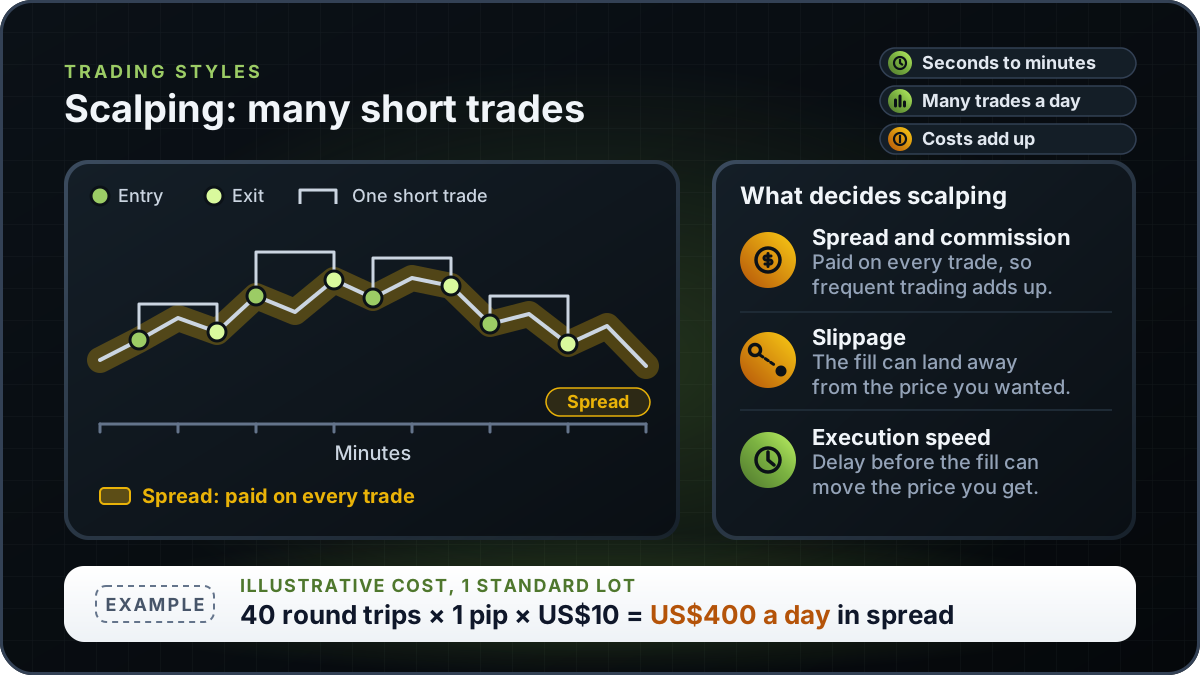
Scalping is a trading style in which a trader opens and closes positions, typically within seconds or minutes, to capture small price moves. Each gain is small, so the spread, commissions and slippage take a large share of any result. Understanding the scalping meaning therefore means understanding its cost structure.
In brief
A short-horizon trading style in which costs weigh heavily. This guide explains the term, typical holding periods and the trade-offs.
Scalpers typically hold a position for seconds to a few minutes. Some hold for longer. The line between scalping and day trading is a matter of convention, not a formal rule. Treat any holding period in this guide as a typical range, not a threshold that defines the style.
Shorter holding periods mean more decisions in each session. Every decision brings its own cost, so the number of trades becomes part of the analysis rather than a side detail. The basics of what a trade is, and how prices and orders work, are covered in what is trading.
The example below is illustrative. It is not a forecast and not a quote from any broker. It uses one simplifying assumption: each round trip costs one pip of spread. Amounts are shown in US dollars for readability. Convert them to your account currency before relying on them.
For a pair quoted in US dollars, such as EUR/USD, one pip on a standard lot of 100,000 units is 0.0001 times 100,000, or US$10. Mini and micro lots scale that value down in proportion.
| Position size | Assumed pip value | Spread cost per round trip | Per day (40 trades) | Per 20 trading days |
|---|---|---|---|---|
| 1 standard lot (100,000 units) | US$10 per pip | US$10 | US$400 | US$8,000 |
| 0.1 lot (10,000 units) | US$1 per pip | US$1 | US$40 | US$800 |
| 0.01 lot (1,000 units) | US$0.10 per pip | US$0.10 | US$4 | US$80 |
Illustrative only. Excludes commission, slippage, and swap or financing charges. The 20-day column assumes 20 trading days. Real spreads vary by broker, pair, session and news.
A scalp must first recover its spread. In the standard-lot row, 40 round trips need at least US$400 of gross gains just to cover the spread, before any commission or slippage.
This arithmetic is why scalping is sensitive to position size and to broker pricing. Use the forex pip calculator to check pip values for your own pair and lot size before you compare brokers.
Scalpers use many approaches. The list below describes common ideas. None is presented here as one that works, and each can lose money.
Choosing a method does not remove the cost. Every approach still pays spreads, and a method that works in one session can fail in another.
The three styles differ mainly in holding period and trade frequency. The table gives typical patterns, not rules.
| Style | Typical holding period | Trade frequency | Main cost drivers | Main skill focus |
|---|---|---|---|---|
| Scalping | Seconds to minutes | Very high, often dozens of trades a session | Spread, commission, slippage | Execution, cost control, quick decisions |
| Day trading | Within one session, usually flat by the close | High to moderate | Commission, spread, financing on leveraged positions | Intraday analysis and session risk limits |
| Swing trading | Days to weeks | Low to moderate | Overnight financing, wider stops | Trend and position analysis |
Definitions vary by market and broker. For the day-trading side in more detail, see day trading explained.
Read the terms before you open an account, and ask the broker in writing how the rules apply to short-term trades. Each broker's terms are its own, and they vary by country and regulator. This guide does not summarise any specific broker.
The US Securities and Exchange Commission's day-trading investor guidance, dated April 2005, says day traders pay their firms large amounts in commissions, training and equipment. It warns that day traders typically suffer severe losses in their first months, that borrowing to trade is risky, and that many lose all their money and may end up in debt as well. Read the SEC guidance.
In 2018, ESMA, the EU securities regulator, introduced temporary EU-wide measures for retail CFDs. ESMA reported in 2018 that 74% to 89% of retail CFD accounts typically lost money on their investments, based on national regulators' analyses. The measures also set leverage caps: 30:1 for major currency pairs, 20:1 for non-major pairs, gold and major indices, and lower caps for other assets. Check your national regulator for the rules that apply today. Read the ESMA press release.
Neither source is a forecast for a new account. They show why cost control matters to anyone trading frequently or with leverage.
This guide defines the term and explains its costs. It does not compare trading apps. For a comparison of apps that scalpers use, see the best trading apps for scalping in 2026. Check each article's date and each app's terms before you rely on it.
RTX5 is Orrnn's trading terminal and broker-technology product. Its Windows desktop client is in preview, and the web and mobile clients are planned. A Google Play listing for Android is published, but the mobile client has no approved release record yet. Check the product-availability record and release notes before relying on any RTX5 feature. This page does not recommend RTX5 or any other app for scalping.
Check RTX5 product availabilityTrust and methodology
We want you to be able to identify who owns the page, inspect the evidence, understand how tools were used, and challenge anything that looks wrong or out of date.
Published under the RTX5 Editorial Team byline. It identifies the responsible publishing organization; it does not imply that a named lawyer, regulator, financial adviser, or licensed expert approved this page.
4 primary references are listed on this page with context about what each one supports. The source set was checked on .
Automation and AI may help organize research, outline a page, or edit language. They are not treated as sources, are not presented as human experts, and do not remove the publisher's responsibility for the final page.
If a statement is incomplete, unsupported, or outdated, send the exact URL, sentence, and supporting evidence through our contact route. Read the full editorial and corrections policy.
Sources were checked on 7 November 2026. They explain market rules and concepts; they do not certify RTX5 or provide individual financial advice.
Scalping is a trading style built on many short trades. A scalper opens and closes positions within seconds or minutes and aims to capture small price moves. Because each gain is small, costs such as the spread, commission and slippage matter a great deal. The term describes holding period and frequency. It does not describe a method that works, and it does not guarantee any result.
Typically seconds to a few minutes, although the exact range varies by trader, market and broker. These are typical patterns rather than rules. Holding period is one way to separate trading styles. The bigger practical difference is how many trades a trader makes in a session and what each one costs.
No, although they overlap. Day trading means opening and closing positions within a single session, usually without holding them overnight. Scalping is narrower: it focuses on very short holds and high trade counts within that session. A day trader may hold for hours, while a scalper usually does not. Definitions vary, so check how your broker or regulator describes each style.
Each trade has to recover its spread, and a scalp targets a small gain. The illustrative example in this guide assumes 40 round trips a day at one pip of spread per round trip. On a standard lot of EUR/USD at US$10 per pip, that is US$400 a day before commission or slippage. Smaller lot sizes reduce the figure, which is why position size matters.
This guide cannot say. No trading style, including scalping, comes with a promise of profit. ESMA reported in 2018 that 74% to 89% of retail CFD accounts typically lost money, a figure about those accounts in that period. Check your national regulator for the rules that apply today. Educational content like this cannot tell you whether any strategy suits your circumstances. For individual advice, speak to a licensed adviser in your country.
Possibly. Some brokers set minimum holding times, restrict certain strategies, or change pricing during news and thin markets. Consequences can include fees, voided profits or closed accounts. Read the broker's terms and execution policy before you open an account. If a term is unclear, ask the broker to explain it in writing.