Accountable publisher
Published under the RTX5 Editorial Team byline. It identifies the responsible publishing organization; it does not imply that a named lawyer, regulator, financial adviser, or licensed expert approved this page.
Trading glossary
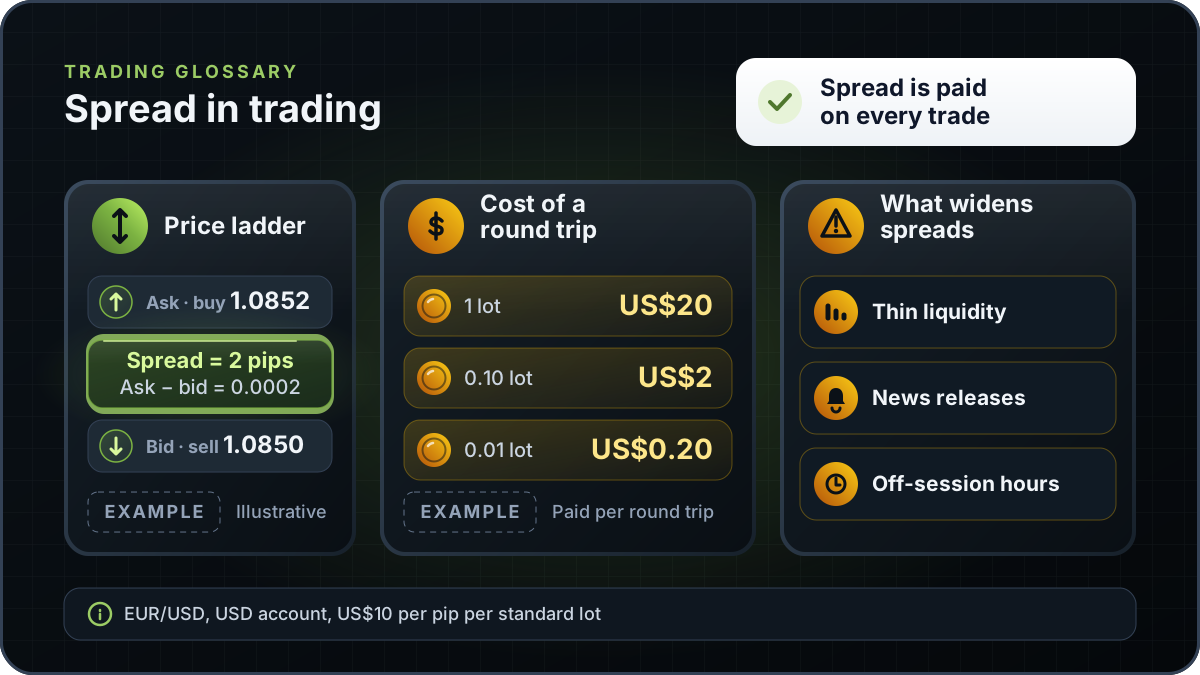
A spread in trading is the difference between the bid price, where you sell, and the ask price, where you buy. You buy at the ask and sell at the bid, so the gap is a cost on every round trip. On one standard EUR/USD lot, a 2-pip spread costs US$20 in a US$ account.
In brief
The spread is the price gap you cross on every trade. Here is how to measure it, what it costs at different lot sizes and why it is only part of the total cost.
The bid is the price at which the market will buy from you, so it is what you receive when you sell. The ask is the price at which the market will sell to you, so it is what you pay when you buy. The difference is the spread. For the quote format itself, read bid and ask.
Investor.gov, the US Securities and Exchange Commission's investor site, describes the same mechanism for stock orders. A market order generally executes at or near the bid for a sell and at or near the ask for a buy. The last traded price is not necessarily the fill price.
MQL5 documentation for MetaTrader 5 symbols defines SYMBOL_BID as the best sell offer, SYMBOL_ASK as the best buy offer and SYMBOL_SPREAD as the spread in points.
Subtract the bid from the ask to get the spread in price terms. Then convert it into the unit your platform uses. In forex, divide by the pip size. For a symbol that reports points, divide by the point. For a stock, the difference is already in money per share.
On EUR/USD with a bid of 1.0850 and an ask of 1.0852, the gap is 0.0002, which is 2 pips at 0.0001 each. On a five-digit quote the same gap is 20 points at 0.00001 each. The what is a pip guide explains pip size.
| Measure | Formula | Worked example |
|---|---|---|
| Pips (forex) | (ask minus bid) divided by pip size | (1.0852 minus 1.0850) divided by 0.0001 = 2 pips |
| Points (MetaTrader 5 symbols) | (ask minus bid) divided by the point value | (1.08520 minus 1.08500) divided by 0.00001 = 20 points |
| Price per share (stocks, often shown in cents) | Ask minus bid, per share | US$50.02 minus US$50.00 = US$0.02 per share, or US$2 on 100 shares |
Illustrative prices chosen for arithmetic. They are not quotes or forecasts. The point value for a symbol is set in its specification, so check it before you rely on a points figure.
The money cost of a spread is pips multiplied by pip value, and pip value rises with lot size. Double the lot, and you double the spread cost on the same quote.
The table uses the EUR/USD example above, in a US$ account, and assumes you open and close at the same quoted price. The forex pip calculator works out pip value for your own lot size and account currency.
| Lot size | Units | Pip value (US$ account) | Spread cost at 2 pips |
|---|---|---|---|
| 1 standard lot | 100,000 | US$10.00 per pip | US$20.00 |
| 0.10 lot | 10,000 | US$1.00 per pip | US$2.00 |
| 0.01 lot | 1,000 | US$0.10 per pip | US$0.20 |
Illustrative only. Your broker's contract size, pip value and conversion rate may differ, and the figures are in US dollars. Convert them into your account currency before you rely on them.
A fixed spread is set by the broker and is meant to stay at a stated size under normal conditions. A variable spread, sometimes called a floating spread, moves with the market. MQL5 symbol properties include SYMBOL_SPREAD_FLOAT, which indicates whether a symbol has a floating spread. Read your broker's terms to see which applies to each instrument.
Fixed does not mean certain. Brokers can change their terms in unusual conditions, and a fixed quote can still move in a fast market. A variable spread can be tight in calm, liquid conditions and wide at other times, so one quoted spread is only a snapshot.
A spread depends on how many buyers and sellers are quoting at a given moment. When liquidity is thinner, the gap between the best bid and the best ask tends to be wider. The size of the effect depends on the instrument, broker and time, so this guide gives no figures for it.
The common causes are these.
The spread is one cost. A broker can also charge commission per trade or per lot. Some brokers build their charges into the spread instead. Holding a leveraged position past the broker's rollover time can add a swap or overnight financing charge, which may be a debit or a credit depending on the direction and the broker.
Compare the total cost, not the spread alone. The commission and swap figures below are hypothetical, not any broker's fee schedule.
| Cost | What it is | Illustrative amount |
|---|---|---|
| Spread | Ask minus bid, paid when you open and close | US$20 at 2 pips |
| Commission | Fee per trade or per lot, if your broker charges one | Hypothetical US$6 round trip (US$3 per side) |
| Swap or overnight financing | Charge for holding past the rollover time | Hypothetical US$1.50 for one night |
| Total | Sum of the costs above for one trade held one night | US$27.50 in this hypothetical case |
Illustrative only. Commission, swap and spread are set by each broker and vary by instrument, direction and time. Use your broker's cost schedule for real figures.
In this hypothetical example, before swap, Broker A has a 2-pip spread and a hypothetical US$6 commission, so the round trip costs US$26. Broker B has a 2.4-pip spread and no commission, so the round trip costs US$24. Broker B is cheaper in this example, even though its spread is wider.
The spread is paid on each round trip, so a strategy that trades often pays it often. Scalping aims for small moves over seconds or minutes, so the spread can be a large share of each result. The what is scalping guide shows how that cost builds up.
Day trading repeats the cost across a session, so the total adds up even when each trade is small. The table uses the same 2-pip spread and 1 standard lot.
| Scenario | Spread per round trip | Gross target | What the spread takes |
|---|---|---|---|
| Scalp, 1 standard lot, 5-pip target | US$20 (2 pips) | US$50 (5 pips) | 40% of the target |
| Day trade, 1 standard lot, 10 round trips | US$20 each | Varies by trade | US$200 in spread before commission |
Illustrative arithmetic, not a forecast of any trade. The scalping guide uses a 1-pip assumption; a 2-pip spread doubles that spread cost.
Use the broker and platform you plan to trade with. Demo spreads and fills may not match live conditions, so treat the demo as a learning step.
Add the symbol to your watch list. In MetaTrader 5, the Market Watch window shows the bid and ask for each symbol.
Subtract the bid from the ask. Convert the result into pips or points using the pip or point size for that symbol, then into money using the pip value for your lot size.
Note the spread at the open, mid-session, in a quiet hour and around a scheduled news time. One reading is a snapshot, not your average cost.
Take commission and any swap or overnight financing figures from your broker's fee schedule and symbol specification. Add them to the spread to get the total cost of a planned trade.
RTX5 is Orrnn's trading terminal and broker-technology product. Its Windows desktop client is in preview, and the web and mobile clients are planned. A Google Play listing for Android is published, but the mobile client has no approved release record yet; check the product-availability record and release notes before relying on any RTX5 feature. RTX5 is not a broker and does not set the spread on your account. The spread figures on this page are illustrative.
Check RTX5 product availabilityTrust and methodology
We want you to be able to identify who owns the page, inspect the evidence, understand how tools were used, and challenge anything that looks wrong or out of date.
Published under the RTX5 Editorial Team byline. It identifies the responsible publishing organization; it does not imply that a named lawyer, regulator, financial adviser, or licensed expert approved this page.
4 primary references are listed on this page with context about what each one supports. The source set was checked on .
Automation and AI may help organize research, outline a page, or edit language. They are not treated as sources, are not presented as human experts, and do not remove the publisher's responsibility for the final page.
If a statement is incomplete, unsupported, or outdated, send the exact URL, sentence, and supporting evidence through our contact route. Read the full editorial and corrections policy.
Sources were checked on 7 November 2026. They explain market rules and concepts; they do not certify RTX5 or provide individual financial advice.
A spread in trading is the gap between the bid price, where you sell, and the ask price, where you buy, for the same instrument. Opening and closing a position at the quoted prices costs you the gap. Forex and CFD spreads are usually measured in pips or points, and stock spreads are measured in price per share.
No. A lower spread is only one cost. A broker with a tighter spread may charge a commission or higher swap, so the total can be greater. Spreads also change with the time of day and with news, so a low quote at a quiet moment may not be what you pay in your session. Compare total cost at the same lot size and hours.
Subtract the bid from the ask. On EUR/USD with a bid of 1.0850 and an ask of 1.0852, the difference is 0.0002. Divided by the 0.0001 pip size, that is 2 pips. To turn it into money, multiply the pips by the pip value for your lot size and account currency. On one standard lot in a US$ account, 2 pips is US$20.
A fixed spread is set by the broker and is meant to stay at a stated size under normal conditions. A variable or floating spread moves with the market. Neither is certain in every condition, so read the broker's terms and check the typical spread in your trading hours.
Yes. Stocks also have a bid and an ask, and a market order generally fills at or near the bid for a sell and the ask for a buy. The gap is the spread, measured in price per share. Commission and fees are separate, so check your broker's disclosures for each product you trade.
At the same quoted spread, each round trip costs the same. The difference is frequency. A scalper who opens and closes many trades pays the spread many times, and a small gross target leaves less room to absorb it. A swing trader who holds for longer pays the spread fewer times over the same period.