Accountable publisher
Published under the RTX5 Editorial Team byline. It identifies the responsible publishing organization; it does not imply that a named lawyer, regulator, financial adviser, or licensed expert approved this page.
Trading glossary
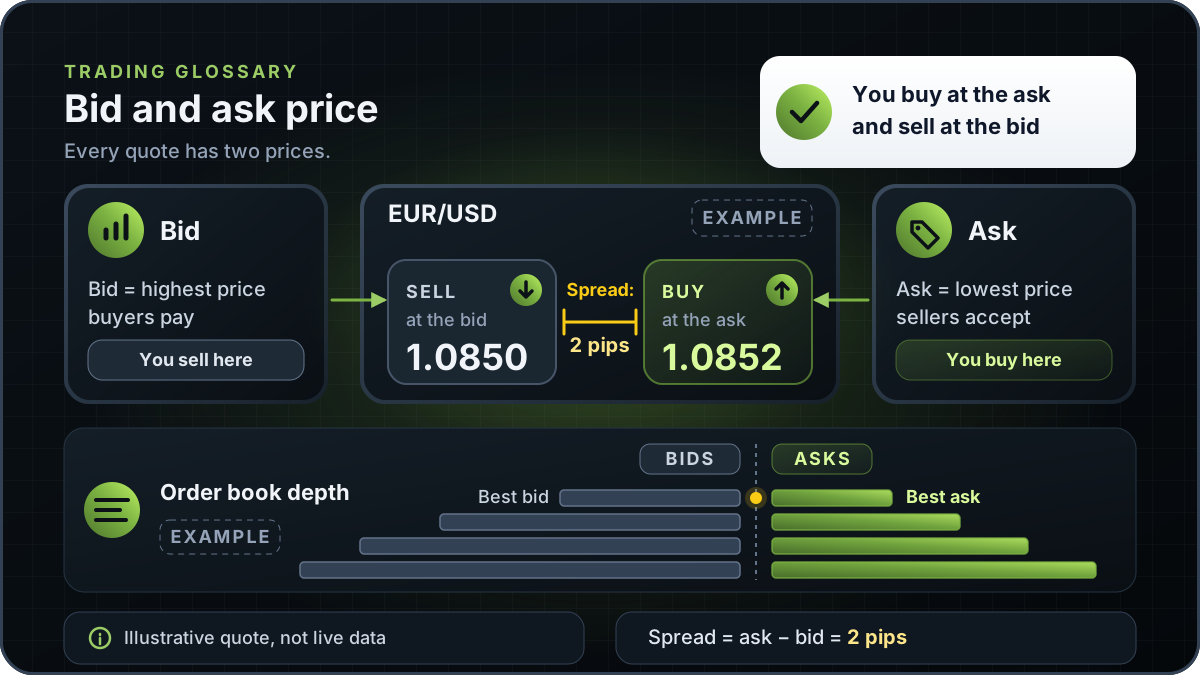
A bid and ask price is the pair of quotes for one instrument at one moment. The bid is the highest price a buyer offers and the ask is the lowest price a seller accepts. A sell order usually fills near the bid and a buy order near the ask. The spread guide covers that cost.
In brief
The bid is what the market pays you when you sell. The ask is what it charges you when you buy. Here is how to read both in a live quote.
The bid is the highest price a buyer is currently willing to pay for an instrument. The ask, also called the offer, is the lowest price a seller is currently willing to accept. Both change as buyers and sellers update their orders.
The MQL5 market-information reference describes the same two prices from the trading side. SYMBOL_BID is the best sell offer and SYMBOL_ASK is the best buy offer. Read the bid as the price you receive when you sell, and the ask as the price you pay when you buy.
A market order is an order to buy or sell immediately. Investor.gov explains that a market order generally executes at or near the current bid for a sell order and at or near the current ask for a buy order. A buy therefore fills near the higher price and a sell near the lower one. What that gap costs you, and how to measure it, is covered in what is spread in trading. If orders are new to you, start with what trading is.
Take an illustrative EUR/USD quote of Bid 1.0850 and Ask 1.0852. If you buy at the ask, you pay 1.0852. If you sell at the bid, you receive 1.0850. The pip for EUR/USD is 0.0001; what is a pip shows how that step is counted. The round-trip cost of that quote is covered on the spread page.
The table uses the illustrative EUR/USD quote from the example above. It shows what each term means, when you use it and how it applies to that quote.
| Term | Meaning | When you use it | EUR/USD example |
|---|---|---|---|
| Bid | The highest price a buyer offers, and the price you receive when you sell | Selling, including opening a short position | 1.0850 |
| Ask | The lowest price a seller accepts, and the price you pay when you buy | Buying, including closing a short position | 1.0852 |
| Spread | Ask minus bid | The cost of opening and closing at the same quote | 0.0002, or 2 pips |
| Last price | The price of the most recent deal | A record of a past trade, not a live buy or sell price | Not fixed; can differ from both the bid and the ask |
Example figures only. They are not a forecast or live market data.
A two-way quote shows a bid and an ask for the same instrument at the same time. In a currency pair, the first currency is the base and the second is the quote currency. A EUR/USD price of 1.0850 means that one euro buys 1.0850 US dollars. The forex overview explains how currency pairs are structured and priced against one another.
The last price is the price of the most recent deal. In MQL5 it is SYMBOL_LAST, which the reference describes as the price of the last deal. It shows where a trade last happened, not where you can buy or sell now.
Investor.gov notes that the last-traded price is not necessarily the price at which a market order will be executed. A quote can also move between your decision and the fill.
A stock quote is normally a bid and an ask for one listed share, shown in the share's currency. The prices you see depend on the exchange where the share is listed and on the data your broker provides.
A forex quote is a price for a currency pair. The bid and ask you see come from the broker or liquidity provider you trade with, so two brokers can show different prices for the same pair at the same moment. Forex prices are often quoted to five decimal places, so spreads are usually described in pips.
A market order takes the current quote and fills at or near it, as set out above. A limit order is different: it sets the worst price you will accept. Investor.gov says a buy limit order can only be executed at the limit price or lower, and a sell limit order only at the limit price or higher.
With the illustrative quote Bid 1.0850 and Ask 1.0852, a buy limit at 1.0820 fills only at 1.0820 or lower, and it may never fill if the price stays above that level. A market order to buy now would fill at about 1.0852. A limit order gives you control over price, but it does not guarantee a fill.
The bid and ask are prices. Size is how many units can trade at each price. A depth of market view lists buy and sell orders across several price levels, with the volume at each one. The MQL5 MarketBookGet reference describes these records for a symbol. The depth must first be opened with MarketBookAdd, so check whether your broker and platform provide depth data for the symbol.
Size changes what a quote means in practice. The top bid and ask may be available only for a small quantity. A large buy can use up the volume at the ask and move to higher prices, so its average fill can differ from the quote you saw. Check how much volume your broker shows at each price before you rely on a quote for a large order.
A depth view shows orders that exist at a moment, and they can change or be withdrawn before you trade. This page does not describe a depth-of-market feature in RTX5.
The gap between bid and ask changes with liquidity and volatility. What is spread in trading explains what drives it and how to measure it.
RTX5 is Orrnn's trading terminal and broker-technology product. Its Windows desktop client is in preview, and the web and mobile clients are planned. A Google Play listing for Android is published, but the mobile client has no approved release record yet; check the product-availability record and release notes before relying on any RTX5 feature. This page does not describe a depth-of-market display in RTX5, and its examples are illustrative.
Check RTX5 product availabilityTrust and methodology
We want you to be able to identify who owns the page, inspect the evidence, understand how tools were used, and challenge anything that looks wrong or out of date.
Published under the RTX5 Editorial Team byline. It identifies the responsible publishing organization; it does not imply that a named lawyer, regulator, financial adviser, or licensed expert approved this page.
4 primary references are listed on this page with context about what each one supports. The source set was checked on .
Automation and AI may help organize research, outline a page, or edit language. They are not treated as sources, are not presented as human experts, and do not remove the publisher's responsibility for the final page.
If a statement is incomplete, unsupported, or outdated, send the exact URL, sentence, and supporting evidence through our contact route. Read the full editorial and corrections policy.
Sources were checked on 7 November 2026. They explain market rules and concepts; they do not certify RTX5 or provide individual financial advice.
In a normal two-way quote the ask is higher than the bid, and the difference is the spread. If the bid were higher, a buyer would be offering more than a seller was asking, so the two would trade at once rather than sit as a quote. That is why a normal quote keeps the ask above the bid.
In the simple case, yes. Investor.gov says a market order generally executes at or near the current bid for a sell order and the ask for a buy order. Your fill can still differ if prices move before execution, if the volume at that price is limited, or if your order is large. A limit order can fill at your price or better, or not at all.
It depends on the platform and its chart setting. The MQL5 documentation says a symbol price chart can be based on Bid or Last prices. A chart drawn from last-deal prices can differ from the bid and ask you trade against, so check the chart mode before you read a candle or a level as the price you would pay.
Bid and ask come from the broker or liquidity provider you trade with, so two brokers can quote the same pair differently at the same moment. Check the live quote on your own platform before you trade. For the cost side, see what is spread in trading.
No. A quote shows the price at one moment. Your order can fill at a different price if the market moves first, if the volume at that price runs out, or if your order type allows only a specific price. A limit order sets the worst price you will accept, but it may not fill. Check your broker's execution terms before you trade.