Accountable publisher
Published under the RTX5 Editorial Team byline. It identifies the responsible publishing organization; it does not imply that a named lawyer, regulator, financial adviser, or licensed expert approved this page.
Forex basics
What is forex trading? It means buying one currency while selling another, always through a currency pair such as EUR/USD. Each pair has a quote: the price of the base currency in units of the quote currency. Traders aim to profit from changes in that rate. Leverage can magnify both gains and losses.
In brief
What is forex trading? A plain-English guide to currency pairs, quotes, spreads, pips, lots and leverage, with the rules regulators set for retail accounts.
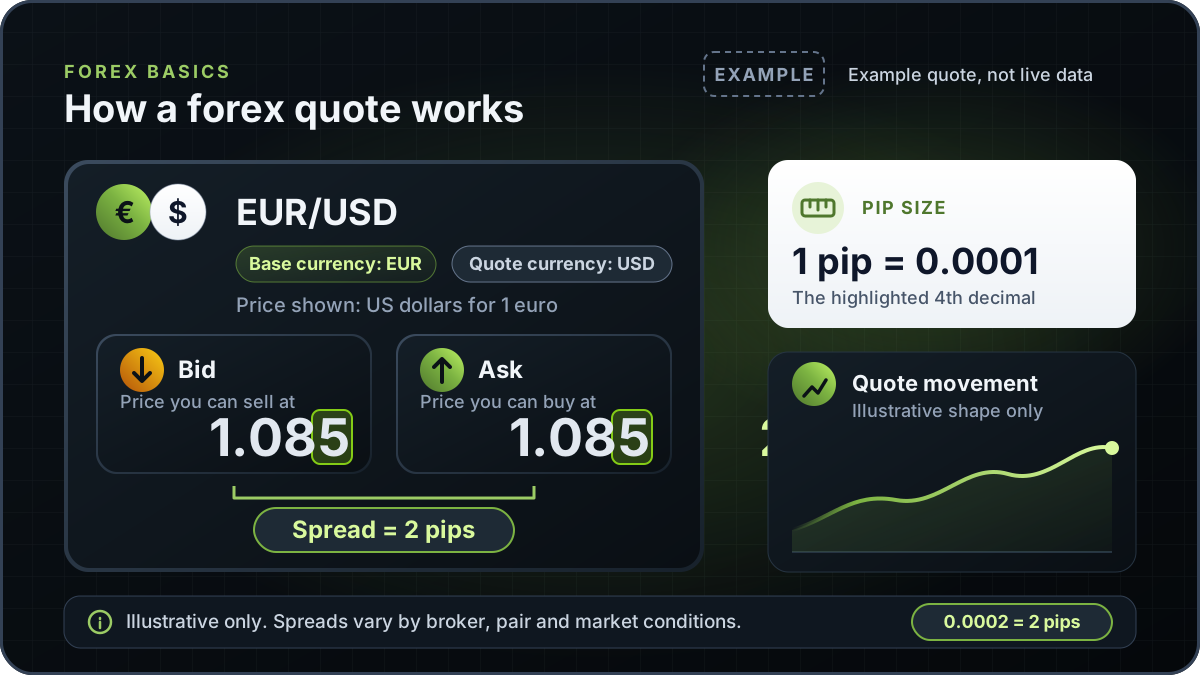
Forex trades always come in pairs. The base currency is the first currency named, and the quote currency is the second. In EUR/USD the base is the euro and the quote is the US dollar. The price shows how many units of the quote currency one unit of the base currency costs. A price of 1.0850 means one euro costs 1.0850 US dollars.
Every pair has two prices. The bid is the price you receive when you sell the base currency, and the ask is the price you pay when you buy it. The difference is the spread. It is a cost you pay on entry, before the price has moved in your favour.
The example below is illustrative, not a live price. Suppose EUR/USD is quoted at bid 1.0850 and ask 1.0852. The spread is 0.0002, or 2 pips. If you bought at the ask and closed straight away at the bid, you would lose that 2-pip spread before any market move, ignoring commissions and financing charges.
| Term | Meaning | Example value |
|---|---|---|
| Base currency | The currency you buy or sell | EUR (euro) |
| Quote currency | The currency the price is expressed in | USD (US dollar) |
| Bid | Price you receive when selling the base currency | 1.0850 |
| Ask | Price you pay when buying the base currency | 1.0852 |
| Spread | Ask minus bid, usually shown in pips | 2 pips |
Spreads vary by broker, pair and market conditions. The figures above are an example only.
A pip is the standard unit for measuring a price change, usually 0.0001 (0.01 for yen pairs). Its money value depends on your lot size and account currency; the pip guide explains how to count pips and work out their value.
A lot is a fixed trade size. The usual convention is a standard lot of 100,000 units of the base currency, a mini lot of 10,000 and a micro lot of 1,000. Brokers set their own sizes, so check the contract specification on your platform.
Leverage lets a deposit control a larger position. A ratio of 30:1 needs margin of about 3.33 percent of the position's value, which is 1 divided by 30. The table applies that arithmetic to a standard lot at the example ask price.
| Item | Convention or calculation | Result |
|---|---|---|
| One pip, standard lot | 100,000 x 0.0001 | US$10 per pip |
| One pip, mini lot | 10,000 x 0.0001 | US$1 per pip |
| One pip, micro lot | 1,000 x 0.0001 | US$0.10 per pip |
| Notional value, standard lot | 100,000 x 1.0852 | US$108,520 |
| Margin at 30:1 | US$108,520 / 30 | About US$3,617 |
| Margin at 50:1 | US$108,520 / 50 | About US$2,170 |
Illustrative arithmetic only. These pip values assume a pair quoted in US dollars in a US dollar account. Yen pairs use a 0.01 pip, so their pip values are calculated differently.
The same arithmetic shows the risk. On that standard lot, a 1 percent move against you is about US$1,085, roughly 30 percent of the US$3,617 margin at 30:1. Use the forex pip calculator to test other pairs and lot sizes, and the position size calculator to size a trade from the amount you are willing to lose.
Major pairs are the most actively traded pairs in the market, and most of them involve the US dollar. They usually have deeper liquidity than other pairs, but spreads can still widen around economic releases and in thin trading hours. The table names the pairs only and shows no prices.
| Pair | Base currency | Quote currency |
|---|---|---|
| EUR/USD | Euro | US dollar |
| USD/JPY | US dollar | Japanese yen |
| GBP/USD | Pound sterling | US dollar |
| USD/CHF | US dollar | Swiss franc |
| AUD/USD | Australian dollar | US dollar |
| USD/CAD | US dollar | Canadian dollar |
| NZD/USD | New Zealand dollar | US dollar |
The order is conventional and is not a ranking. The pair name shows the base and quote currencies; confirm the contract details with your broker.
Retail traders usually reach the market through a forex broker, using spot accounts or contracts for difference (CFDs). A CFD is an agreement with the provider, not ownership of the currency, so read the product terms and confirm who your counterparty is.
Forex trading is speculation on price moves. It is not a savings product, and nothing in this guide is a forecast or personal advice.
Spot forex is traded over the counter, so there is no single central exchange. Banks, dealers and electronic trading venues quote prices to each other and to their clients. The price you see depends on your broker's feed and terms.
The market is very large. The Bank for International Settlements' 2025 Triennial Central Bank Survey reported that trading in FX markets reached $9.6 trillion per day in April 2025, up 28% from 2022. That figure covers the whole FX market, not retail accounts.
Activity moves through the day as trading centres in Asia, Europe and North America open and overlap. Liquidity and spreads often change with these sessions, so check your broker's trading hours and the timing of major economic releases.
Leverage rules are set by local regulators and change over time. The table records what each regulator source checked for this guide says. It does not cover every country.
| Jurisdiction | Regulator | Rule stated in the source |
|---|---|---|
| United States | CFTC and NFA | Minimum security deposit of 2% of notional value for major currency groups and 5% for other currencies (NFA Forex Regulatory Guide, September 2022 revisions). A 2% deposit equals 50:1. |
| European Union | ESMA | 30:1 for major currency pairs. ESMA introduced this retail CFD leverage limit in 2018 as a temporary EU-wide measure, renewable in three-month periods (press release dated 1 June 2018). Check ESMA and your national regulator for the rules that apply today. |
| United Kingdom | FCA | Leverage limited to between 30:1 and 2:1 for retail CFDs, with the rules applying from 1 August 2019 for CFDs (FCA press release). |
Each regulator sets its own tiers and exceptions, and professional clients may be treated differently. Check the rule for your residence and for the entity you open an account with. Rules may have changed since these sources were published.
If orders, markets and risk are new to you, start with what trading is. Then read about forex and stock markets to see how the two differ in structure, hours and products.
When you compare trading apps, the 2026 guide to forex trading apps for Android is a starting point only. Ranking lists reflect their author's criteria, so check each broker's regulation, costs and availability in your country before you deposit.
RTX5 is Orrnn's trading terminal and broker-technology product. Its Windows desktop client is in preview, and the web and mobile clients are planned. A Google Play listing for Android is published, but the mobile client has no approved release record yet. RTX5 is not a broker and does not hold client money, so a forex account is opened with a broker, not with RTX5. Check the product-availability record and release notes before relying on any RTX5 feature.
Check RTX5 product availabilityTrust and methodology
We want you to be able to identify who owns the page, inspect the evidence, understand how tools were used, and challenge anything that looks wrong or out of date.
Published under the RTX5 Editorial Team byline. It identifies the responsible publishing organization; it does not imply that a named lawyer, regulator, financial adviser, or licensed expert approved this page.
6 primary references are listed on this page with context about what each one supports. The source set was checked on .
Automation and AI may help organize research, outline a page, or edit language. They are not treated as sources, are not presented as human experts, and do not remove the publisher's responsibility for the final page.
If a statement is incomplete, unsupported, or outdated, send the exact URL, sentence, and supporting evidence through our contact route. Read the full editorial and corrections policy.
Sources were checked on 9 November 2026. They explain market rules and concepts; they do not certify RTX5 or provide individual financial advice.
Forex trading means buying one currency and selling another at the same time, through a currency pair such as EUR/USD. You profit if the exchange rate moves in your favour and lose if it moves against you. Retail forex is usually traded through a broker, often as spot trading or CFDs, and the rules depend on where you live.
A pip is usually 0.0001, or 0.01 for yen pairs. Its money value depends on your lot size and account currency, so it is not a fixed amount. The pip guide explains the definition and the calculation, and the forex pip calculator works out the value for a chosen pair.
No. Forex trades currency pairs, usually over the counter through banks, dealers and brokers, rather than through a single exchange. Stocks are shares in companies and usually trade on exchanges. Both involve risk. Forex accounts often offer leverage, so a price move can have a larger effect on your deposit. The forex and stock markets page compares them.
It depends on where you live. The NFA guide sets a minimum 2% deposit for major currency groups in the US, which equals 50:1. ESMA introduced a 30:1 limit for major currency pairs on retail CFDs in 2018 as a temporary EU-wide measure, so check the rule that applies to you with your national regulator. The FCA limits retail CFDs in the UK to between 30:1 and 2:1. Check the current rule from your own regulator before you open an account.
Some brokers accept small deposits and offer micro lots of 1,000 units, but a small account has little room for losses. Margin and the value of each pip are the main limits. Use the position size calculator to see how much of your account a trade would risk before you place it.
RTX5 is a trading terminal and broker-technology product licensed to brokers. It is not a broker and does not hold client money. Its Windows desktop client is in preview, and the web and mobile clients are planned. A Google Play listing for Android is published, but the mobile client has no approved release record yet. Check the product availability record before relying on any feature.