Accountable publisher
Published under the RTX5 Editorial Team byline. It identifies the responsible publishing organization; it does not imply that a named lawyer, regulator, financial adviser, or licensed expert approved this page.
Trading glossary
Margin in trading is the deposit a broker requires you to hold against a leveraged position. It is collateral that stays in your account, not a fee. In a stock margin account, margin means money borrowed from the broker. A margin call or close-out follows when your equity falls too far below the required level.
In brief
Margin is the collateral that supports a leveraged position. Here is how it differs from a stock margin loan, how margin level is worked out and when a broker can close your trades.
Margin in trading is the money you must have in your account to open and keep a leveraged position open. The broker holds it as collateral against the risk that the position moves against you. It is not a fee, a commission or a spread. When the position closes, the margin is released, adjusted for the result of the trade.
The term is used in two different ways. In a stock margin account, margin means borrowing: the broker lends you cash and uses the account as collateral. On leveraged products such as CFDs and forex, margin is a deposit that supports a larger position. The two uses share a name but work differently, so check which one a product uses before you rely on the figure.
For the idea of controlling a large position with a smaller amount of capital, read what is leverage in trading. Margin is the mechanism that makes that leverage possible.
Investor.gov defines a margin account as a type of brokerage account in which the broker-dealer lends the investor cash, using the account as collateral, to purchase securities. Margin increases purchasing power, but it also exposes investors to the potential for larger losses.
In the US, FINRA sets a minimum. Its investor page on day trading, dated 4 June 2026, says you must maintain at least US$2,000 in equity in a margin account, and that trading on margin means borrowing funds from your firm. Firms may set higher house requirements. When you trade on margin during the day, intraday margin requirements apply, and they are calculated from positions held during the trading day, not only at the end of it.
FINRA has also changed the pattern day trader rule. In the US, FINRA replaced the pattern day trader rule and its US$25,000 minimum equity requirement with intraday margin standards, effective 4 June 2026. Brokers can phase the change in until 20 October 2027, and may still apply stricter house rules. Some accounts may follow the older requirements during the phase-in, so ask your broker which rules apply to you.
On a CFD or forex position, you put up a fraction of the position's value. The required margin is the position value divided by the leverage ratio. With US$30,000 of EUR/USD exposure at 30:1, the required margin is US$1,000. Your deposit covers only that margin, so a small move against you can use a large share of it.
Leverage limits depend on the country. In the UK, the FCA's permanent rules limit retail CFD leverage to between 30:1 and 2:1. In the EU, ESMA introduced leverage limits for retail CFD clients in 2018 as temporary measures, ranging from 30:1 for major currency pairs to 2:1 for cryptocurrencies. Check your national regulator for the rules that apply to you today.
For the product itself, read what is a CFD. It explains how a contract for difference tracks an asset's price without giving you ownership of the asset.
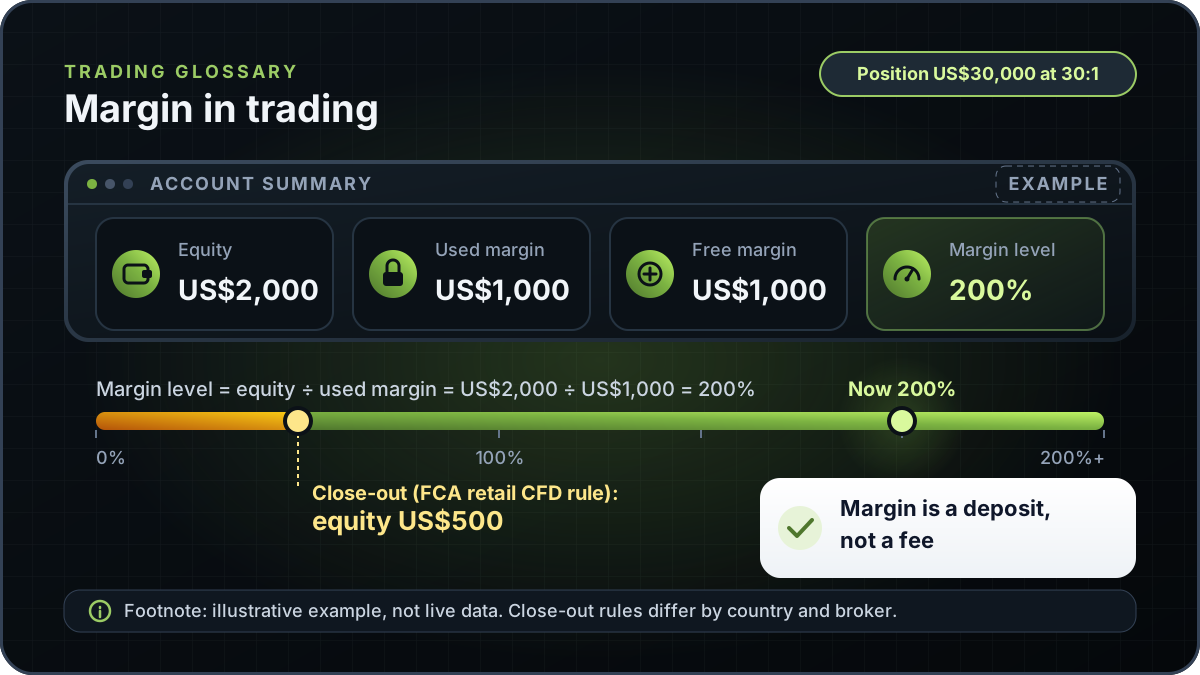
Used margin is the margin your open positions require. Equity is your account balance plus or minus the floating profit or loss on open positions. Free margin is equity minus used margin, the amount left to open new positions or to absorb further losses. Margin level is equity divided by used margin, shown as a percentage.
The table below uses one example throughout. A US$30,000 EUR/USD position at 30:1 requires US$1,000 of used margin. The figures are illustrative, not forecasts, and your broker may label them differently.
| Equity (US$) | Used margin (US$) | Free margin (US$) | Margin level | What it means |
|---|---|---|---|---|
| 2,000 | 1,000 | 1,000 | 200% | Starting point. Equity is twice the margin used. |
| 1,700 | 1,000 | 700 | 170% | After a 1% adverse move, a US$300 loss on US$30,000. |
| 1,000 | 1,000 | 0 | 100% | Free margin is used up. No room for new positions or further losses. |
| 500 | 1,000 | -500 | 50% | Close-out point under the FCA's permanent retail CFD rules and ESMA's 2018 measure. |
Equity falls from US$2,000 to US$500 after a 5% adverse move (a US$1,500 loss on US$30,000). Free margin turns negative when equity is below the margin used.
A margin call is a demand or warning from your broker that your equity has fallen below the level it requires. Investor.gov explains that if you buy on margin and the value of your securities declines, the brokerage firm can require you to deposit cash or securities immediately, or sell securities in your account to cover the shortfall. It can do this without informing you in advance, and it can change the threshold at which a margin call applies.
A close-out is different. The broker closes some or all open positions for you when equity falls to a set level. For UK retail CFDs, the FCA's permanent rules require positions to be closed out when funds fall to 50% of the margin needed. ESMA's 2018 measure set the same 50% level for EU retail CFD clients, as a temporary measure.
A margin call can arrive with little or no notice in a fast market. Prices can move several percent between one check and the next. A close-out may execute at the next available price rather than the level you expected, and overnight gaps, thin trading around news and wider spreads can all make the fill worse than the figure on your screen.
Your margin level is a snapshot that changes with every price movement. A position that looked comfortable at 200% can reach the close-out level before you have time to respond. Investor.gov notes that a firm can act without informing you in advance, so do not treat a margin call as the only warning you will get.
RTX5 is Orrnn's trading terminal and broker-technology product. Its Windows desktop client is in preview, and the web and mobile clients are planned. A Google Play listing for Android is published, but the mobile client has no approved release record yet; check the product-availability record and release notes before relying on any RTX5 feature. RTX5 is not a broker and does not hold client money, so the margin rules on your account are set by your broker. The figures on this page are illustrative and do not come from an RTX5 feature.
Check RTX5 product availabilityTrust and methodology
We want you to be able to identify who owns the page, inspect the evidence, understand how tools were used, and challenge anything that looks wrong or out of date.
Published under the RTX5 Editorial Team byline. It identifies the responsible publishing organization; it does not imply that a named lawyer, regulator, financial adviser, or licensed expert approved this page.
6 primary references are listed on this page with context about what each one supports. The source set was checked on .
Automation and AI may help organize research, outline a page, or edit language. They are not treated as sources, are not presented as human experts, and do not remove the publisher's responsibility for the final page.
If a statement is incomplete, unsupported, or outdated, send the exact URL, sentence, and supporting evidence through our contact route. Read the full editorial and corrections policy.
Sources were checked on 7 November 2026. They explain market rules and concepts; they do not certify RTX5 or provide individual financial advice.
A margin call is a request from your broker to restore your account to the level it requires, usually by adding funds or reducing positions. It is a warning that your equity has fallen toward a required level. Investor.gov notes that a firm can sell securities in a margin account without informing you in advance, and that it can change its threshold. A close-out is different: the broker closes positions when equity reaches its close-out level.
It depends on the product and the country. For UK retail CFDs, FCA rules require protection so a client cannot lose more than the funds in the CFD account. ESMA's 2018 EU measures included negative balance protection per account, as a temporary measure, so check your national regulator. For US margin accounts, Investor.gov says margin exposes investors to larger losses. The sources checked here do not confirm a negative balance guarantee, so read your broker's agreement.
Not always. In a stock margin account, margin means borrowing: the broker lends you cash secured by the account. On a leveraged CFD or forex position, margin is a deposit held against the position, not a loan of cash to buy the asset. Financing charges can still apply to positions held overnight, so read the product terms before you open one.
Margin level is equity divided by used margin, shown as a percentage. If you have US$2,000 of equity and US$1,000 of used margin, the margin level is 200%. A falling margin level means your equity is shrinking relative to the margin your positions need. Brokers set the level at which they close positions, and the figure varies by broker and product.
Required margin is the position value divided by the leverage ratio, plus any extra amount your broker sets. A US$30,000 position at 30:1 needs US$1,000 of margin, and the same position at 2:1 needs US$15,000. Margin requirements differ by instrument, broker and country, so confirm the figure in the contract specification before you trade.
FINRA says you must maintain at least US$2,000 in equity in a margin account, and firms may set higher house requirements. Intraday margin requirements apply when you trade on margin during the day. FINRA's US$25,000 pattern day trader minimum was replaced by intraday margin standards effective 4 June 2026, with a phase-in ending 20 October 2027, so check which rules your broker applies.