Accountable publisher
Published under the RTX5 Editorial Team byline. It identifies the responsible publishing organization; it does not imply that a named lawyer, regulator, financial adviser, or licensed expert approved this page.
Trading glossary
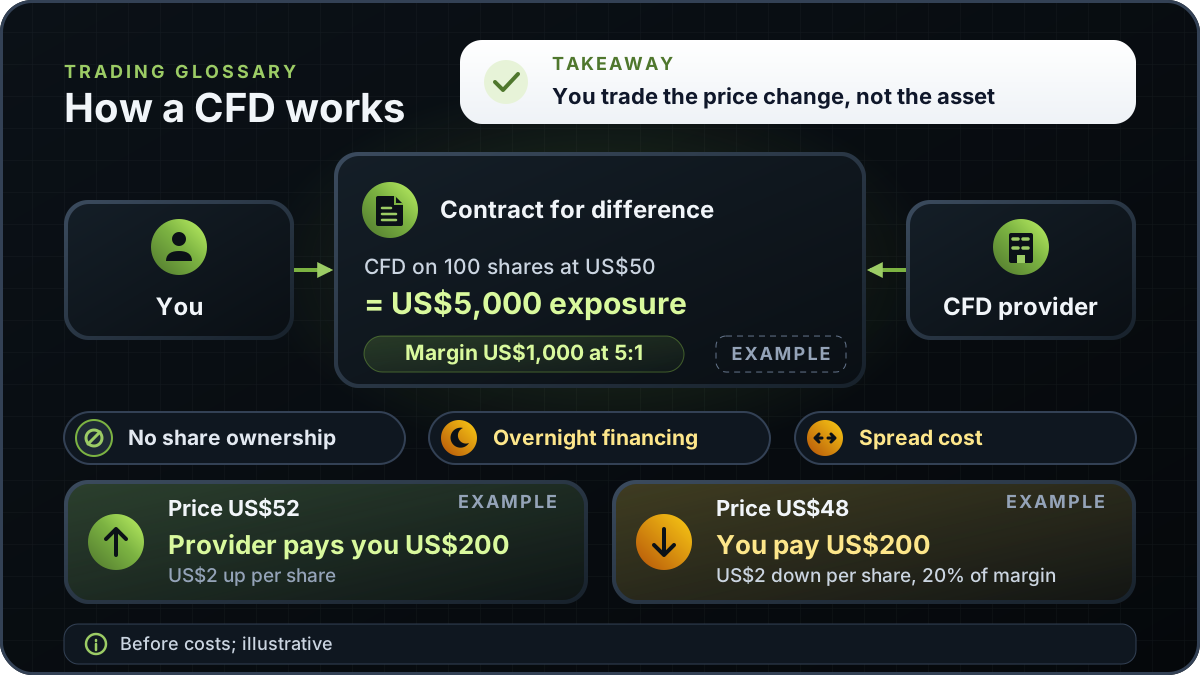
A CFD, or contract for difference, is an agreement between you and a provider to exchange the change in an asset's price between the time you open and close the trade. You do not own the underlying asset. Gains and losses follow the price move, and leverage can magnify both.
In brief
A CFD lets you trade the price movement of an asset without owning it. Here is how a trade works, what it costs and where the risks sit.
The cfd meaning comes straight from the name. A contract for difference is a contract, not a purchase of the asset. You agree with a provider to settle the difference between the price when you open the trade and the price when you close it. The asset itself stays where it is.
With a CFD on a share, for example, you receive or pay the price change of that share. You do not receive the share, and you do not become a shareholder in the company. CFDs can be written on shares, indices, currencies, commodities and other markets, but the markets a provider offers depend on that provider and on your country.
For the wider picture of how instruments are bought and sold, read what is trading first. The rest of this guide assumes you know what an order and a position are.
Take an illustrative CFD on 100 shares priced at US$50. The position gives exposure of US$5,000 (100 x US$50). At a leverage of 5:1, the margin needed is US$1,000. The figures are in US$ for readability; your provider will show the amounts in your account currency. The 5:1 level is used only for arithmetic. It matches ESMA's 2018 limit for individual equities for retail clients in the EU.
A long CFD gains when the price rises. A short CFD gains when the price falls. The table below shows the result of four simple moves before costs. The margin is a deposit set aside against the position, not a fee. Your gain or loss is still calculated on the full US$5,000 of exposure, so a US$200 move is 20% of the US$1,000 margin.
| Position | Price move | Result (US$) | Share of US$1,000 margin |
|---|---|---|---|
| Long (buy) | US$50 to US$52 | +200 | +20% |
| Long (buy) | US$50 to US$48 | -200 | -20% |
| Short (sell) | US$50 to US$48 | +200 | +20% |
| Short (sell) | US$50 to US$52 | -200 | -20% |
Illustrative arithmetic only: 100 units, a US$50 start price and a 5:1 margin. Not a forecast and not data from any market. Costs are excluded.
Financing is the other part of the arithmetic. If you hold a CFD past the provider's daily cut-off, providers commonly charge a financing cost on the position. The rate and method depend on the provider, so read its contract specification before you hold a position across sessions. Financing adds to the cost of a long trade you keep open for weeks, and it can also work against a short trade.
Owning shares and holding a CFD on the same share both expose you to its price. The structure is different, and the difference matters for ownership, costs and who you are dealing with. The table below sets the two side by side.
| Feature | CFD | Owning the shares |
|---|---|---|
| Ownership | You do not own the asset. You hold a contract that pays the price change. | You own the shares directly. |
| Voting rights and dividends | Not covered by the sources checked for this guide. Check the provider's contract terms. | Not covered by the sources checked for this guide. Check the company and your broker's terms. |
| Leverage | Offered with margin. The limit depends on your country's rules. | Depends on your broker and your country. Not covered by the sources checked here. |
| Costs | Spread, any commission and overnight financing. | Commissions and fees set by your broker. Not covered in detail here. |
| Counterparty | The CFD provider is your counterparty. | Depends on how and where the shares are held. Not covered in the sources checked here. |
Only the description of a CFD as a contract on price is drawn from the regulator sources checked for this guide. Other entries are general and depend on your broker.
A CFD usually has a spread, the gap between the buy and sell price. As with any spread, you start the trade slightly behind the market, so the price has to move past the spread before you gain. The mechanics are explained in what is spread in trading.
Costs are paid whatever the direction of the trade. Spreads can widen around news or outside main trading hours, so a cost you expect may not be the cost you pay. Check the contract specification for the instrument and session you trade.
Leverage is the main risk to understand. It lets a small deposit control a larger position. US$1,000 of margin at 5:1 controls the US$5,000 position above, so a 10% fall in price takes US$500, half the margin. The same position at 2:1 would need US$2,500 of margin, which is one reason regulators have set limits on leverage for retail clients.
Losses can build quickly. A CFD gains and loses with the price, so a move against you reduces your account equity directly. Depending on the provider and your country, the position may be closed automatically before your funds run out. ESMA reported in 2018 that 74–89% of retail CFD accounts typically lose money, and this guide does not claim to explain the causes of that figure.
Prices can also gap. If the market opens well away from where it closed, or moves sharply overnight, a stop order can fill far from the level you chose. Your counterparty is the provider, so the protection you have depends on that provider and on the rules in your country.
United Kingdom (FCA). From 1 August 2019, the Financial Conduct Authority applies permanent rules to CFDs sold to retail clients. Leverage is limited to between 30:1 and 2:1. A position must be closed out when funds fall to 50% of the margin needed. Firms must provide protection so a client cannot lose more than the funds in the CFD account. The FCA press release of 1 July 2019 sets out these rules.
European Union (ESMA). In 2018, the European Securities and Markets Authority introduced temporary EU-wide measures for retail CFD clients. They set leverage limits from 30:1 to 2:1 depending on the asset, a standard close-out at 50% of minimum required margin, negative balance protection for each account and a standardised risk warning. ESMA's 27 March 2018 release describes these measures. Check your national regulator for the rules that apply to you today.
United States. Availability depends on country and regulator. We could not load an official SEC or CFTC page that confirms whether CFDs are offered to US retail customers, so do not assume a CFD is available to you in the US.
Other countries. Leverage limits, client protections and the products a provider may offer differ from country to country. Read your regulator's guidance and the provider's risk disclosures before you open an account.
RTX5 is Orrnn's trading terminal and broker-technology product. Its Windows desktop client is in preview, and the web and mobile clients are planned. A Google Play listing for Android is published, but the mobile client has no approved release record yet; check the product-availability record and release notes before relying on any RTX5 feature. RTX5 is not a broker and does not hold client money. The CFD figures on this page are illustrative and do not come from an RTX5 feature.
Check RTX5 product availabilityTrust and methodology
We want you to be able to identify who owns the page, inspect the evidence, understand how tools were used, and challenge anything that looks wrong or out of date.
Published under the RTX5 Editorial Team byline. It identifies the responsible publishing organization; it does not imply that a named lawyer, regulator, financial adviser, or licensed expert approved this page.
4 primary references are listed on this page with context about what each one supports. The source set was checked on .
Automation and AI may help organize research, outline a page, or edit language. They are not treated as sources, are not presented as human experts, and do not remove the publisher's responsibility for the final page.
If a statement is incomplete, unsupported, or outdated, send the exact URL, sentence, and supporting evidence through our contact route. Read the full editorial and corrections policy.
Sources were checked on 7 November 2026. They explain market rules and concepts; they do not certify RTX5 or provide individual financial advice.
No. A CFD is a contract with the provider that pays the change in the asset's price between opening and closing. You do not own the underlying shares, commodity or currency, and you do not receive it. Whether a CFD gives you voting rights or dividends is not covered by the sources checked for this guide, so check the provider's contract terms before you trade.
ESMA reported in 2018 that 74–89% of retail CFD accounts typically lose money. This guide does not claim to explain the causes behind that figure. The mechanics are clear, though: leverage magnifies small price moves, spreads and financing add cost, and a losing position can be closed out. Treat the statistic as a warning, not a forecast for your account.
Yes. A CFD can be opened as a short position, so you gain if the price falls. In the illustrative example on this page, a short sold at US$50 that falls to US$48 gains US$200 before costs. The same short loses US$200 if the price rises to US$52. Spreads and financing apply to short positions too.
Availability depends on country and regulator. We could not load an official SEC or CFTC page that confirms whether CFDs are offered to US retail customers. Check with your regulator and any provider before you assume you can trade CFDs in the US.
It is protection that stops a retail client losing more than the funds in the CFD account. The FCA's permanent UK rules require it, and ESMA's 2018 EU measures included it for each account. It limits losses to the funds in the account, but it does not stop losses within those funds or remove the other risks of CFD trading.