Accountable publisher
Published under the RTX5 Editorial Team byline. It identifies the responsible publishing organization; it does not imply that a named lawyer, regulator, financial adviser, or licensed expert approved this page.
Trading basics
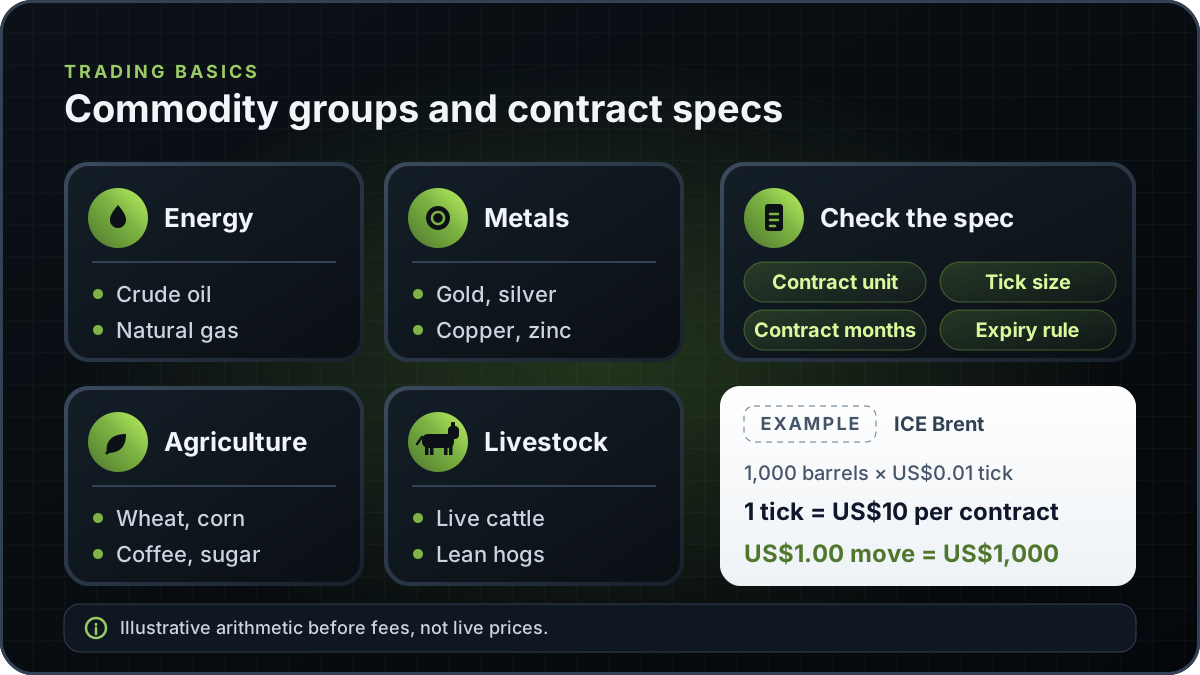
What are commodities? They are raw materials and primary products, such as crude oil, natural gas, gold, copper, wheat and coffee. Exchange futures on a commodity use standardised specifications for quality, quantity and delivery, so contracts for the same delivery month on the same exchange are interchangeable. The main groups are energy, metals, agriculture and livestock.
In brief
What are commodities? A plain guide to the main groups, how each commonly trades and the contract details to check before you trade.
Commodities are raw materials or primary products. The CFTC glossary describes a commodity as a physical good, such as an agricultural product or a natural resource, set against financial instruments such as currencies or interest rates.
The groups below are the ones most traders meet. Some markets overlap, and whether an instrument is available depends on your broker and your country, not only on the commodity itself.
| Group | Typical examples | How it commonly trades | What to check |
|---|---|---|---|
| Energy | Crude oil, natural gas, heating oil | Exchange futures, spot and OTC, ETFs, CFDs | Grade and delivery point differ by contract. |
| Metals | Precious: gold, silver, platinum. Industrial: copper, aluminium, zinc, nickel | Exchange futures, spot and OTC, ETFs, CFDs | Contract size, delivery terms and trading hours vary by exchange and contract. |
| Agriculture | Grains: wheat, corn, soybeans. Softs: coffee, cocoa, sugar | Exchange futures, OTC, ETFs, CFDs | Harvest timing can change supply, so check the contract months. |
| Livestock | Live cattle, lean hogs | Exchange futures, OTC, CFDs | Check whether your broker offers the contract at all. |
Groups and examples are general. Venues are named as examples only. Availability depends on your broker and country. This is not a list of products RTX5 offers.
The most common route into commodities is the futures contract. The CFTC glossary describes a futures contract as "An agreement to purchase or sell a commodity for delivery in the future", at a price determined when the contract starts. The same entry says it may be satisfied by delivery or by offset, which means closing the position with an equal and opposite trade in the same delivery month.
The CFTC glossary describes the cash market as the market for the physical commodity, as contrasted with a futures contract. It can be an organised exchange, a decentralised over-the-counter (OTC) market or a local buyer such as a grain elevator. The spot market is the market for immediate delivery and payment. OTC deals are agreed between two parties, so their terms depend on the counterparty rather than on a standard exchange specification.
ETFs and CFDs give price exposure without physical delivery. An ETF is a fund that holds commodities or futures, and its price follows the fund's own rules. A CFD pays the price change between opening and closing, and it is usually leveraged.
Crude oil trades in a global market. The EIA notes that prices of the many crude streams produced worldwide tend to move closely together. For how the two main oil benchmarks differ, read WTI vs Brent crude.
Gold hours depend on the venue and the contract, so check them before you plan a trade. The gold market hours guide covers the main points.
A commodity price means little until you know the unit it refers to. Every futures contract has a specification that sets its size, its smallest price step, the months that trade and how the contract ends. Two contracts for the same commodity can differ, so read the specification for the exact contract you plan to trade.
| Specification | Value | Source |
|---|---|---|
| Contract size | 1,000 barrels | ICE product specification |
| Minimum price fluctuation | One cent (US$0.01) per barrel | ICE product specification |
| Contract series | Up to 156 consecutive months, or as the exchange determines | ICE product specification |
| Expiry | Trading ceases on the last Business Day of the second month preceding the contract month | ICE product specification |
Verified on 9 November 2026 from the ICE Brent Crude Futures specification page. Specifications can change, so check the current exchange page before trading.
Example: at a US$0.01 tick on 1,000 barrels, one tick is worth US$10 per contract before fees (1,000 x US$0.01). A US$1.00 move per barrel is 100 ticks, or US$1,000 per contract. The arithmetic is exact, but the price move is illustrative and not a forecast.
Commodity prices can move sharply. Futures and CFDs add leverage, because a deposit controls a larger contract. A move against you can cost more than the margin you put up, especially on a futures position.
Other risks are specific to the market. Prices can gap on news or at the open, a contract can become harder to trade near expiry, and physical delivery brings obligations for storage and transport. If a contract is priced in a different currency from your account, currency moves add a second layer of risk.
Commodities are one part of a wider market picture. Index and single-stock futures are a different group, covered in what are stock futures. Each instrument has its own specification, so compare terms rather than assuming that one account treats every market the same way.
The IMF publishes monthly commodity price data through its Primary Commodity Prices System. Those series are useful for history and context. They do not show what a contract will do next.
RTX5 is Orrnn's trading terminal and broker-technology product. Its Windows desktop client is in preview, and the web and mobile clients are planned. A Google Play listing for Android is published, but the mobile client has no approved release record yet; check the product-availability record before relying on any RTX5 feature. RTX5 has no evidenced commodities or futures trading feature. RTX5 is not a broker and does not hold client money. The Brent figures on this page come from the ICE specification, not from an RTX5 feature.
Check RTX5 product availabilityTrust and methodology
We want you to be able to identify who owns the page, inspect the evidence, understand how tools were used, and challenge anything that looks wrong or out of date.
Published under the RTX5 Editorial Team byline. It identifies the responsible publishing organization; it does not imply that a named lawyer, regulator, financial adviser, or licensed expert approved this page.
6 primary references are listed on this page with context about what each one supports. The source set was checked on .
Automation and AI may help organize research, outline a page, or edit language. They are not treated as sources, are not presented as human experts, and do not remove the publisher's responsibility for the final page.
If a statement is incomplete, unsupported, or outdated, send the exact URL, sentence, and supporting evidence through our contact route. Read the full editorial and corrections policy.
Sources were checked on 9 November 2026. They explain market rules and concepts; they do not certify RTX5 or provide individual financial advice.
Commodities are raw materials and primary products, such as crude oil, natural gas, gold, copper, wheat, coffee and live cattle. On an exchange, a commodity trades through standardised futures contracts that fix the quality, quantity and delivery terms, so contracts for the same month are interchangeable. The main groups are energy, metals, agriculture and livestock.
This guide sorts commodities into four groups: energy, metals, agriculture and livestock. Energy covers crude oil and natural gas. Metals include precious metals such as gold and silver and industrial metals such as copper and aluminium. Agriculture covers grains such as wheat and softs such as coffee, cocoa and sugar, and livestock covers cattle and hogs.
The main routes are exchange futures, spot and over-the-counter deals, exchange-traded funds and CFDs. Futures are standardised and listed on an exchange. OTC deals are agreed between two parties, so their terms depend on the counterparty. ETFs hold exposure through a fund, and CFDs pay the price change without delivery. Availability depends on your broker and country.
The CFTC glossary describes a futures contract as an agreement to purchase or sell a commodity for delivery in the future, at a price determined when the contract starts. It may be satisfied by delivery or by offset, an equal and opposite trade that closes the position. Each contract has its own unit, tick size and expiry rule, so check the specification before you trade.
No. Historical price series, such as the IMF's monthly commodity data, show past movements and are useful for context. They do not predict the next move. Commodity prices respond to supply, demand, weather, policy and currency conditions, and those factors can change quickly. Treat any forecast as a view, not a fact.