Accountable publisher
Published under the RTX5 Editorial Team byline. It identifies the responsible publishing organization; it does not imply that a named lawyer, regulator, financial adviser, or licensed expert approved this page.
Trading basics
Stock futures are futures contracts on a stock index, such as the S&P 500. Each is an agreement to buy or sell the index's value at a price set when the trade is opened, for settlement on a later date. They are leveraged: you post margin rather than the full value, so losses can exceed the deposit.
In brief
Here is how stock index futures contracts are sized, which contract features to check, why their prices can move while the cash market is closed, and how margin makes the risk larger than the deposit.
A futures contract is an agreement to buy or sell something later at a price agreed now. The CFTC glossary describes it as an agreement with a price determined at initiation of the contract, which obligates each party to fulfil the contract at the specified price and may be satisfied by delivery or offset. Offset means closing the position with an equal and opposite trade in the same contract month.
In this guide, stock futures means futures on a stock index, such as the S&P 500, the Nasdaq-100 or the Dow Jones Industrial Average. You are not buying the individual shares in that index. The contract follows the index level, and the index is a basket of shares built by its provider. The CFTC glossary keeps a separate term for a single stock future: "A futures contract on a single stock as opposed to a stock index." For how an index is built and weighted, read what is a stock index.
Start with what is trading if you are new to instruments, orders and risk. The rest of this guide assumes you know what a position is.
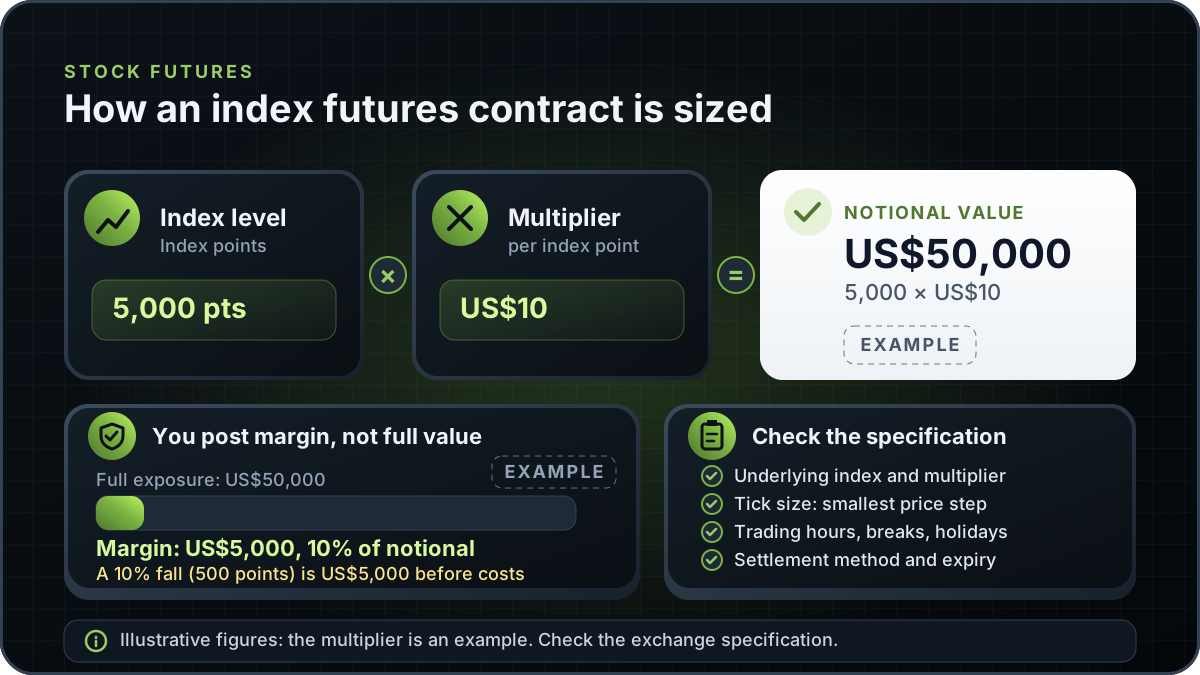
The size of a contract is the index level multiplied by the contract multiplier. The result is the notional value, the full market exposure the contract gives you. Each index point moves the value of the contract by the multiplier, so the multiplier decides how much a one-point move is worth.
Example, with an illustrative multiplier used only for arithmetic: if the index is at 5,000 and the multiplier is US$10 per point, the notional value is 5,000 × US$10 = US$50,000. A move of 20 points changes the value by 20 × US$10 = US$200. Real multipliers differ by contract, so use the figure in the contract's official specification, not this example.
The exchange that lists a contract sets its terms in the contract specification, and two contracts on the same index can differ in size. The table below lists the features to read in any index futures specification, what each one means, and an example calculation. The examples are arithmetic only and do not describe any listed contract.
| Feature | What it means | Illustrative arithmetic (not an exchange specification) |
|---|---|---|
| Underlying index | The stock index whose level the contract follows. | Example: an index at 5,000 points. |
| Multiplier | The money value of one index point. Index level × multiplier = notional value. | Example: 5,000 × US$10 = US$50,000 notional. |
| Tick size | The minimum price fluctuation, which the CFTC glossary defines as the "Smallest increment of price movement possible in trading a given contract." | Example: a 0.5-point tick × US$10 = US$5 per tick. |
| Trading hours | Session times and time zone, any daily break, and holiday changes, all set by the exchange. | No example: take hours from the exchange's official calendar. |
| Settlement | How the contract is closed out at expiry. Cash settlement pays a cash amount based on the level of an index, using a procedure specified in the contract. | Example: settling 20 points above the entry price is 20 × US$10 = US$200 for a buyer, before costs. |
| Expiry | The contract month in which the contract matures, and the last day it trades. | No example: check the listed contract months. |
Definitions checked against the CFTC Futures Glossary on 9 November 2026. The US$10 multiplier and 0.5-point tick are examples, not the terms of any listed contract. Take every feature from the listing exchange's official contract specification before trading.
Index futures trade on hours set by the exchange, and those hours can differ from the cash stock market's session. A futures price can therefore change while the cash market is closed. That movement reflects trades in the futures market at the time. It is not a forecast of where the cash index will open, and it does not show that the cash market will follow.
Futures and cash indices have different session times and settle on different terms, so a futures price and the index level can differ. The gap can close, widen or reverse during the session. Extended trading in individual shares is a separate topic, covered in after-hours trading.
Hours are set by each exchange and can change for holidays and maintenance. Use the exchange's official calendar, and check these points before you act on any session time:
A futures position is not paid for in full: you post margin, and the CFTC glossary notes that "The margin is not partial payment on a purchase." It adds that exchanges specify initial and maintenance margin for each futures contract, and that brokers may require customers to post more than the exchange levels. In the example above, a US$5,000 deposit is 10% of the US$50,000 notional, so a 10% fall of 500 points (500 × US$10 = US$5,000) would use the whole deposit before costs. For margin calls, margin levels and how leverage magnifies results, read what is margin in trading and what is leverage in trading.
US stock futures trade on designated contract markets, which the CFTC glossary defines as "A board of trade or exchange designated by the CFTC to trade futures, swaps, and/or options under the CEA." The CFTC's weekly Traders in Financial Futures report shows which index contracts are reported: its edition with positions as of 3 November 2026 lists futures on the S&P 500, Nasdaq-100, Dow Jones Industrial Average and Russell 2000 indices, and each entry's heading states the contract unit.
Outside the US, the regulator, the rules on who can offer futures to retail clients and the margin required can all differ. A product may be open to you in one country and closed in another. Before you assume a futures product is available to you, check your national regulator and the risk disclosures of the broker you would use, and confirm the contract's specification with the exchange that lists it.
RTX5 is Orrnn's trading terminal and broker-technology product. Its Windows desktop client is in preview, and the web and mobile clients are planned. A Google Play listing for Android is published, but the mobile client has no approved release record yet; check the product-availability record before relying on any RTX5 feature. RTX5 does not offer futures trading, and it is not a broker and does not hold client money. The contract and margin figures on this page are illustrative and do not come from an RTX5 feature.
Check RTX5 product availabilityTrust and methodology
We want you to be able to identify who owns the page, inspect the evidence, understand how tools were used, and challenge anything that looks wrong or out of date.
Published under the RTX5 Editorial Team byline. It identifies the responsible publishing organization; it does not imply that a named lawyer, regulator, financial adviser, or licensed expert approved this page.
4 primary references are listed on this page with context about what each one supports. The source set was checked on .
Automation and AI may help organize research, outline a page, or edit language. They are not treated as sources, are not presented as human experts, and do not remove the publisher's responsibility for the final page.
If a statement is incomplete, unsupported, or outdated, send the exact URL, sentence, and supporting evidence through our contact route. Read the full editorial and corrections policy.
Sources were checked on 9 November 2026. They explain market rules and concepts; they do not certify RTX5 or provide individual financial advice.
No. A stock index futures contract is an agreement based on the level of an index, not a purchase of the shares in that index. You post margin rather than paying the full value, and you do not become a shareholder in any company. How the contract settles is set in its official specification, which you should read before trading.
No. A futures price reflects trading in the futures market at that moment. It can move before the cash market opens, but that movement is not a forecast of the opening level. The cash index can open above or below where futures were trading, so treat a pre-market move as information about futures, not a prediction.
Yes. The CFTC states that losses may exceed the initial margin deposit, and that traders can lose all of their money and in some cases may be required to pay more than invested initially. A fall in the index can reduce your account below the required margin level and trigger a margin call. An order to limit the loss may not fill at your chosen price in a fast market.
Margin is the deposit set against a futures position, not a part-payment for it. The CFTC glossary defines initial margin as "Customers' funds put up as security for a guarantee of contract fulfillment at the time a futures market position is established." Margin does not cap your loss, because your gain or loss follows the full notional value. For maintenance margin and margin calls, read the guide to margin in trading.
Each exchange sets the session times for its index futures, and they can include a daily break and holiday changes. This page does not list session times, so it is not a timetable. Check the exchange's official calendar for the current hours and time zone before you act on any session time.
No. RTX5 is Orrnn's trading terminal and broker-technology product, and it does not offer futures trading. Its Windows desktop client is in preview, and the web and mobile clients are planned. A Google Play listing for Android is published, but the mobile client has no approved release record yet. Check the product-availability record before relying on any RTX5 feature.