Accountable publisher
Published under the RTX5 Editorial Team byline. It identifies the responsible publishing organization; it does not imply that a named lawyer, regulator, financial adviser, or licensed expert approved this page.
Market sessions
After hours trading is trading in a stock or other security outside the regular exchange session, usually in the pre-market session before the open or the after-hours session after the close. Trading volume is typically thinner, so spreads can be wider and prices can move more sharply than in regular hours.
In brief
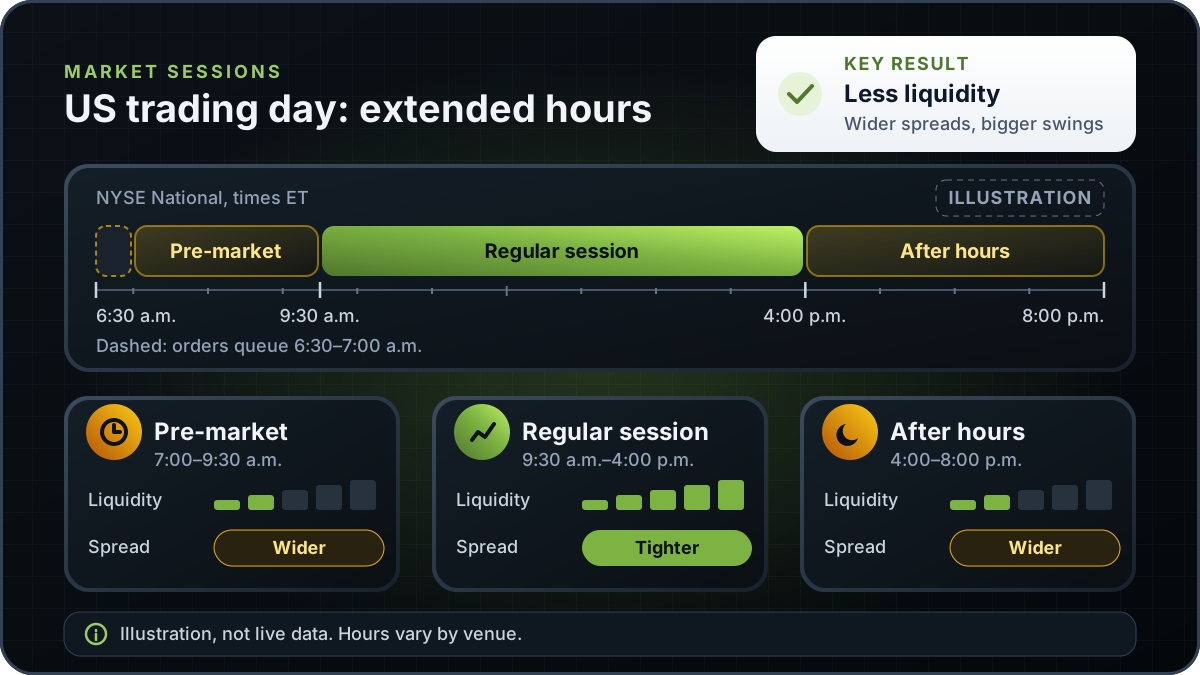
Extended-hours sessions run before the regular US open and after the close. Liquidity is usually thinner there, and prices can differ from regular-session prices.
After hours trading is the umbrella term for trading outside the regular session. Trading before the open is usually called pre-market trading, and trading after the close is usually called after-hours trading. Both are often grouped under extended-hours trading. FINRA's model disclosure defines that as trading outside regular trading hours, which it says generally means 9:30 a.m. to 4:00 p.m. Eastern Standard Time.
The regular US session on NYSE runs from 9:30 a.m. to 4:00 p.m. Eastern Time, according to the NYSE hours page (verified on 9 November 2026). Extended windows are not the same everywhere. The same page lists a pre-opening session from 6:30 a.m. ET for several NYSE venues and a late session from 4:00 to 8:00 p.m. ET for some, but not all of them. On NYSE National, for example, orders entered from 6:30 a.m. are queued until the early trading session opens at 7:00 a.m. Brokers set their own windows and may offer fewer hours than the exchange.
Rather than repeat a full calendar here, use the stock market holidays guide for session times, closed days and early closes, and confirm the current hours with the venue before you trade.
| Feature | Regular session | Extended-hours sessions |
|---|---|---|
| Hours | Core NYSE session 9:30 a.m. to 4:00 p.m. ET | Outside the core session. Windows vary by venue and broker |
| Liquidity | Usually deeper, with more buyers and sellers | Usually thinner. Some stocks may not trade at all (SEC) |
| Spreads | Usually narrower | Often wider, because there is less trading interest (SEC) |
| Order types | Set by your broker and the venue | Many electronic systems accept only limit orders (SEC) |
| Price discovery | Prices reflect a deeper market | Prices may not reflect regular-session prices (SEC) |
| News impact | More participants are usually active when news arrives | News released outside regular hours can have a greater impact on prices (SEC) |
Extended-hours entries marked (SEC) are summarised from the SEC after-hours investor publication; regular-session entries are general descriptions for comparison. The table describes general patterns, not any particular stock or broker.
Liquidity is how easily an asset can be bought or sold without moving its price much. Outside regular hours, fewer participants are active. The SEC says there may be less trading volume for some stocks, and that some stocks may not trade at all during extended hours.
The bid is the highest price a buyer offers, and the ask is the lowest price a seller accepts. The gap between them is the spread, and it is part of the cost of every round trip. Thin trading tends to widen that gap, which can make it harder to get a good fill. For how the bid and ask are set, see bid and ask price.
Venues also differ. FINRA's model risk disclosure lists unlinked markets as a separate risk. Extended-hours trading systems are not always linked to one another, so you may receive a worse price on one system than on another.
The SEC notes that many electronic trading systems accept only limit orders during extended hours. A limit order sets the price you will accept, so it may not fill if the market does not reach that price. Check your broker's list of accepted order types for each session before you place an order.
Some after-hours orders are routed from the brokerage firm to an electronic trading system, and the SEC warns: "If a computer problem exists at your firm, this may prevent or delay your order from reaching the system." Ask how unfilled orders are handled and whether they carry over into the regular session.
The SEC says news announced after hours may have greater impacts on stock prices, and that stocks with limited trading can see bigger price swings.
FINRA's model risk disclosure adds that extended-hours prices may not reflect the prices at the end of regular trading hours or at the opening the next morning. An after-hours quote is a reading of thin trading. It is not a forecast of the next session, and this page does not predict prices.
Stock futures are a separate instrument with their own contract and session rules. If you compare them with cash stock prices, read what are stock futures first and check each market's official calendar.
A short checklist helps before any extended-hours order. None of these steps guarantees a fill or a price, but each one reduces the chance of a surprise.
RTX5 is Orrnn's trading terminal and broker-technology product. Its Windows desktop client is in preview, and the web and mobile clients are planned. A Google Play listing for Android is published, but the mobile client has no approved release record yet; check the product-availability record before relying on any RTX5 feature. The session information on this page comes from exchange and regulator sources, not from an RTX5 feature.
Check RTX5 product availabilityTrust and methodology
We want you to be able to identify who owns the page, inspect the evidence, understand how tools were used, and challenge anything that looks wrong or out of date.
Published under the RTX5 Editorial Team byline. It identifies the responsible publishing organization; it does not imply that a named lawyer, regulator, financial adviser, or licensed expert approved this page.
4 primary references are listed on this page with context about what each one supports. The source set was checked on .
Automation and AI may help organize research, outline a page, or edit language. They are not treated as sources, are not presented as human experts, and do not remove the publisher's responsibility for the final page.
If a statement is incomplete, unsupported, or outdated, send the exact URL, sentence, and supporting evidence through our contact route. Read the full editorial and corrections policy.
Sources were checked on 9 November 2026. They explain market rules and concepts; they do not certify RTX5 or provide individual financial advice.
They are both extended-hours sessions, but they are not the same window. Pre-market trading happens before the regular session opens, and after-hours trading happens after it closes. Exact windows depend on the venue and your broker. The NYSE hours page lists a pre-opening session from 6:30 a.m. ET for several of its venues and a late session from 4:00 to 8:00 p.m. ET for some. Check the official calendar for current times.
The spread is the gap between the bid and the ask. Fewer buyers and sellers are active outside regular hours, so there is less competition to narrow the gap. The SEC notes that less trading activity can mean wider spreads. The SEC adds that you may find it more difficult to get your order executed or to get as favourable a price as during regular hours. The effect can be larger for thinly traded stocks. See bid and ask price for how the spread is set.
It depends on your broker and the venue. The SEC notes that many electronic trading systems accept only limit orders during extended hours. Check your broker's order-type list before you trade. If you place a limit order and the price does not reach it, the order may go unexecuted. The limit order guide explains how limit orders behave.
Not reliably. The SEC says prices in the after-hours session may not reflect regular-hours prices. FINRA's model risk disclosure adds that they may not reflect the prices at the end of regular trading or at the next morning's opening. This page does not forecast prices. Treat extended-hours quotes as a reading of thin trading, not as a preview of the next session.
They carry risks that regular-session trades usually have less of, including thinner liquidity, wider spreads, bigger price swings and news that arrives outside regular hours. FINRA Rule 2265 requires member firms to give customers a risk disclosure before extended-hours trading. How much risk applies depends on the stock, the order and the broker, so read your broker's disclosure before you trade.