Accountable publisher
Published under the RTX5 Editorial Team byline. It identifies the responsible publishing organization; it does not imply that a named lawyer, regulator, financial adviser, or licensed expert approved this page.
Trading basics
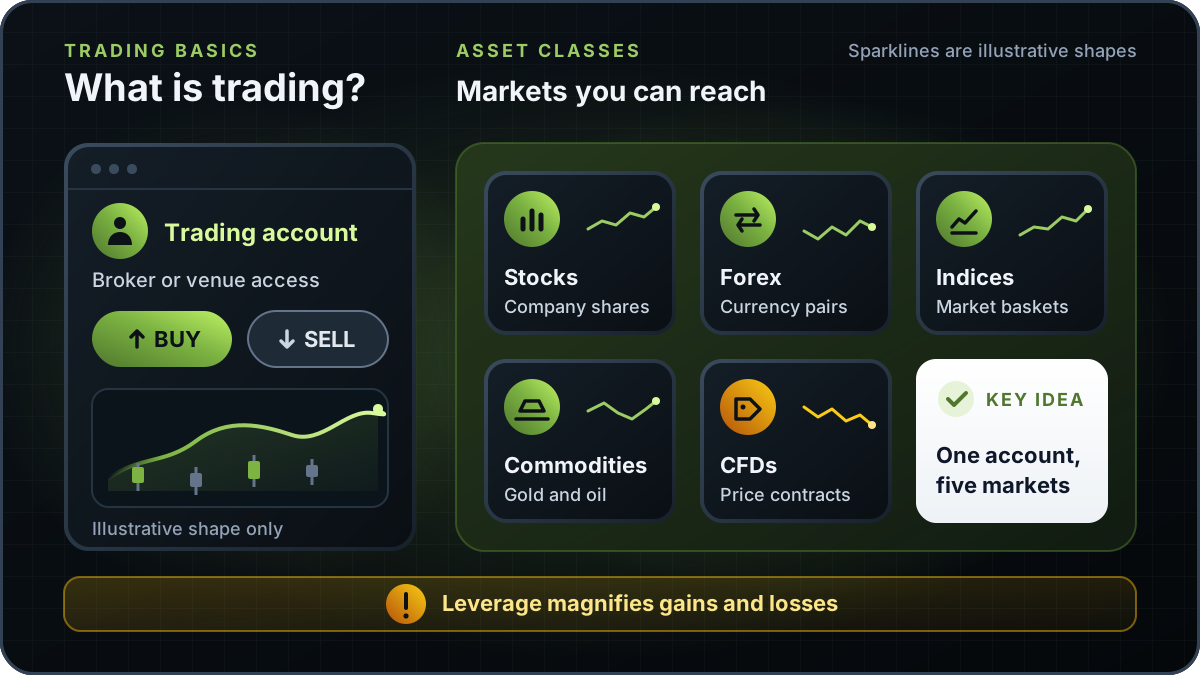
What is trading? Trading is buying and selling financial instruments, such as shares, currency pairs, stock indices, commodities and CFDs, to profit from price changes. Traders usually hold positions for minutes, days or weeks rather than years, and every trade can lose money as well as make it.
In brief
The main markets, the terms you will meet, how a trade is placed, and the risks that come with leverage.
Traders use the same basic idea in every market. They take a position because they expect the price to move, then close it. The differences lie in what is traded, how it is priced, and what it costs to hold a position.
Stocks are ownership shares in a company, as FINRA explains on its stocks page. Forex means exchanging one currency for another, and it is covered in forex trading explained.
| Market | What you trade | What to know first |
|---|---|---|
| Stocks | Shares, which are ownership stakes in a single company | Prices react to company news and to the wider market. A share can lose most or all of its value. |
| Forex | Currency pairs, such as EUR/USD, where one currency is bought against another | Pairs are quoted in pips and are often traded with leverage. See what a pip is. |
| Indices | Baskets of shares that track a stock market index | Often traded through derivatives such as CFDs or futures, depending on your broker and country. |
| Commodities | Raw materials such as gold, oil or wheat | Prices can move sharply on supply, demand and news events. |
| CFDs | Contracts that pay the difference in an asset's price. You do not own the asset itself. | Rules for retail clients vary by country. Read the risk section below before opening one. |
| Trading vs investing | Trading follows short-term price moves. Investing usually means holding over a longer horizon. | Both can lose money. The difference is mainly the time horizon and how often you act. |
This table is an overview, not a recommendation. Product names and rules differ by broker and jurisdiction.
Learning one market at a time keeps the number of new terms and new risks manageable.
The glossary below covers the terms you will meet most often. Where a term has its own page, the table links to it.
| Term | Plain definition | Read more |
|---|---|---|
| Pip | The standard small price step used to quote most currency pairs. | What is a pip |
| Pip value | The money value of one pip for a given position size, in your account currency. | Forex pip calculator |
| Forex trading | Buying one currency and selling another to profit from a change in their exchange rate. | Forex trading explained |
| Scalping | A style of trading that opens and closes many small positions within minutes or less. | What is scalping |
| Day trading | Opening and closing positions within the same trading day, so that none is held overnight. | Day trading explained |
| Stock screener | A tool that filters stocks by criteria such as price, volume or sector. | What is a stock screener |
| Trading terminal | The software you use to view prices, place orders and manage open positions. | What is a trading terminal |
| Position size | How much of an instrument you buy or sell in one trade, set against the loss you accept. | Position size calculator |
| Bid | The highest price a buyer is currently willing to pay for an asset. | Bid and ask price |
| Ask | The lowest price a seller is currently willing to accept. It is also called the offer. | Bid and ask price |
| Spread | The gap between the bid and the ask, which is part of the cost of opening a position. | Spread in trading |
| Leverage | Borrowed exposure that lets you control a larger position than your cash deposit, which magnifies gains and losses. | Leverage in trading |
| Margin | The deposit you must keep with your broker to open and hold a leveraged position. | Margin in trading |
| Stop-loss order | An instruction to close a position if the price reaches a set level. In fast markets it can fill at a worse price. | What is a stop-loss order |
| Limit order | An instruction to buy or sell only at a set price or better. It may never fill. | What is a limit order |
| CFD | A contract for difference: an agreement to exchange the change in an asset's price, without owning the asset. | What is a CFD |
| Take-profit order | An order that closes a position once the price reaches a set target, locking in the gain if it fills. | Take profit order: definition and examples |
| Risk-reward ratio | The planned gain to a target divided by the planned loss to the stop. It says nothing about the chance of either. | Risk reward ratio: formula and worked example |
| Candlestick | A chart bar that shows the open, high, low and close for one period. | Candlestick patterns explained |
| Bullish chart pattern | A multi-bar price formation that chartists read as a possible rise. It is a description, not a forecast. | Bullish chart patterns |
| Support and resistance | Price areas where buying or selling has repeatedly slowed a move. They describe the past, not a promise. | Support and resistance |
| Trendline | A straight line drawn through swing lows or swing highs to describe the direction of a trend. | How to draw trendlines |
| Fibonacci retracement | Horizontal levels drawn at set percentages of a prior move. They are drawing conventions, not laws. | Fibonacci retracement |
| Price action | Reading a chart from price itself: candles, swing points, levels and trend structure. | Price action trading |
| Elliott wave | A theory that describes trends as five-wave moves and corrections as three-wave moves. Wave counts are subjective. | Elliott wave theory explained |
| MACD | An indicator built from the gap between two moving averages of price. It lags price by design. | MACD meaning |
| Volume | The number of shares or contracts traded in a period. | Volume in trading |
| Level 2 | A view of the order book showing several bid and ask prices with their sizes, not just the best quote. | Level 2 trading explained |
| Stock index | A number that tracks the combined price of a defined group of shares, using set weighting rules. | What is a stock index |
| Stock futures | Futures contracts on a stock index, settled on a future date and traded with margin. | Stock futures explained |
| Commodities | Raw materials such as energy, metals and farm products that trade as standardised contracts. | What are commodities |
| After-hours trading | Trading in the sessions before and after a market's regular hours, usually with thinner liquidity. | After hours trading |
| Economic calendar | A schedule of upcoming data releases and policy decisions that can move markets. | Economic calendar |
| Forex broker | A firm that gives you access to the currency market and executes your trades. | What is a forex broker |
| Paper trading | Practice trading with simulated money, which cannot reproduce real fills or real pressure. | Paper trading explained |
| Pattern day trader rule | A former US margin rule for frequent day traders, replaced by FINRA in 2026. | Pattern day trader rule |
| High-frequency trading | Automated trading by professional firms that relies on speed and very high order rates. | High-frequency trading (HFT) |
| Trade blotter | A running record of trades as they are executed, kept by brokers and trading desks. | Trade blotter vs trade book |
These guides cover market hours, benchmarks and published research rather than single terms.
Each guide below explains how one indicator or chart tool is calculated, with a worked example and its limits. Indicators describe past prices; none of them forecasts a move.
| Guide | What it covers |
|---|---|
| Pivot points | Classic pivot levels from the prior high, low and close, with the main variants. |
| ADX indicator | Trend strength from 0 to 100, built from the +DI and -DI lines. |
| Average true range (ATR) | True range, 14-period smoothing and an ATR stop-distance example. |
| Parabolic SAR | Trailing dots, the acceleration factor and whipsaws in ranges. |
| Supertrend indicator | ATR bands around a source price, and how the line flips. |
| Exponential moving average (EMA) | The 2/(N+1) multiplier, EMA against SMA, and crossovers. |
| Ichimoku Cloud | The five lines, their default periods and how the cloud is drawn. |
| Donchian and Keltner channels | Three band types, including envelopes, and how each sets its width. |
| Linear regression channel | A least-squares line with standard-deviation bands. |
| Stochastic oscillator | %K and %D, the fast, slow and full forms, and Stochastic RSI. |
| Williams %R | Where the close sits in the recent range, on a 0 to -100 scale. |
| Ultimate Oscillator | Buying pressure over three windows, weighted 4, 2 and 1. |
| Awesome Oscillator and Gator | The 5- and 34-period median-price averages, and the Gator histograms. |
| TRIX indicator | The one-period percent change of a triple-smoothed EMA. |
| Know Sure Thing (KST) | Four smoothed rate-of-change lines, weighted and summed. |
| Coppock Curve | A long-term momentum line built for stock index turns. |
| Detrended price oscillator (DPO) | A past close against a displaced average, for reading cycles. |
| Aroon indicator | Bars since the recent high and low, scaled from 0 to 100. |
| Chaikin money flow (CMF) | Volume weighted by where each bar closes in its range. |
| Volume profile vs Market Profile | Volume at each price compared with time at each price. |
| Heikin-Ashi candles | Averaged candles: the four formulas and what they hide. |
| Fractals indicator | The five-bar swing rule and its two-bar confirmation lag. |
| ZigZag indicator | Swings filtered by a reversal threshold, and why the last leg repaints. |
| RSI and MACD cross alerts | A checklist for indicator cross alerts in any trading app. |
Most of the work in a trade happens before the order is sent. The steps below apply to most markets, although the details differ by product.
Pick what you want to trade, then confirm that your broker offers it in your region and under a regulator you can check.
Decide the price at which you would take profit and the price at which you would accept a loss and close the trade.
Work out how many units to trade so that a stop-loss hit costs an amount you can accept. Use the position size calculator, and for currency pairs the forex pip calculator.
A market order fills now at the prevailing price, which can differ from the price you saw. A limit order fills only at your price or better. Check the spread and the margin shown before you confirm.
Watch the position and close it when your plan says so. Record the result, the costs and what you would change, so that you can review the decision later.
A trade with a clear size and a clear exit is easier to review than one opened on impulse.
A trading platform is the software that connects you to a market. It shows prices, sends orders to a broker or exchange, and records your open positions and history. Many platforms also offer charts and alerts.
RTX5's own trading platform is covered on the trading platform page and the day trading platform page. Check product availability for what is live today.
Platform choice does not change how a trade works. Read the trading terminal guide for what to check before you choose one.
Leverage lets a small deposit control a larger position, and it works in both directions. A move against you can cost more than the margin you posted. The CFTC's customer advisory on retail forex says so directly, and the risk section at the end of this guide repeats the point.
Costs add up. The spread, any commission, and any overnight financing charge can reduce a result even when the price moves your way. Ask your broker for its full cost schedule before you trade.
Leverage limits are set by regulators and differ by product and country. In the EU, ESMA introduced maximum leverage caps for retail CFD clients in 2018 as temporary EU-wide measures, renewable in three-month periods. The caps below are the ones ESMA published in its 27 March 2018 press release. Check ESMA's website and your national regulator for the rules that apply today.
In the US, FINRA replaced the pattern day trader rule and its US$25,000 minimum with intraday margin standards effective 4 June 2026. Firms that need more time can phase the change in until 20 October 2027. FINRA's frequent intraday trading page says a firm may require higher minimum equity, often called house requirements.
| Asset class | Maximum leverage when opening a position |
|---|---|
| Major currency pairs | 30:1 |
| Non-major currency pairs, gold and major indices | 20:1 |
| Commodities other than gold, and non-major equity indices | 10:1 |
| Individual equities | 5:1 |
| Cryptocurrencies | 2:1 |
Source: ESMA press release, 27 March 2018. These were temporary measures. Check current ESMA and national rules before you trade.
Before you open a live position, learn how position size and stop-loss orders fit together. Start with risk management, then work through the position size calculator using the figures from your own account.
RTX5 is Orrnn's trading terminal and broker-technology product. Its Windows desktop client is in preview, and the web and mobile clients are planned. A Google Play listing for Android is published, but the mobile client has no approved release record yet. Check the product-availability record and release notes before relying on any RTX5 feature.
Check RTX5 product availabilityTrust and methodology
We want you to be able to identify who owns the page, inspect the evidence, understand how tools were used, and challenge anything that looks wrong or out of date.
Published under the RTX5 Editorial Team byline. It identifies the responsible publishing organization; it does not imply that a named lawyer, regulator, financial adviser, or licensed expert approved this page.
6 primary references are listed on this page with context about what each one supports. The source set was checked on .
Automation and AI may help organize research, outline a page, or edit language. They are not treated as sources, are not presented as human experts, and do not remove the publisher's responsibility for the final page.
If a statement is incomplete, unsupported, or outdated, send the exact URL, sentence, and supporting evidence through our contact route. Read the full editorial and corrections policy.
Sources were checked on 10 November 2026. They explain market rules and concepts; they do not certify RTX5 or provide individual financial advice.
No, although the two overlap. Investing usually means buying and holding for a longer period, often years. Trading usually means acting on shorter-term price moves, such as days or weeks. FINRA describes the difference in terms of time horizon. Both approaches can lose money, and neither offers any assurance of success.
Yes, in some products. The CFTC's customer advisory on retail forex warns that you could lose all of your margin and more, and may be liable for losses beyond your initial deposit. In the EU, ESMA introduced negative balance protection for retail CFD accounts in 2018 as a temporary measure, which limits losses to the funds in the account. Check whether your broker applies it today. Whether losses can exceed deposits depends on the product, the broker and the country, so check the terms before you open a position.
A stock gives you ownership of a share in a company. A CFD is a contract that pays the difference in an asset's price, so you do not own the asset. CFDs usually involve leverage and margin, which increases risk. Their availability and rules differ by country, and some regulators limit how they can be sold to retail clients.
There is no single answer. Minimum deposits and margin requirements depend on the broker, the product and the country. A more useful question is how much you can lose without harming your finances, and how large a position that limit allows. The position size calculator shows how a stop-loss relates to the amount at risk.
Start with the vocabulary: pip, spread, leverage, margin and stop-loss order. Then learn position sizing and how your broker charges. Read the risk disclosure for each product before you trade it, and keep a written record of every trade so that you can review it honestly.
No. RTX5 is Orrnn's trading terminal and broker-technology product, and it is licensed to brokers. It is not a broker and does not hold client money. Its Windows desktop client is in preview, and the web and mobile clients are planned. A Google Play listing for Android is published, but the mobile client has no approved release record yet. See product availability before relying on any feature.