Accountable publisher
Published under the RTX5 Editorial Team byline. It identifies the responsible publishing organization; it does not imply that a named lawyer, regulator, financial adviser, or licensed expert approved this page.
Market calendars
An economic calendar is a schedule of planned economic data releases and central bank decisions, each with a time, a prior value, a consensus forecast and an impact level. Impact levels rate how much an event may move markets. Traders in stocks, indices, bonds, commodities and gold use the calendar to plan around releases.
In brief
An economic calendar is a timetable, not a signal. Here is what each row means, which releases matter across stocks, indices, bonds, commodities and gold, and how to convert the times.
An economic calendar is a list of planned releases, sorted by date and time. Each entry names the event and the time it is due, and many calendars add the publisher, the previous value, a forecast and an impact level. Read together, these show which events matter most for a given day or week.
Impact levels are the calendar provider's rating of how much an event is expected to matter to markets, commonly shown as low, medium or high. The rating is a convention, not a measured outcome. A high rating does not mean a market will move, and a low rating does not mean it will stay quiet. Providers define their ratings differently, so read the legend on your calendar before you rely on it.
Most calendars cover the same core group of official releases. The table lists common types, what each one measures, who publishes it, and the asset classes that are often discussed alongside it.
| Release | What it measures | Published by | Markets often discussed |
|---|---|---|---|
| Central bank rate decisions | The policy rate and the central bank's statement on the economy, released after its monetary policy meeting | Federal Reserve (FOMC); European Central Bank | Bonds, stock indices, gold |
| Consumer Price Index (CPI) inflation | The average change over time in prices paid by urban consumers for a market basket of goods and services | US Bureau of Labor Statistics (BLS) | Bonds, stock indices, gold |
| Employment report | Monthly US employment data, published as the Employment Situation | US Bureau of Labor Statistics (BLS) | Bonds, stock indices |
| Gross domestic product (GDP) | The value of the final goods and services produced in the United States | US Bureau of Economic Analysis (BEA) | Stock indices, bonds |
| Crude oil inventories | Weekly US petroleum data, including stocks of crude oil | US Energy Information Administration (EIA) | Crude oil, energy stocks |
Verified on 9 November 2026 against the publisher pages in the references. Market lists describe commonly discussed links, not predictions.
The table describes what each release measures and who publishes it. A release can move one market strongly and leave another flat. The direction usually depends on the figure compared with expectations, not on the headline alone.
Corporate earnings are a different kind of event. Companies publish their own results and guidance, so there is no single statistics agency. Use each company's investor-relations calendar for its dates.
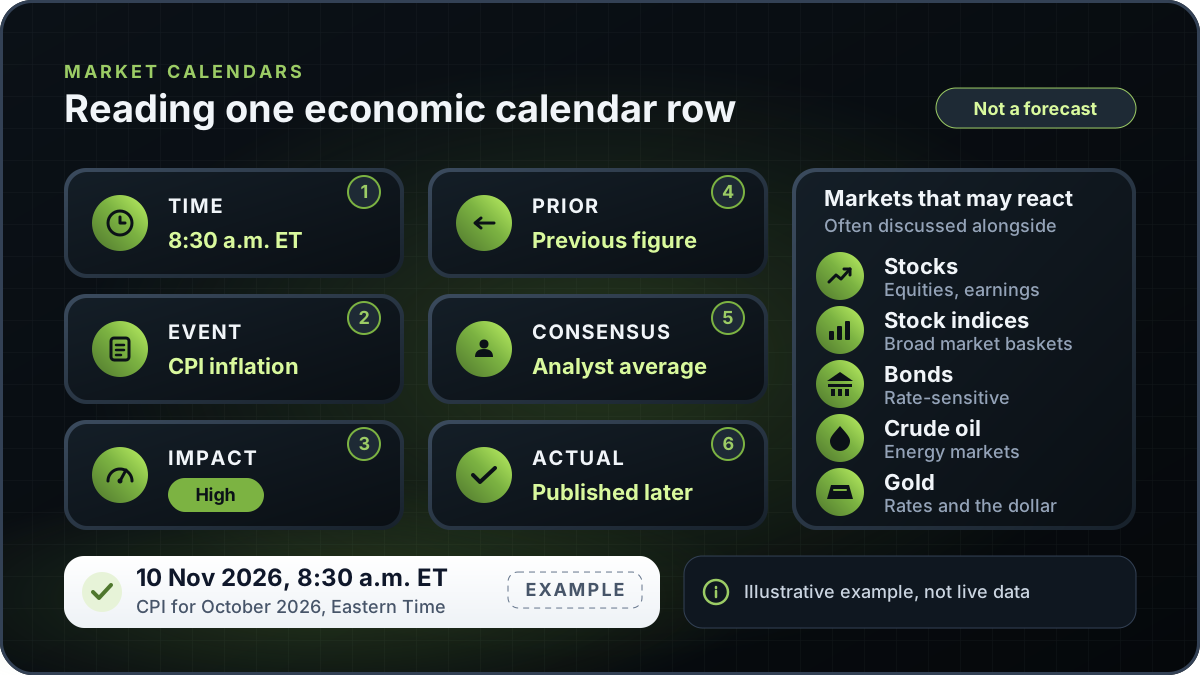
Each row of a calendar carries the same fields. Learn what each one means before you use the rating or the forecast.
The gap between the actual figure and the consensus is the surprise. A common way to read a release is to compare the surprise with the level of the number, since prices may already reflect the consensus. Reading a row means comparing these fields together, not treating any single one as a signal.
A calendar that is read in the wrong zone can send you to your screen an hour late, or a day early. The safer method is to convert each time from the zone the calendar states, rather than from the clock on your wall.
Example: the BLS lists the Consumer Price Index for October 2026 for 10 November 2026 at 8:30 a.m. Eastern Time. The same moment is a different clock time in London, Tokyo and Sydney, so convert the zone rather than the clock.
The calendar is useful across asset classes, but the links are not uniform. A rate decision can affect bond prices and stock indices at the same time. Inflation data can change expectations for interest rates, which some traders also watch when they trade gold. Commodity traders often watch the weekly crude oil report because it shows changes in US crude stocks.
Gold is a useful example of why a calendar is not a rule. Some gold traders watch inflation and central bank releases, but the link to rates and to the dollar changes over time, so treat any release as one input among many. For the hours when gold trades, see gold market hours.
Calendar dates also interact with closures. A release can fall on a day when an exchange is shut or trades a shortened session. Check stock market holidays before you plan around a date, and read after-hours trading to see how news outside regular hours can be priced.
A calendar tells you when information arrives. It does not explain what the information means. For that, read fundamental analysis, and use financial news for context on what a release says.
RTX5 is Orrnn's trading terminal and broker-technology product. Its Windows desktop client is in preview, and the web and mobile clients are planned. A Google Play listing for Android is published, but the mobile client has no approved release record yet; check the product-availability record before relying on any RTX5 feature. RTX5 does not provide an economic calendar feed, so the dates and times on this page come from the publishers listed in the references, not from RTX5. RTX5 is not a broker and does not hold client money.
Check RTX5 product availabilityTrust and methodology
We want you to be able to identify who owns the page, inspect the evidence, understand how tools were used, and challenge anything that looks wrong or out of date.
Published under the RTX5 Editorial Team byline. It identifies the responsible publishing organization; it does not imply that a named lawyer, regulator, financial adviser, or licensed expert approved this page.
6 primary references are listed on this page with context about what each one supports. The source set was checked on .
Automation and AI may help organize research, outline a page, or edit language. They are not treated as sources, are not presented as human experts, and do not remove the publisher's responsibility for the final page.
If a statement is incomplete, unsupported, or outdated, send the exact URL, sentence, and supporting evidence through our contact route. Read the full editorial and corrections policy.
Sources were checked on 9 November 2026. They explain market rules and concepts; they do not certify RTX5 or provide individual financial advice.
Impact is the calendar provider's rating of how much an event is expected to matter to markets, usually shown as low, medium or high. It describes expected interest, not a measured result or a direction. Providers set their own rules for ratings, so read the legend on your calendar before you rely on it. A high rating does not mean a large move will follow, and a low rating does not mean the market will stay quiet.
The calendar lists the scheduled time and leaves the actual figure blank until the publisher releases it. Whether a calendar updates the actual value in real time depends on the provider. RTX5 does not supply an economic calendar feed, so check the publisher's own release page for the published figure. Release times can change, so confirm the date before you act on it.
The consensus is usually an average of analyst forecasts that a data provider collects before a release. Different providers collect different sets of estimates, so the consensus on two calendars can differ. It is a benchmark for comparison. A figure that matches the consensus can still move a market, because traders also weigh the prior figure and the wider context.
No. Central bank decisions, inflation and employment data, GDP and weekly oil stock reports can affect stock indices, bonds, commodities and gold as well as currencies. Traders in each market read the same calendar for different reasons. The calendar is a planning tool across markets, not a forecast for any one of them.
No. Many releases move some markets only a little, and some barely move them at all. The reaction depends on the surprise, the expectations already in prices, the time of day and how liquid the market is. A scheduled release is a time to be prepared, not a reliable opportunity. Look at how your own market has reacted to similar releases before you assume a reaction.