Accountable publisher
Published under the RTX5 Editorial Team byline. It identifies the responsible publishing organization; it does not imply that a named lawyer, regulator, financial adviser, or licensed expert approved this page.
Market hours
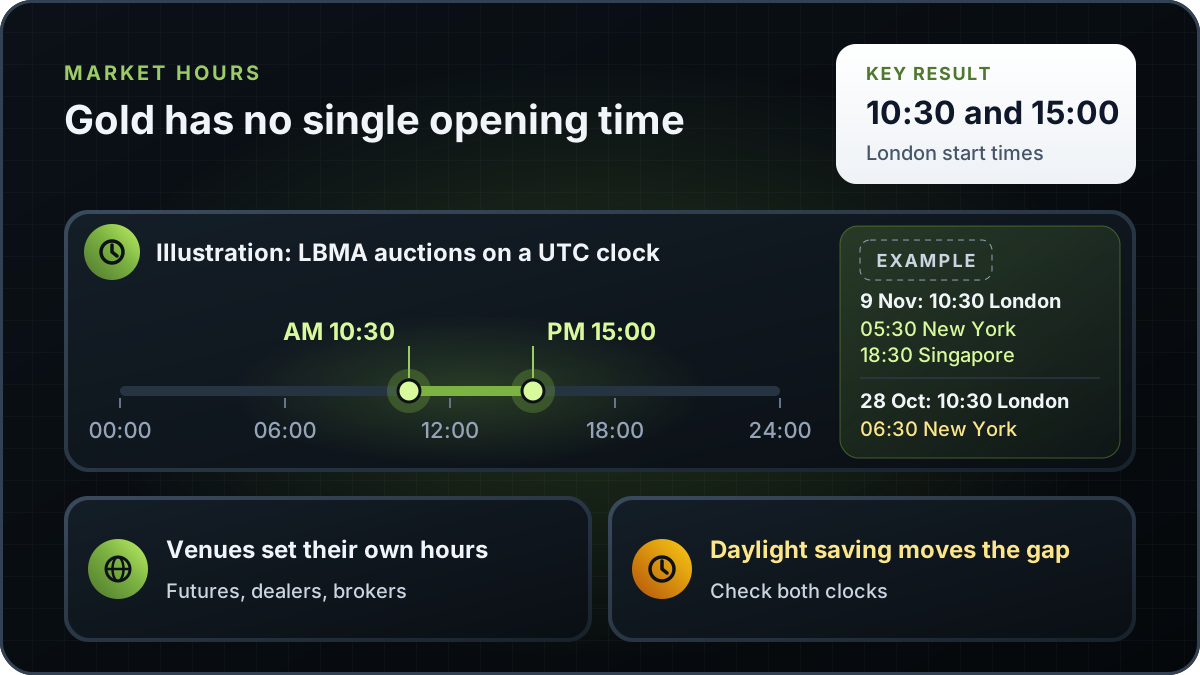
Gold market hours depend on the venue: there is no single gold market open time. The LBMA Gold Price is set in auctions that start at 10:30 and 15:00 London time. Spot gold trades over the counter, and futures exchanges, spot dealers and brokers each set their own session hours, so check the venue's contract specification.
In brief
Gold trades in several places on several timetables. Here is the official benchmark timing, how it converts across time zones, and what to check before you trade.
Gold is traded in more than one place, and each has its own timetable. The LBMA describes the London precious metals market as over-the-counter (OTC). Gold futures are listed on exchanges, and each exchange sets the hours in its contract specification. Spot dealers and brokers set the session hours for the gold they quote. Benchmark prices are set in auctions that have published expected start times.
A question about the gold market open time therefore has no single answer. The useful question is which market you trade, and which hours apply to the instrument your broker gives you. For the wider background on the asset class, read what are commodities. For the general trading basics, start with what is trading.
According to the LBMA, the LBMA Gold Price is the global benchmark price for unallocated gold delivered in London, and it is administered by ICE Benchmark Administration (IBA). The LBMA states that the price is set twice a day in auctions, commencing at 10:30 and 15:00 London time. IBA says it operates electronic auctions for spot, unallocated loco London gold, and its timetable lists 10:30 and 15:00 London time as the expected auction start times for gold. IBA also says that, because the benchmarks are derived from the price of the final round of the auctions, they do not have set publication times.
Because the benchmark has published expected auction start times in London, it is one of the few gold timings that can be checked against an official source. It is a reference price, not a live quote you can trade on, and it does not show what your broker will charge you at the same moment. The table converts the two auction times to UTC, New York and Singapore for each clock period in 2026.
| Period and clocks | London (AM and PM) | UTC | New York | Singapore |
|---|---|---|---|---|
| 1 January to 7 March 2026 (London GMT, New York standard time) | 10:30 and 15:00 | 10:30 and 15:00 | 05:30 and 10:00 | 18:30 and 23:00 |
| 8 to 28 March 2026 (London GMT, New York daylight saving time) | 10:30 and 15:00 | 10:30 and 15:00 | 06:30 and 11:00 | 18:30 and 23:00 |
| 29 March to 24 October 2026 (London BST, New York daylight saving time) | 10:30 and 15:00 | 09:30 and 14:00 | 05:30 and 10:00 | 17:30 and 22:00 |
| 25 to 31 October 2026 (London GMT, New York daylight saving time) | 10:30 and 15:00 | 10:30 and 15:00 | 06:30 and 11:00 | 18:30 and 23:00 |
| 1 November to 31 December 2026 (London GMT, New York standard time) | 10:30 and 15:00 | 10:30 and 15:00 | 05:30 and 10:00 | 18:30 and 23:00 |
Verified on 9 November 2026. Auction times are from the LBMA and ICE Benchmark Administration. Offsets used: BST is UTC+1 and GMT is UTC+0; New York is UTC-5 on standard time and UTC-4 on daylight saving time; Singapore is UTC+8. Clock dates are from GOV.UK (UK) and NIST (US). The times shown are expected auction start times, not publication times, and they are converted arithmetically; they are not trading hours.
Time zone gaps change with daylight saving. London and New York are normally five hours apart. For the weeks when only one country has moved its clocks, the gap is four hours. NIST gives the 2026 US daylight saving period as 8 March to 1 November, and GOV.UK gives the 2026 UK changes as 29 March and 25 October, with British Summer Time (BST) one hour ahead of Greenwich Mean Time (GMT).
New York is in the eastern standard time zone, which US federal regulations call the second zone. US law sets the standard time of that zone at Coordinated Universal Time retarded by 5 hours, so New York is UTC-5 on standard time and UTC-4 during daylight saving time.
Example: on 28 October 2026 the US was still on daylight saving time, while London had already returned to GMT. A London time of 10:30 that day is 06:30 in New York. On 9 November 2026 the same London time is 05:30 in New York, because both places are now on standard time. The same clock time gives a different New York time, so check the date as well as the hour.
Singapore is simpler. A*STAR's National Metrology Centre, the timekeeper of Singapore Standard Time, states that the time is generated by advancing UTC(SG) by 8 hours. With London on BST, the auctions fall at 17:30 and 22:00 in Singapore. With London on GMT, they fall at 18:30 and 23:00, so the Singapore time moves only when London changes its clocks.
A trader who uses a platform clock should confirm whether that clock follows daylight saving and which time zone it shows. A clock set to a fixed offset will be an hour out for part of the year in some cases. Converting from UTC, which does not change, avoids most of this confusion.
Gold futures hours are set by the exchange that lists the contract, in its own contract specifications and calendar. Check those for the contract you trade, including any weekly open, daily break and holiday closure, before you rely on a futures session. This page does not list futures session times, so use the exchange's official specification.
Spot dealers and brokers set their own session hours for gold instruments, including spot metal and CFDs, and the opening time each week depends on that venue. The broker may also run its own maintenance break, close early on some holidays and trigger stop orders on its own price. The gold contract a broker quotes is not always the same as the futures contract on an exchange, so read the instrument details the broker gives you.
Holiday closures add another layer. The stock market holidays guide explains how exchange closures work for equities, and the principle is the same for other markets. Scheduled economic releases can also change the trading environment, so check the economic calendar for the times of the releases you follow.
The LBMA auction start times are a published reference. They are not the same as your broker's live price, and they do not tell you when your order will fill. Treat them as one input when you plan a session.
RTX5 is Orrnn's trading terminal and broker-technology product. Its Windows desktop client is in preview, and the web and mobile clients are planned. A Google Play listing for Android is published, but the mobile client has no approved release record yet; check the product-availability record before relying on any RTX5 feature. This page does not describe an RTX5 feature for market hours, exchange holidays or an economic calendar, so do not assume the product shows them.
Check RTX5 product availabilityTrust and methodology
We want you to be able to identify who owns the page, inspect the evidence, understand how tools were used, and challenge anything that looks wrong or out of date.
Published under the RTX5 Editorial Team byline. It identifies the responsible publishing organization; it does not imply that a named lawyer, regulator, financial adviser, or licensed expert approved this page.
6 primary references are listed on this page with context about what each one supports. The source set was checked on .
Automation and AI may help organize research, outline a page, or edit language. They are not treated as sources, are not presented as human experts, and do not remove the publisher's responsibility for the final page.
If a statement is incomplete, unsupported, or outdated, send the exact URL, sentence, and supporting evidence through our contact route. Read the full editorial and corrections policy.
Sources were checked on 9 November 2026. They explain market rules and concepts; they do not certify RTX5 or provide individual financial advice.
No single time applies. Spot gold is traded over the counter, futures follow the calendar of the exchange that lists them, and the LBMA benchmark auctions start at 10:30 and 15:00 London time. Spot dealers and brokers set their own session hours, so the weekly opening time depends on the venue. Check its contract specification.
According to the LBMA, the LBMA Gold Price is set twice a day in auctions, commencing at 10:30 and 15:00 London time. ICE Benchmark Administration administers the benchmark and runs the electronic auctions. The benchmark is a reference price, so it does not promise the price your broker will fill.
From 29 March to 24 October 2026, with London on BST, the auctions were at 17:30 and 22:00 in Singapore and 05:30 and 10:00 in New York. From 25 October 2026, with London on GMT, they are at 18:30 and 23:00 in Singapore. New York was at 06:30 and 11:00 from 25 to 31 October, while the US was still on daylight saving time, and is at 05:30 and 10:00 from 1 November.
Not necessarily. Futures hours are set by the exchange that lists the contract, while CFD and broker spot hours may be set by the broker. Read the contract specification or the broker's instrument details, and check its daily break and holiday schedule before you trade.
This page does not describe an RTX5 feature for market hours, exchange holidays or an economic calendar, so do not assume the product shows them. RTX5's Windows desktop client is in preview, and the web and mobile clients are planned. A Google Play listing for Android is published, but the mobile client has no approved release record yet. Check the product availability record before relying on any feature.
No. The auction time is a reference time for a benchmark. It is not a time when your broker will fill an order at a fixed price. Your execution depends on your broker's live prices, the liquidity available, and the order type you choose. This is educational information, not personal financial advice.