Accountable publisher
Published under the RTX5 Editorial Team byline. It identifies the responsible publishing organization; it does not imply that a named lawyer, regulator, financial adviser, or licensed expert approved this page.
Trading glossary
A stop loss order, also called a stop-loss order, is an order to buy or sell a stock, currency pair or other instrument once its price reaches a stop price. When that price is reached, the order becomes a market order. A stop loss can limit a loss, but it does not guarantee the exit price.
In brief
A stop loss is a trigger, not a price guarantee. Here is how it works for long and short positions, where the fill can land away from the stop, and how it links to position size.
A stop loss order is an order to buy or sell a stock once its price reaches a specified level, known as the stop price. When that price is reached, the stop order becomes a market order. The SEC's investor education site describes stop orders in this way for stocks. For the wider background, read what is trading.
The stop loss is an instruction about timing, not a promise about price. It tells the broker when to act. It does not tell the broker which price to accept. The order can help control a loss, but only as far as the market allows once the trigger is reached. Stop orders on forex and CFD accounts follow the rules of the broker, so check them before you rely on one.
In both cases the stop closes the position: a long is closed by a sell and a short by a buy. Confirm the side and the stop price on the order ticket before you submit it.
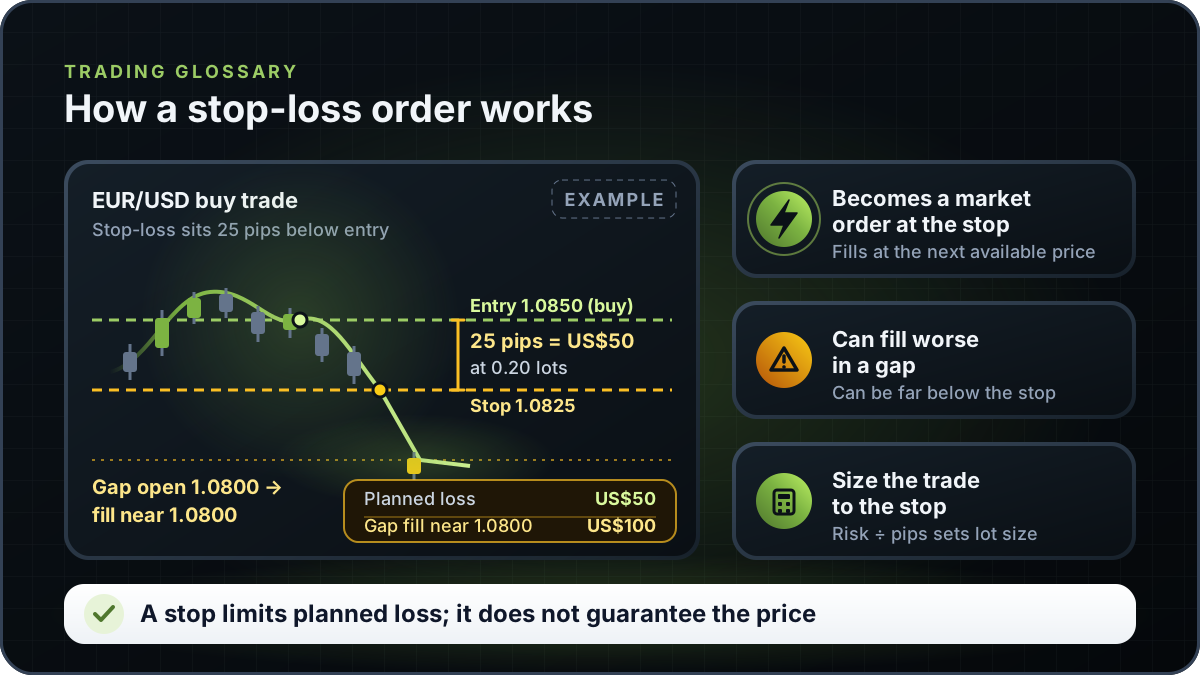
This is an illustrative example, not a recommendation. You buy EUR/USD at 1.0850 and place a sell stop loss at 1.0825. That is 25 pips below your entry. A pip is 0.0001 for EUR/USD, so the distance is 0.0025. The pip guide explains how pips are counted.
Assume a US$ account and a position of 0.20 lots. One standard lot of EUR/USD is worth US$10 per pip, so 0.20 lots is worth US$2 per pip. A 25 pip move to the stop costs 25 x US$2 = US$50. That is the planned loss before spreads, commissions and any slippage. If your account is US$5,000 and you accept 1% risk, which is US$50, the same numbers give a position of 0.20 lots.
A gap is a jump from one price to another with no trades in between. It can happen when a market reopens or after news. Use the same trade as above and suppose the market reopens at 1.0800, below the 1.0825 stop. The stop order becomes a market order at that point, and it can fill near 1.0800.
At 1.0800 the move from the 1.0850 entry is 50 pips. At US$2 per pip that is US$100, double the US$50 planned loss. This gap example is illustrative only. The SEC investor bulletin says the execution price can deviate significantly from the stop price because of the prices of the liquidity available when the market order executes.
A stop loss is not the only stop-type order. The SEC investor bulletin covers three. A stop-limit order adds a limit price to the stop price, and a trailing stop order moves its stop as the price moves in your favour. The table sets out what each order does according to that bulletin.
| Order | What triggers it | What happens once triggered | Main trade-off |
|---|---|---|---|
| Stop loss (stop order) | The market reaches the stop price | Becomes a market order and fills at the prevailing price | The fill can differ significantly from the stop price |
| Stop-limit order | The market reaches the stop price | Becomes a limit order that fills only at the limit price or better | May not fill at all if the price moves away from the limit |
| Trailing stop order | The price reaches a stop set a defined percentage or dollar amount from the market price | The stop price adjusts as the price moves in a favourable direction, then acts as a stop or stop-limit order | Not offered by every broker; the platform and broker set availability |
Source: SEC investor bulletin 'Stop, Stop-Limit, and Trailing Stop Orders'. The bulletin notes these orders may not be available through all brokerage firms.
For the limit side of the comparison, see what is a limit order. The order that closes a trade at your target is a take-profit order, and the risk-reward ratio compares the distance to each.
The position of a stop loss is a judgement about your trade idea and the loss you can accept. Two common approaches are a technical level, such as a price where your analysis says the trade idea is no longer valid, and a fixed amount, such as the most you will lose in your account currency. This guide does not recommend either approach.
The SEC bulletin warns that a stop order may be triggered by a short-term, intraday price move that fills substantially worse than the day's closing price. Short-term traders, such as those described in day trading explained, see these moves more often. Before choosing a level, check which price your broker uses to trigger the stop.
Stop distance and position size work together. Once you know the amount you accept to lose and the distance from entry to stop, the position size follows. The arithmetic is: position size in lots equals the amount at risk, divided by the stop distance in pips multiplied by the pip value per lot.
Using the same US$5,000 account and 1% risk of US$50, a 25 pip stop with a pip value of US$10 per standard lot gives 50 / (25 x 10) = 0.20 lots. A 50 pip stop with the same risk gives 50 / (50 x 10) = 0.10 lots. The wider stop needs the smaller position. These are illustrative figures, not a suggested trade.
Use the position size calculator to run the same arithmetic for your own account currency and pair. The position sizing in forex article explains the method in more detail.
A stop loss can be held in different places. Some stops are recorded with the broker's trading system, so the broker monitors and triggers them. Others are held by trading software on your own device, so they depend on that software running and staying connected when the price moves. Terminology and behaviour differ between brokers, so ask yours how its stops are stored and triggered.
The difference matters when your device, connection or software is offline. Check with your broker where its stops are held and which price triggers them. RTX5 is not a broker and does not hold client money.
RTX5 is Orrnn's trading terminal and broker-technology product. Its Windows desktop client is in preview, and the web and mobile clients are planned. A Google Play listing for Android is published, but the mobile client has no approved release record yet; check the product-availability record and release notes before relying on any RTX5 feature. The stop-loss examples on this page are illustrative and do not come from an RTX5 feature.
Check RTX5 product availabilityTrust and methodology
We want you to be able to identify who owns the page, inspect the evidence, understand how tools were used, and challenge anything that looks wrong or out of date.
Published under the RTX5 Editorial Team byline. It identifies the responsible publishing organization; it does not imply that a named lawyer, regulator, financial adviser, or licensed expert approved this page.
4 primary references are listed on this page with context about what each one supports. The source set was checked on .
Automation and AI may help organize research, outline a page, or edit language. They are not treated as sources, are not presented as human experts, and do not remove the publisher's responsibility for the final page.
If a statement is incomplete, unsupported, or outdated, send the exact URL, sentence, and supporting evidence through our contact route. Read the full editorial and corrections policy.
Sources were checked on 9 November 2026. They explain market rules and concepts; they do not certify RTX5 or provide individual financial advice.
No. A stop loss sets a trigger, the stop price. When the trigger is reached, a stop order becomes a market order, and the execution price can differ from the stop price, especially in a fast market or after a gap. The SEC investor bulletin says the stop price is not the guaranteed execution price. A stop loss can still limit a loss, but it does not fix the exit price.
A stop loss becomes a market order once triggered, so it executes at the prevailing market price, which can differ from the stop price. A stop-limit order becomes a limit order at the limit price or better, so it controls the fill price but may not fill at all if the market moves away from the limit. The stop and limit prices do not have to be the same. Availability depends on your broker.
This guide does not recommend a level. Some traders place a stop at a technical level where their trade idea would no longer be valid. Others start from a fixed amount they are willing to lose and size the position to match. Either way, consider short-term price moves, check which price your broker uses to trigger the stop, and confirm the pip value before you size the trade.
No, not necessarily. The SEC investor bulletin says stop, stop-limit and trailing stop orders may not be available through all brokerage firms, and firms can have different policies. Ask your broker which order types it offers, whether trailing stops work on your platform, and whether it triggers stops on last-sale prices or on quotes.
It can be triggered when the market reopens beyond the stop, but it cannot promise a fill at the stop price. A market that reopens at a new level can fill far from the stop, so the planned loss can become a larger one. Check your broker's trading hours and how its stops behave when your platform is offline.