Accountable publisher
Published under the RTX5 Editorial Team byline. It identifies the responsible publishing organization; it does not imply that a named lawyer, regulator, financial adviser, or licensed expert approved this page.
Market data basics
Level 2 trading is the practice of reading market depth, the order book beyond the best bid and best ask. Level 2 data shows resting bid and offer prices, and the size at each price, across several levels on each side. It shows displayed orders only, so size that is not displayed does not appear.
In brief
Level 2 shows more than the best bid and ask. It shows the orders stacked on each side and how far a market order could move the price. It does not show everything.
In common usage, Level 1 is the top of the book: the best bid, the best ask and the last trade. These labels are general market conventions rather than terms an exchange rule defines. The bid and ask guide explains those two prices. Level 1 shows the spread but not how much is waiting behind it.
Level 2 is market depth. It lists bid and ask prices beyond the best quote, with the size at each price. Nasdaq says its TotalView feed "displays the full order book depth on Nasdaq, including every single quote and order at every price level in Nasdaq-, NYSE-, NYSE American- and regional-listed securities trading on Nasdaq." The same Nasdaq page compares TotalView with alternative products and names Level 2 as one of them, so "Level 2" is a label, not a fixed standard. The NYSE lists depth of book as one of its real-time feeds, next to top of book, trades and auction imbalances.
Names, the number of levels and the venues covered differ by vendor and exchange. Before you rely on a depth view, check which feed you are receiving and which venues it includes.
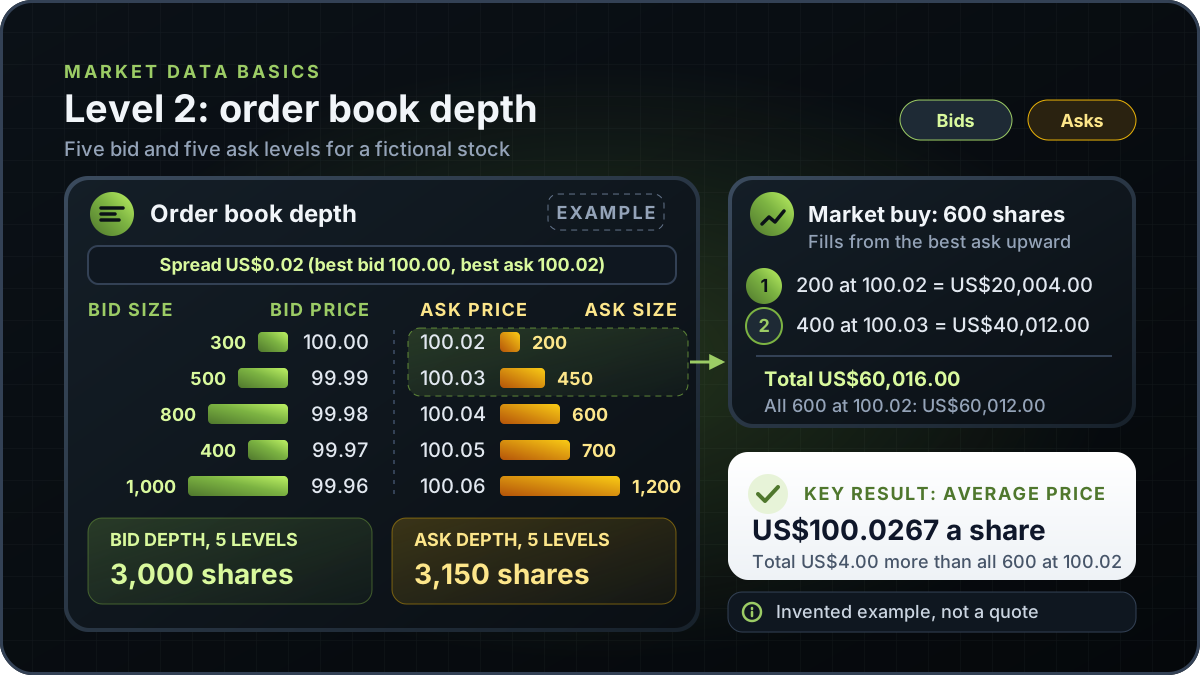
The table below is an Example, not a market quote. It shows five bid levels and five ask levels for a fictional stock. Bid sizes are shares waiting to buy at each price, and ask sizes are shares waiting to sell.
| Level | Bid size (shares) | Bid price (US$) | Ask price (US$) | Ask size (shares) |
|---|---|---|---|---|
| 1 (best) | 300 | 100.00 | 100.02 | 200 |
| 2 | 500 | 99.99 | 100.03 | 450 |
| 3 | 800 | 99.98 | 100.04 | 600 |
| 4 | 400 | 99.97 | 100.05 | 700 |
| 5 | 1,000 | 99.96 | 100.06 | 1,200 |
Illustrative only. The prices and sizes are invented and are not a quote for any security. Top five levels: 3,000 shares on the bid and 3,150 on the ask.
The best bid is 100.00 and the best ask is 100.02, so the spread is US$0.02 and the mid-point is 100.01. The totals describe the displayed book at one moment. They do not show which way the price will go.
A market buy is filled from the lowest ask upward. It takes the shares at the best ask first, then moves to the next ask price for the rest. For US stocks, FINRA's investor page on order types says a market order "generally will execute at or near the current bid or ask prices" during normal trading hours, and warns that "you might not get the price you saw or were originally quoted, especially in fast-moving markets."
Example: buy 600 shares at market. The best ask has 200 shares at 100.02, so the first 200 cost 200 x US$100.02 = US$20,004.00. The remaining 400 fill at the next level, 100.03, which costs 400 x US$100.03 = US$40,012.00. The total is US$60,016.00, an average of US$100.0267 per share. Buying all 600 at the best ask would cost 600 x US$100.02 = US$60,012.00, so the walk costs US$4.00 more in total, or about US$0.0067 a share.
Example: buy 1,000 shares at market. This order uses three levels: 200 at 100.02 (US$20,004.00), 450 at 100.03 (US$45,013.50) and 350 at 100.04 (US$35,014.00). The total is US$100,031.50, an average of US$100.0315 per share, or US$11.50 more in total than 1,000 shares at 100.02.
Example: sell 500 shares at market. The sale fills 300 at the best bid of 100.00 (US$30,000.00) and 200 at 99.99 (US$19,998.00). The total is US$49,998.00, an average of US$99.996 per share, which is US$2.00 less in total than selling all 500 at 100.00.
These figures are arithmetic on the example book only. Real books change between your order and its fill, and commissions, fees and taxes are excluded. A limit order sets the worst price you will accept instead. It can rest in the book without filling.
Depth is useful but partial. Exchanges such as the NYSE accept orders whose full size is not shown. A March 2024 Federal Register notice on NYSE Rule 7.31 describes Reserve Orders as limit orders with a displayed quantity and a reserve quantity "of the size that is not displayed", and it also refers to Non-Displayed Limit Orders. A depth view of displayed quotes cannot show that interest. Traders often call partly shown orders iceberg orders; that is a market nickname, not an order-type name in the rule.
Orders also change: a quote can be cancelled or reduced before it trades.
| Item | What it can tell you | What it does not tell you |
|---|---|---|
| Displayed bids and offers | Price and size of resting orders at several levels, on the feed you receive | Size that is not displayed, such as the reserve quantity of a reserve order or a non-displayed limit order |
| Other venues | Depth for the venues your feed includes | Depth on venues outside that feed, so compare prices with care |
| Order intent | The size visible at a price | Why an order is there, or whether it will stay in the book |
| Direction | How size is spread across the book right now | Whether price will rise or fall. Depth is a snapshot, not a forecast |
| Execution | The prices shown at the time of the data | The price you will get. A market order fills at the prices available when it executes |
| Spoofing | Visible size that may be placed to mislead | Whether a large bid or offer is genuine. The US Commodity Exchange Act makes spoofing unlawful on or subject to the rules of a registered entity |
Summarised from the Nasdaq TotalView description, the NYSE data product list, the Federal Register notice on NYSE Rule 7.31 and the CFTC's 2013 guidance on disruptive practices. Checked 9 November 2026.
The CFTC's 2013 interpretive guidance on disruptive practices explains that section 4c(a)(5) of the Commodity Exchange Act, added by the Dodd-Frank Act, makes it unlawful to engage in trading on or subject to the rules of a registered entity that is spoofing, which it describes as "bidding or offering with the intent to cancel the bid or offer before execution". In April 2024 a federal court entered a consent order against a Nevada metals trader that resolved CFTC charges of spoofing in gold and silver futures.
For a trader reading depth, the practical lesson is caution. A large visible bid or offer shows only that size was posted at that moment, not who posted it or whether they meant to trade it. Use depth as one input, and do not treat it as proof of support or resistance. The support and resistance guide covers how those levels are described and why they can fail.
Depth data can be a separate product with its own fee. The NYSE market data page, for example, links to purchase options for its cloud streaming products, one of which is named Pillar Depth. Fees vary by exchange and vendor, so check the current published fee schedule before you subscribe.
Ask three questions first: which venues the feed covers, how many levels it shows, and whether it shows displayed orders only. A trading terminal displays whatever feed it is given and cannot add what the feed leaves out.
RTX5 is Orrnn's trading terminal and broker-technology product. Its Windows desktop client is in preview, and the web and mobile clients are planned. A Google Play listing for Android is published, but the mobile client has no approved release record yet; check the product-availability record before relying on any RTX5 feature. RTX5 does not have an evidenced Level 2 or order-book depth view, and the examples on this page are illustrative. The market data page lists market depth among its capabilities under an in-development status, which does not confirm a release.
Check RTX5 product availabilityTrust and methodology
We want you to be able to identify who owns the page, inspect the evidence, understand how tools were used, and challenge anything that looks wrong or out of date.
Published under the RTX5 Editorial Team byline. It identifies the responsible publishing organization; it does not imply that a named lawyer, regulator, financial adviser, or licensed expert approved this page.
6 primary references are listed on this page with context about what each one supports. The source set was checked on .
Automation and AI may help organize research, outline a page, or edit language. They are not treated as sources, are not presented as human experts, and do not remove the publisher's responsibility for the final page.
If a statement is incomplete, unsupported, or outdated, send the exact URL, sentence, and supporting evidence through our contact route. Read the full editorial and corrections policy.
Sources were checked on 9 November 2026. They explain market rules and concepts; they do not certify RTX5 or provide individual financial advice.
Level 2 trading means trading with the order book in view. In common usage, Level 1 shows the best bid, the best ask and the last trade, and Level 2 adds the size waiting at several prices on each side. It does not show size that is not displayed, and the view depends on the feed you receive.
Find the best bid, the highest buy price, and the best ask, the lowest sell price. The gap between them is the spread. Each row shows a price and the size at that price. Add the sizes to see how much is quoted at each level. Remember that displayed size can change or be cancelled before it trades.
No. Level 2 shows displayed orders on the feed you receive. Exchange rules such as the NYSE's provide for orders whose size is not shown, such as the reserve quantity of an NYSE Reserve Order or a Non-Displayed Limit Order, and that size does not appear. Orders on venues outside your feed are also missing. Check what your feed covers before you compare depth across markets.
Yes. A market buy takes the best ask first, then the next levels as needed. In the Example, 600 shares fill 200 at 100.02 and 400 at 100.03, an average of US$100.0267. That is US$4.00 more in total, or about US$0.0067 a share, than buying all 600 at the best ask. The actual fill depends on the book when the order executes.
Not where section 4c(a)(5) of the US Commodity Exchange Act applies. The CFTC's 2013 guidance on disruptive practices explains that this section makes spoofing, bidding or offering with the intent to cancel the bid or offer before execution, unlawful on or subject to the rules of a registered entity. Rules in other jurisdictions differ. A large visible order does not prove the trader meant to trade it.
Not one that we can evidence. This site has not published a Level 2 or order-book depth view for RTX5, and the market data page lists market depth only under an in-development status. Check the product-availability record before relying on any RTX5 feature.