Accountable publisher
Published under the RTX5 Editorial Team byline. It identifies the responsible publishing organization; it does not imply that a named lawyer, regulator, financial adviser, or licensed expert approved this page.
Trading glossary
A trade blotter is an itemised record of trades in the order they are executed. For US broker-dealers, SEC Rule 17a-3(a)(1) requires "Blotters (or other records of original entry)". A trade book usually shows the positions built from those trades, and a ledger holds the accounting entries. Firms use these terms differently, so check your procedures.
In brief
Three records sit between an order and the final accounts. Here is what the trade blotter, the trade book and the ledger each hold, when they change and who relies on them.
People in broker and desk teams often use the trade blotter, the trade book and the ledger as if they were one record. They are not. Each has a different job, a different update rhythm and a different set of users. Keeping them apart makes it easier to trace a trade from the order to the final account.
The table sets out the three terms as working definitions. Only the blotter description follows rule text, from SEC Rule 17a-3(a)(1). The trade book and ledger rows describe common practice, so check them against your firm's procedures.
| Record | What it holds | When it is updated | Who relies on it |
|---|---|---|---|
| Trade blotter | An itemised daily record of purchases and sales, receipts and deliveries of securities, cash receipts and disbursements, and other debits and credits | As each trade is executed and recorded, in time order | Operations and compliance teams |
| Trade book | Open positions and exposure built from trades, by desk, account or instrument | Through the trading day as fills and positions change | Traders, desk heads and risk managers |
| Trading ledger | Accounting entries and balances, including cash, commissions and customer accounts | After trades are booked and posted, often in batches or at period close | Finance, operations and auditors |
The blotter description follows SEC Rule 17a-3(a)(1). The other cells are industry conventions, not rule text. Check your firm's procedures and the rules that apply to it.
In the US, SEC Rule 17a-3 applies to exchange members and registered broker-dealers. Paragraph (a)(1) requires "Blotters (or other records of original entry)" containing an itemised daily record of all purchases and sales of securities, all receipts and deliveries of securities, all receipts and disbursements of cash and all other debits and credits. The regulatory blotter is therefore wider than a list of trades.
The same paragraph says what each purchase or sale entry must show. In summary:
Security-based swaps carry extra fields under the same paragraph, such as the date and time of execution and the unique transaction identifier. Paragraph (a)(2) then requires ledgers reflecting all assets and liabilities, income and expense and capital accounts, and paragraph (a)(3) requires ledger accounts itemising each customer account. Read the current rule text on eCFR and confirm the fields with your compliance function before you design a process.
For the blotter itself, SEC Rule 17a-4(a) sets the period. Records made under Rule 17a-3(a)(1) through (3), which include blotters and ledgers, must be kept for not less than six years, the first two years in an easily accessible place. Other record types carry different periods.
FINRA Rule 4511 sets the general duty for FINRA members. Members must make and preserve the books and records that FINRA rules, the Exchange Act and the applicable Exchange Act rules require. Where no period is specified under those rules, paragraph (b) requires at least six years for those FINRA records. Retention is a compliance decision for the firm, so use this section to understand the terms rather than to set a policy.
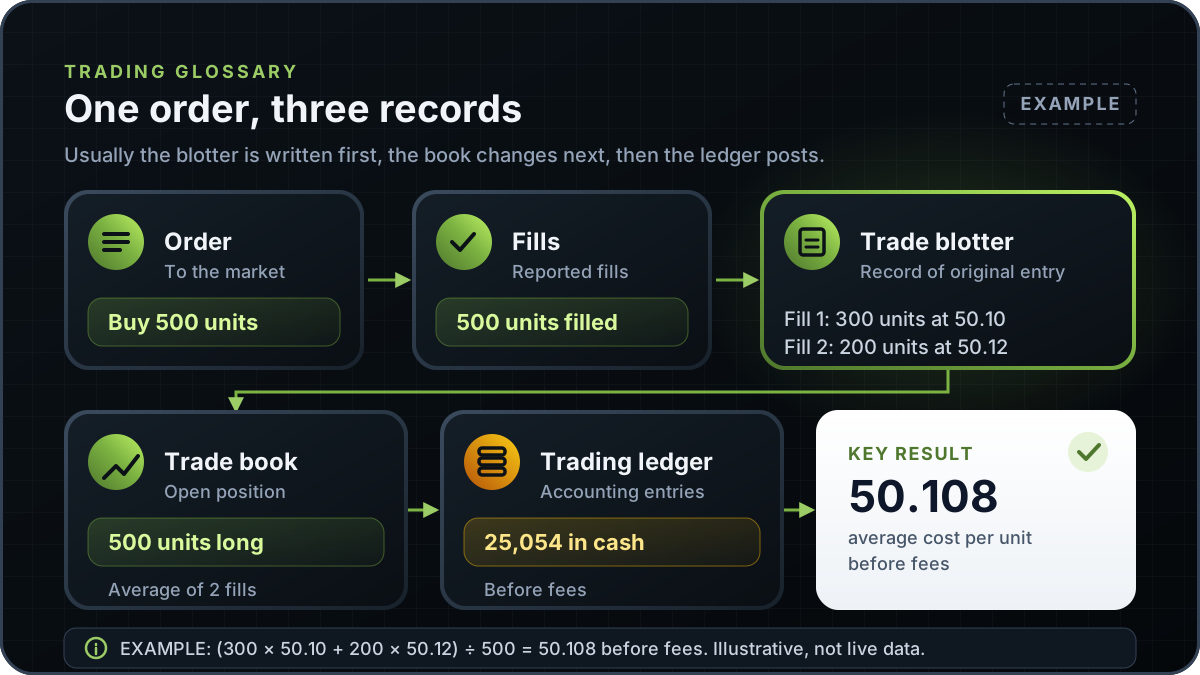
This is an illustrative example, not a recommendation. A desk buys 500 units of an instrument in two fills: 300 units at 50.10 and 200 units at 50.12. The example uses round numbers and ignores fees, so it shows the record flow rather than a real trade.
The blotter keeps the two fills as separate itemised entries, each with its time, price and quantity. The trade book shows one long position of 500 units. The average price is (300 x 50.10 + 200 x 50.12) / 500 = 25,054 / 500 = 50.108, so the book carries an average cost of 50.108 per unit before fees.
The ledger then records the cash effect, which is 500 x 50.108 = 25,054 in the account currency, before commissions and posting rules. The exact entries depend on the firm's accounting system. The example shows why one order can leave three different records behind.
An order is sent, filled and then recorded. In many firm processes the fill creates a blotter entry first. The position in the trade book changes next, and the ledger posts the accounting effect later. The diagram on this page shows that sequence as a flow with one stage per record.
The order types that generate these fills change the timing and the price, so check them before you read the blotter. For the limit side of that picture, see what is a limit order. For the order-handling side of a platform, see order management, and for the wider terminal context see what is a trading terminal.
RTX5's order management and trading ledger pages describe capabilities that are in development. Neither page should be read as a released trade blotter feature. This page explains the three terms in general, and it does not describe any RTX5 output.
Before you rely on any RTX5 function for record-keeping, check the product-availability record. It lists the status of each product and client, and it is the reference for what is live.
RTX5 is Orrnn's trading terminal and broker-technology product. Its Windows desktop client is in preview, and the web and mobile clients are planned. A Google Play listing for Android is published, but the mobile client has no approved release record yet; check the product-availability record and release notes before relying on any RTX5 feature. RTX5 is not a broker and does not hold client money, and this page does not describe a trade blotter feature.
Check RTX5 product availabilityTrust and methodology
We want you to be able to identify who owns the page, inspect the evidence, understand how tools were used, and challenge anything that looks wrong or out of date.
Published under the RTX5 Editorial Team byline. It identifies the responsible publishing organization; it does not imply that a named lawyer, regulator, financial adviser, or licensed expert approved this page.
4 primary references are listed on this page with context about what each one supports. The source set was checked on .
Automation and AI may help organize research, outline a page, or edit language. They are not treated as sources, are not presented as human experts, and do not remove the publisher's responsibility for the final page.
If a statement is incomplete, unsupported, or outdated, send the exact URL, sentence, and supporting evidence through our contact route. Read the full editorial and corrections policy.
Sources were checked on 9 November 2026. They explain market rules and concepts; they do not certify RTX5 or provide individual financial advice.
A trade blotter is an itemised record of trades in the order they are executed. For US broker-dealers, SEC Rule 17a-3(a)(1) treats blotters as records of original entry and requires each purchase or sale to show the account, the securities, the price, the trade date and the other party. Other firms and jurisdictions may use the term differently, so confirm it with compliance.
A trade book is an operating view of a desk's positions and exposure, built from the trades recorded during the day. Traders and risk managers use it to see what is open and at what average price. Neither SEC Rule 17a-3 nor FINRA Rule 4511 defines the term, so firms set its meaning in their own procedures. It does not replace the blotter or the ledger.
No. A blotter lists trades in the order they were executed. A ledger records accounting entries and balances, such as cash, commissions and customer accounts. The two records serve different purposes and are kept apart, so reconciling them is a separate control that firms set in their own procedures.
In the US, SEC Rule 17a-4(a) requires records made under Rule 17a-3(a)(1) through (3), which include blotters and ledgers, to be kept for not less than six years, the first two years in an easily accessible place. FINRA Rule 4511(b) sets six years for FINRA records with no other specified period. Confirm the periods that apply to your firm with its compliance function.
This page does not claim one. RTX5 is Orrnn's trading terminal and broker-technology product. Its Windows desktop client is in preview, and the web and mobile clients are planned. A Google Play listing for Android is published, but the mobile client has no approved release record yet. Check the product-availability record for the current status of any order or ledger function before you rely on it.