Accountable publisher
Published under the RTX5 Editorial Team byline. It identifies the responsible publishing organization; it does not imply that a named lawyer, regulator, financial adviser, or licensed expert approved this page.
Commodities guide
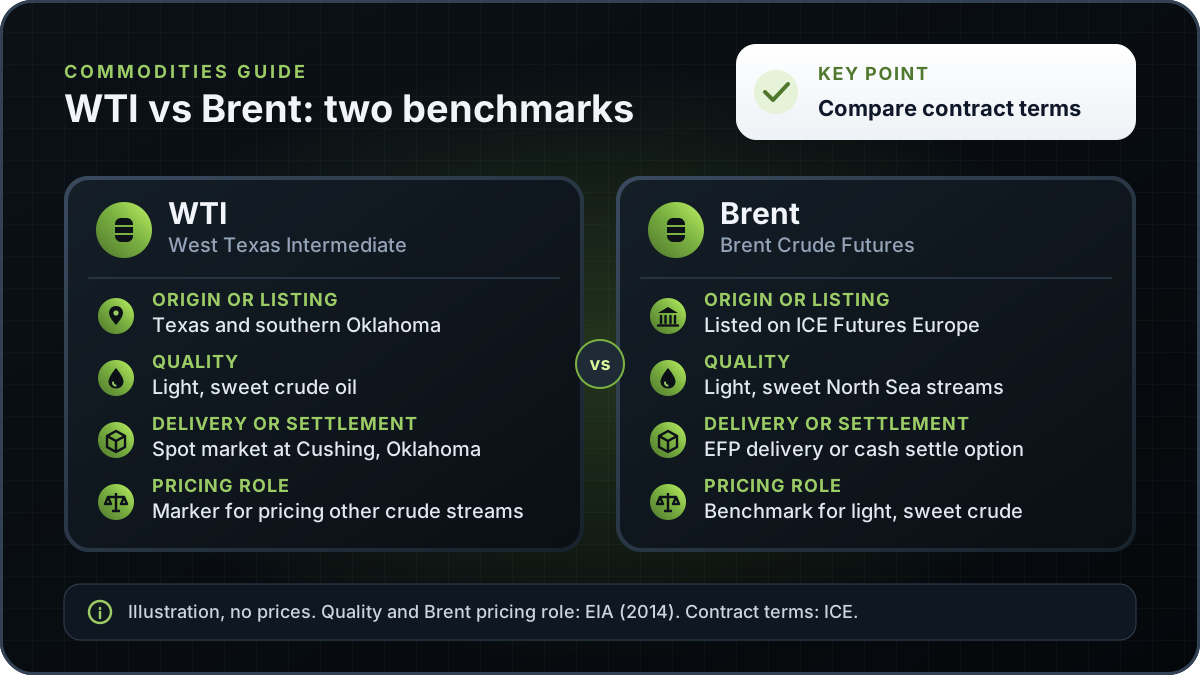
WTI vs Brent compares two crude oil benchmarks. WTI, or West Texas Intermediate, is a crude stream from Texas and southern Oklahoma, traded in the spot market at Cushing, Oklahoma. Brent is listed as Brent Crude Futures on ICE Futures Europe, and its contract can settle against ICE Brent Index. The two differ in origin, delivery and settlement.
In brief
WTI and Brent are the two oil benchmarks most often quoted in news. Here is how they differ in origin, delivery and settlement, and what to check before you rely on either price.
WTI vs Brent is a comparison of two crude oil benchmarks. A benchmark is a reference price for a type of crude oil. Other prices are often read against it, so knowing which benchmark a headline means is the first step in reading oil news.
WTI, or West Texas Intermediate, is described by the US Energy Information Administration (EIA) as a crude stream produced in Texas and southern Oklahoma. EIA also says it serves as a reference or 'marker' for pricing a number of other crude streams. Brent is quoted through ICE's Brent Crude Futures contract, which ICE lists on ICE Futures Europe.
In practice, a WTI price and a Brent price usually refer to different contracts with different terms. Each has its own delivery and settlement rules, which is why a price on its own tells you little. Read the contract or benchmark the source names. For the wider picture of raw materials, read what are commodities first.
The table compares the two benchmarks on the points that matter most when you read a price. Each cell names its source. Where a cell says to check the specification, read the official contract specification of the exchange that lists the futures contract.
| Point | WTI (West Texas Intermediate) | Brent (ICE Brent Futures) |
|---|---|---|
| Origin or listing | A crude stream produced in Texas and southern Oklahoma (EIA). | Listed as Brent Crude Futures on ICE Futures Europe, with North Sea as the trading screen hub name (ICE). |
| Crude quality | A light, sweet crude oil produced in the United States (EIA, 2014). | Four light, sweet crude streams produced in the North Sea: Brent, Forties, Ekofisk and Oseberg (EIA, 2014). |
| Delivery or settlement | Traded in the domestic spot market at Cushing, Oklahoma (EIA). For futures delivery terms, check the exchange's official specification. | A deliverable contract based on EFP delivery, with an option to cash settle against the ICE Brent Index price for the last trading day (ICE). |
| Daily settlement price | Check the exchange's official specification. | The weighted average price of trades during a two-minute settlement period from 19:28:00, London time (ICE). |
| Contract size | Check the exchange's official specification. | 1,000 barrels, traded in any multiple of 1,000 barrels (ICE). |
| Typical pricing role | A reference or marker for pricing a number of other crude streams (EIA). In 2014, EIA said it was a benchmark for other US crudes and for crude imported from Canada, Mexico and South America. | In 2014, EIA called Brent the most widely used global crude oil benchmark, used to price light, sweet crude in Europe, the Mediterranean, Africa, Australia and some countries in Asia (EIA, 2014). |
No prices, spreads or forecasts are shown. EIA uses light for higher API gravity (lower density) and sweet for low sulphur content. For grade-level API gravity and sulphur limits, and for the grades deliverable today, check the exchange's official specification.
Delivery and settlement are where WTI and Brent differ most in practice. A futures contract can end in physical delivery of the underlying crude, in a cash payment, or in a mix of both, depending on its rules.
For Brent, ICE describes the contract as a deliverable contract based on EFP delivery. It adds an option to cash settle against the ICE Brent Index price for the last trading day of the futures contract. The contract size is 1,000 barrels. ICE lists exchange of futures for physical (EFP) among the trading methods available for the contract, alongside electronic futures, exchange of futures for swap (EFS) and block trades.
ICE also sets a daily settlement price for Brent futures: the weighted average price of trades during a two-minute settlement period from 19:28:00, London time. ICE adds that all open contracts are marked to market daily.
For WTI, EIA says the crude is traded in the domestic spot market at Cushing, Oklahoma. Exchange-traded WTI futures have their own delivery, expiry and contract-size terms, set by the exchange that lists them. Read that exchange's official specification before you trade.
The price gap between two benchmarks is not fixed. It reflects where each crude is produced and delivered, how each contract is priced and settled, and what it costs to move crude between regions. Quality differences can matter as well.
EIA explains that two of the most important quality characteristics of crude oil are density and sulphur content. It says crude oils that are light (higher API gravity, lower density) and sweet (low sulphur content) are usually priced higher than heavy, sour crude oils. EIA also says other crudes are compared with a benchmark by an agreed-upon differential that takes into account quality, such as API gravity or sulphur content, transport costs and regional and global supply and demand.
Transport, storage and regional supply and demand can all widen or narrow a gap. These are general points about how oil markets work. They are not a description of any current market, and this guide does not predict how the gap will move.
Scheduled energy data can also move both benchmarks. Scheduled releases, including EIA inventory data, are covered on the economic calendar page. A release is a scheduled data point, not a forecast, and its effect on price is uncertain.
A quote is only meaningful when you know what it refers to. The checks below apply to any oil benchmark, whether you read it in a news story or see it on a platform.
An oil CFD is a separate contract from the futures it may follow. Its terms, costs and expiry are set by the provider, so read what is a CFD before you consider one. For how futures work in another market, see what are stock futures.
RTX5 is Orrnn's trading terminal and broker-technology product. Its Windows desktop client is in preview, and the web and mobile clients are planned. A Google Play listing for Android is published, but the mobile client has no approved release record yet; check the product-availability record before relying on any RTX5 feature. This page does not describe an RTX5 feature for commodities or futures trading. RTX5 is not a broker and does not hold client money.
Check RTX5 product availabilityTrust and methodology
We want you to be able to identify who owns the page, inspect the evidence, understand how tools were used, and challenge anything that looks wrong or out of date.
Published under the RTX5 Editorial Team byline. It identifies the responsible publishing organization; it does not imply that a named lawyer, regulator, financial adviser, or licensed expert approved this page.
5 primary references are listed on this page with context about what each one supports. The source set was checked on .
Automation and AI may help organize research, outline a page, or edit language. They are not treated as sources, are not presented as human experts, and do not remove the publisher's responsibility for the final page.
If a statement is incomplete, unsupported, or outdated, send the exact URL, sentence, and supporting evidence through our contact route. Read the full editorial and corrections policy.
Sources were checked on 9 November 2026. They explain market rules and concepts; they do not certify RTX5 or provide individual financial advice.
The main differences are origin, delivery and settlement. WTI, or West Texas Intermediate, is a crude stream from Texas and southern Oklahoma, traded in the spot market at Cushing, Oklahoma. Brent Crude Futures on ICE Futures Europe are a deliverable contract based on EFP delivery, with an option to cash settle against the ICE Brent Index. The contract specifications give the final terms.
The gap is not fixed. It can widen or narrow as transport costs, storage, regional supply and demand, and crude quality change. This guide does not describe any current gap or predict how it will move. Scheduled data and news can affect both benchmarks, so check the source behind any claim before you act on it.
ICE describes Brent Crude Futures as a deliverable contract based on EFP delivery, with an option to cash settle against the ICE Brent Index price for the last trading day. Settlement can therefore be physical through EFP or in cash, depending on how the contract is used. Read the ICE contract specification for the exact rules before you trade.
EIA describes WTI as traded in the domestic spot market at Cushing, Oklahoma, and in a 2014 article said it is priced at the Cushing crude oil trading hub. Exchange-traded WTI futures have their own delivery terms. Check the listing exchange's official specification for the delivery location, contract months and contract unit before you trade.
This guide does not recommend either benchmark and does not give trading calls. The right instrument depends on your goals, the products your broker offers, the contract terms and the rules in your country. Read the specification of any contract you consider, and check whether you could accept a loss on it.
This page does not describe an RTX5 feature for commodities or futures trading. RTX5 is Orrnn's trading terminal and broker-technology product, its Windows desktop client is in preview, and RTX5 is not a broker. Check the product availability record before relying on any RTX5 feature.