Accountable publisher
Published under the RTX5 Editorial Team byline. It identifies the responsible publishing organization; it does not imply that a named lawyer, regulator, financial adviser, or licensed expert approved this page.
Trading glossary
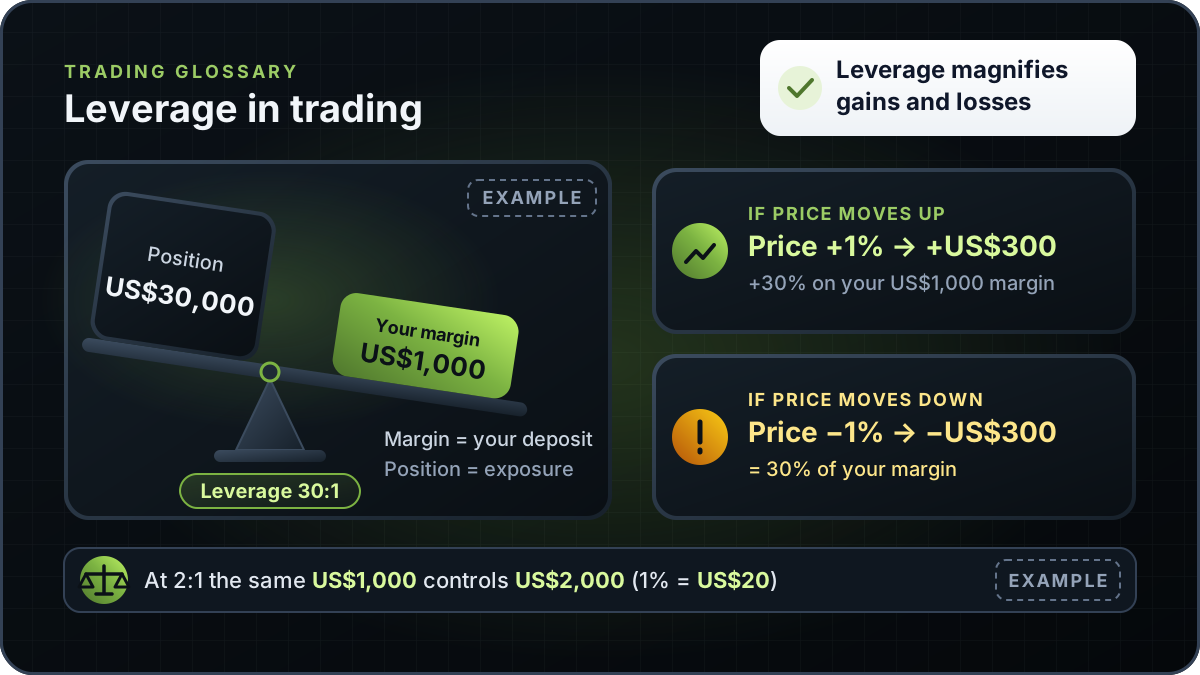
Leverage in trading means controlling a position larger than the money you put up as margin, with the broker providing the difference. A 30:1 ratio means US$1,000 of margin controls a US$30,000 position. Gains and losses both apply to the full position, so a 1% move costs 30% of the margin.
In brief
Leverage lets a deposit control a larger position. The ratio sets how much of that position each market move can use up.
A leverage ratio states how large a position is compared with the margin you deposit. A 30:1 ratio means every US$1 of margin supports US$30 of position. The same relationship can be written as a margin percentage. The margin equals the position value divided by the ratio, so at 30:1 the margin is 1 divided by 30, or 3.33%, of the position.
The two forms describe the same deal. A 2% margin requirement is the same as 50:1, because 1 divided by 50 is 2%. Brokers often quote margin as a percentage and traders often quote leverage as a ratio, so check which one your broker shows before you size a trade. For the wider meaning of the deposit itself, read what is margin in trading.
The table below holds the margin at US$1,000 and changes only the ratio. The position size is the margin multiplied by the ratio. A 1% move is 1% of the position, not 1% of the deposit, so the last column divides the dollar move by the margin.
| Leverage | Margin as % of position | Position size | Gain or loss on a 1% move | Share of margin lost on a 1% move |
|---|---|---|---|---|
| 2:1 | 50% | US$2,000 | US$20 | 2% |
| 5:1 | 20% | US$5,000 | US$50 | 5% |
| 10:1 | 10% | US$10,000 | US$100 | 10% |
| 30:1 | 3.33% | US$30,000 | US$300 | 30% |
Illustrative arithmetic in US$ for clarity. Your account currency will differ. The figures ignore spreads, commissions, overnight financing and slippage, and they are not a forecast of any market move.
The pattern is simple. The share of margin lost on a 1% move equals the leverage ratio multiplied by 1%. At 30:1 that is 30%, and at 2:1 it is 2%. The position is 15 times larger at 30:1 than at 2:1, and the loss relative to the deposit is also 15 times larger.
Leverage does not change the size of a price move. It changes how much of your deposit that move can use up. A position's profit or loss equals the price change multiplied by the number of units held. When those units are financed with a small margin, the same price change is a larger share of the money you put in.
At 30:1 the arithmetic tightens quickly. On a US$30,000 position, a 3.33% adverse move is US$1,000, which is the whole margin. Under the FCA rules for retail CFDs, a position is closed out when funds fall to 50% of the margin needed. On the same position, that is a loss of US$500, a 1.67% adverse move, before costs.
Costs scale with the full position too, so they weigh more heavily against a small deposit.
Leverage limits are set by national regulators and mostly apply to retail clients, not to professional traders. The rules below are summarised from the sources listed on this page, with their publication dates. They describe the rules in each jurisdiction, not every product or every broker.
UK: The Financial Conduct Authority (FCA) permanent rules, in force since 1 August 2019, limit retail CFD leverage to between 30:1 and 2:1. It confirmed these as permanent restrictions in a press release dated 1 July 2019. The CFD rules applied from 1 August 2019, and the CFD-like option rules from 1 September 2019.
EU: The European Securities and Markets Authority (ESMA) agreed retail CFD leverage limits in March 2018. They ran from 30:1 for major currency pairs down to 2:1 for cryptocurrencies, with 5:1 for individual equities. ESMA introduced these as temporary EU-wide measures. Check your national regulator for the rules that apply today.
US: The CFTC's customer advisory on forex states that offering leverage above the legal limit in the United States is a warning sign of fraud. It gives the legal margin as 2% for major currency pairs and 5% for other pairs. A 2% margin equals 50:1 and a 5% margin equals 20:1. The advisory shows no date, so confirm the current requirements with the National Futures Association before relying on them.
The US figures cover retail forex. This guide does not state whether CFDs are available to US customers, because that depends on the country and the regulator.
For UK retail CFD accounts, the FCA requires firms to close out a position when funds fall to 50% of the margin needed to keep the positions open. The FCA also requires protection so that a client cannot lose more than the total funds in the CFD account. This is commonly called negative balance protection.
ESMA's 2018 measures included the same two safeguards, applied per account. Both limit how far losses can go, but neither stops a losing trade from using up the funds in the account. A position can also close at a worse price than you expected in a fast market.
Negative balance protection caps losses at the funds in the account. It does not protect those funds, does not stop a losing trade from using them, and does not apply in every country or to every product.
Leverage is the ratio. Margin is the money set aside from your account to open and keep a position, measured in your account currency. The two are linked: the margin required falls as leverage rises, and the margin is the amount the broker needs before it lets you open the trade.
Higher leverage does not mean you deposit more. It means you deposit less for the same position. That is why leverage looks attractive, and also why a loss can be large relative to the deposit. For the worked margin figures, including free margin and margin level, read what is margin in trading.
The leverage ratio tells you how large a position the broker allows. It does not tell you how large a position you should take. Start from the loss you can accept on the trade, then work out the size from the distance to your stop loss.
The position size calculator applies that approach. For forex pairs, the forex pip calculator converts a pip distance into money. For the markets where leverage is common, read what is forex trading and what is a CFD.
RTX5 is Orrnn's trading terminal and broker-technology product. Its Windows desktop client is in preview, and the web and mobile clients are planned. A Google Play listing for Android is published, but the mobile client has no approved release record yet; check the product-availability record and release notes before relying on any RTX5 feature. The leverage figures on this page are illustrative and do not come from an RTX5 feature. Leverage offered to any client depends on the broker and its regulator, and RTX5 is not a broker.
Check RTX5 product availabilityTrust and methodology
We want you to be able to identify who owns the page, inspect the evidence, understand how tools were used, and challenge anything that looks wrong or out of date.
Published under the RTX5 Editorial Team byline. It identifies the responsible publishing organization; it does not imply that a named lawyer, regulator, financial adviser, or licensed expert approved this page.
4 primary references are listed on this page with context about what each one supports. The source set was checked on .
Automation and AI may help organize research, outline a page, or edit language. They are not treated as sources, are not presented as human experts, and do not remove the publisher's responsibility for the final page.
If a statement is incomplete, unsupported, or outdated, send the exact URL, sentence, and supporting evidence through our contact route. Read the full editorial and corrections policy.
Sources were checked on 7 November 2026. They explain market rules and concepts; they do not certify RTX5 or provide individual financial advice.
Yes, in the sense that a higher ratio makes each market move a larger share of your margin. At 2:1 a 1% move costs 2% of the margin, and at 30:1 it costs 30%. Leverage does not change how often a trade moves against you. It changes how much of your deposit a move can use up. Lower leverage reduces that effect but does not remove the risk of loss.
30:1 means every US$1 of margin controls US$30 of position. With US$1,000 of margin, the position is US$30,000. The margin is 3.33% of the position, because 1 divided by 30 is 0.0333. Your broker's margin requirement and any limits in your country may differ, so check the figure in the contract details before you place a trade.
The FCA's permanent rules, in force since 1 August 2019, limit retail CFD leverage to between 30:1 and 2:1. It confirmed this as a permanent restriction in a press release dated 1 July 2019, and the CFD rules applied from 1 August 2019. The limit is a range, so the figure a broker shows for a given product can differ. Check the figure your broker displays before you open a position.
No. Negative balance protection means a client cannot lose more than the funds in the CFD account. It does not protect those funds, and you can still lose all of them. The FCA requires this for UK retail CFD accounts, and ESMA's 2018 measures applied it per account. It does not protect profits and does not cover every product or country.
Leverage is the ratio between a position and the margin you deposit, such as 30:1. Margin is the amount of your money set aside to open and keep the position, measured in your account currency. A higher ratio means less margin for the same position. Margin as a percentage is the reverse of the ratio: 30:1 is a margin of 3.33 percent of the position.