Accountable publisher
Published under the RTX5 Editorial Team byline. It identifies the responsible publishing organization; it does not imply that a named lawyer, regulator, financial adviser, or licensed expert approved this page.
Trading basics
AI stock trading means using software, often machine learning or large language models, to help with tasks such as screening stocks, summarising filings, sending alerts and checking risk. It can organise information faster. It does not promise returns, and the CFTC warns that claims of high or guaranteed returns are red flags of fraud.
In brief
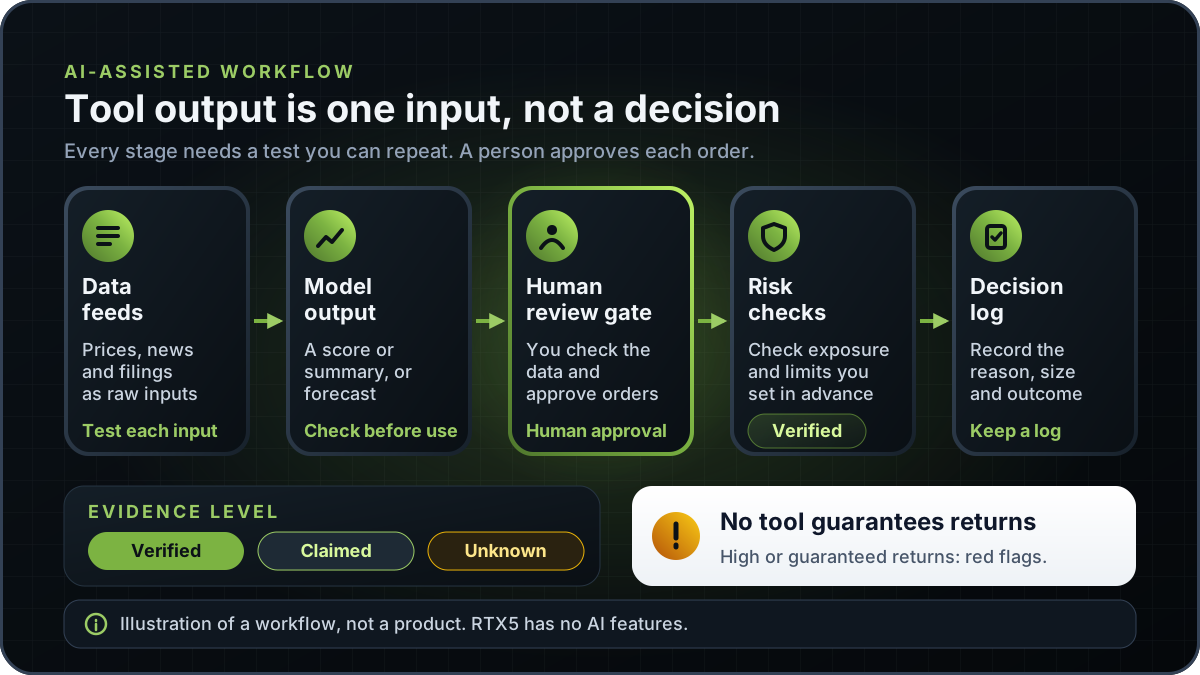
AI can speed up research, alerts and risk checks. Whether it improves trading results is a separate question, and the answer depends on the task, the data and the tests you run before you risk money.
AI can sit at several points in a trading workflow. It can collect and clean data, rank candidate stocks, summarise news and filings, produce alerts, check exposure against limits, and in some products produce forecasts or place orders. Each point needs its own test. A tool that writes a useful summary has not thereby shown that it picks winning stocks.
Many tools marketed as AI are rule-based screens with an AI label. A rule such as 'price above a moving average and volume above a set level' is not machine learning, and it can be tested in the same way as any other rule. Ask which parts of a product use a learned model and which parts follow fixed rules. For the basics of the order and market concepts behind these tools, start with what is trading.
The table lists the common uses. The evidence column rates how much support a reader can check. Verified means the function is observable and testable by you. It does not mean the output is correct. Claimed means a vendor or promoter says the use improves results, without public evidence you can check. Unknown means there is no reliable public evidence either way.
Read the limits column before you read the others. Most failures in AI-assisted trading come from a function being trusted beyond what it can show, rather than from the function failing in its own terms.
| Use | What it does | Evidence level | Limits |
|---|---|---|---|
| Screening and ranking | Filters or scores a stock list against rules or model outputs | Verified | Same inputs give the same output, which you can check. A ranking is not a forecast of future returns. |
| Summarising news and filings | Condenses earnings releases, filings and news into short notes | Verified | Summaries can omit or misstate detail. Check each one against the original document before acting. |
| Alerts | Notifies you when a price, indicator or news item meets a condition | Verified | Alert timing depends on the data feed. An alert that fires often may add noise rather than information. |
| Pattern search | Scans past data for shapes, clusters or correlations | Claimed | Patterns found in past data often do not repeat. Scanning many patterns finds false matches by chance. |
| Risk checks | Flags exposure, concentration or volatility against limits you set | Verified | The check is only as good as its inputs and limits. It cannot stop a gap or a poor fill. |
| Return forecasting | Predicts price direction or future returns | Unknown | No reliable public evidence shows consistent accuracy out of sample. The CFTC says AI technology can't predict the future or sudden market changes. |
Evidence levels are this guide's reading of public sources as of 9 November 2026, not a rating of any product. Verified 9 November 2026.
The method below applies to any AI tool, whether it screens stocks, summarises news or generates signals. It is the same discipline used to test a rule-based strategy, with extra checks on the data and on the people behind the tool.
Write one sentence that states what the tool does, what it outputs, and which decision it informs. If you cannot write that sentence, the tool is not ready to use.
Confirm that every input was available at the time the model would have used it. Look-ahead bias happens when a test uses information released after the signal date, such as a revised earnings figure. It makes results look better than they were.
Test on a period the model was not built or tuned on. Include spreads, commissions, slippage and any financing costs. A result that disappears once costs are included is not a usable result.
Run the tool on live prices with simulated orders for a fixed period before you risk money. The paper trading guide explains how this works and what it cannot show.
A person reads the signal, checks the data behind it and approves each order. Write down when you override the tool and when you switch it off, so the rule is set before the pressure of a live trade.
Record each decision with the context that shaped it, then compare the log with outcomes over time. The log shows whether the tool helps, and it exposes the cases where you trusted it too quickly.
In March 2024 the SEC settled charges against two investment advisers, Delphia (USA) Inc. and Global Predictions Inc., for false and misleading statements about their use of artificial intelligence. The SEC found that Delphia made false and misleading statements about its purported use of AI and machine learning that incorporated client data, and that it did not have the AI and machine learning capabilities it claimed. It found that Global Predictions falsely claimed to be the 'first regulated AI financial advisor'. Total civil penalties were US$400,000, and both firms consented to the orders without admitting or denying the SEC's findings.
Cases like these are often described as AI washing: overstating or inventing the role of AI in a product. The lesson for a retail reader is practical. Any AI claim is a claim you can ask a firm to support. Ask which model it uses, what data it uses, how it was tested, and who checks the results.
On 25 January 2024 the CFTC issued a customer advisory titled AI Won't Turn Trading Bots into Money Machines. It says scammers claim AI can generate huge returns using bots, trade signal algorithms and crypto-asset arbitrage algorithms. The advisory warns that claims of high or guaranteed returns are red flags of fraud, and that strangers promoting these claims online should be ignored.
Before you pay for a bot or a signal service, research the people and the company behind it. The CFTC release lists researching the background of a company or trader among four items to consider before trusting money to trading bots or trade-signal providers. The advisory also suggests a reverse image search on key personnel, a check on the age of the website's domain registration, a second opinion, and a look at how fees, spreads and subscription costs would affect returns. Suspicious activity can be reported to the CFTC at cftc.gov/complaint.
A joint US investor article from the SEC's Office of Investor Education and Advocacy, NASAA and FINRA, dated 25 January 2024, lists high-pressure sales tactics by unregistered individuals, promises of quick profits, and claims of guaranteed returns with little or no risk as red flags in its section on investing in AI-focused companies.
A decision log does not need special software. A spreadsheet with one row per decision is enough, provided the fields are filled in at the time, not reconstructed later. These fields are most useful for judging an AI tool.
Review the log on a fixed schedule. A tool that looks useful in memory may look different once every decision is written down.
RTX5 is Orrnn's trading terminal and broker-technology product. Its Windows desktop client is in preview, and the web and mobile clients are planned. A Google Play listing for Android is published, but the mobile client has no approved release record yet; check the product-availability record before relying on any RTX5 feature. RTX5 has no AI features. It does not offer AI signals, AI stock picks or AI forecasts. Bots, algorithm hosting and backtesting are planned, not available. See algorithmic trading and automations for roadmap context only.
Check RTX5 product availabilityTrust and methodology
We want you to be able to identify who owns the page, inspect the evidence, understand how tools were used, and challenge anything that looks wrong or out of date.
Published under the RTX5 Editorial Team byline. It identifies the responsible publishing organization; it does not imply that a named lawyer, regulator, financial adviser, or licensed expert approved this page.
4 primary references are listed on this page with context about what each one supports. The source set was checked on .
Automation and AI may help organize research, outline a page, or edit language. They are not treated as sources, are not presented as human experts, and do not remove the publisher's responsibility for the final page.
If a statement is incomplete, unsupported, or outdated, send the exact URL, sentence, and supporting evidence through our contact route. Read the full editorial and corrections policy.
Sources were checked on 9 November 2026. They explain market rules and concepts; they do not certify RTX5 or provide individual financial advice.
No tool can promise profit. Public evidence that an AI model earns consistent returns after costs is hard to find, and the CFTC reminds investors that AI technology can't predict the future or sudden market changes. Treat any return claim as unproven until it has been tested on data the model did not see, with realistic costs, and then in paper trading.
Start by defining one task for the tool. Check its data for look-ahead bias, backtest it with spreads, commissions and slippage, and paper trade it before risking money. Keep a person in the review gate for every order, and log each decision with its outcome so you can judge the tool over time.
No reliable public evidence shows that AI predicts stock prices consistently. The CFTC's 2024 advisory says AI technology can't predict the future or sudden market changes. Forecasts from an AI tool are model outputs with unknown accuracy. Read them as one input to check, not as a signal to act on without testing.
AI washing is overstating or inventing a firm's use of artificial intelligence. In March 2024 the SEC settled charges against two investment advisers, Delphia (USA) Inc. and Global Predictions Inc., for false and misleading AI statements. Total civil penalties were US$400,000, and both firms settled without admitting or denying the SEC's findings.
The CFTC warns that claims of high or guaranteed returns are red flags of fraud, and its 2024 advisory on AI scams covers trading bots and trade-signal providers. Before paying for any bot, research the people and the company behind it, and test the tool yourself in paper trading. A bot that cannot explain its method in plain terms is a reason for caution.
No. RTX5 has no AI features, and it does not offer AI signals, AI stock picks or AI forecasts. Its Windows desktop client is in preview, and the web and mobile clients are planned. A Google Play listing for Android is published, but the mobile client has no approved release record yet. Check the product-availability record before relying on any RTX5 function.