Accountable publisher
Published under the RTX5 Editorial Team byline. It identifies the responsible publishing organization; it does not imply that a named lawyer, regulator, financial adviser, or licensed expert approved this page.
Market structure
High-frequency trading (HFT), also written high frequency trading, is automated trading by professional firms that use extremely fast computer programs, often with servers co-located near exchange matching engines, to generate, route and execute large numbers of orders over very short holding periods. In 2010 the US SEC said the term was not yet clearly defined.
In brief
High-frequency trading is defined by speed and automation. Here is what regulators describe, how HFT firms differ from retail traders and what the term does not mean.
In its 2010 concept release on equity market structure, the US Securities and Exchange Commission (SEC) described high-frequency trading by its features rather than by one legal test. It said the term is relatively new and not yet clearly defined. It typically refers to professional traders acting in a proprietary capacity who run strategies that generate a large number of trades on a daily basis.
The SEC said those traders could be organised in a variety of ways, including as a proprietary trading firm, as the proprietary trading desk of a multi-service broker-dealer or as a hedge fund. What sets them apart is speed. The SEC said speed matters both in achieving very small latencies and in being faster than competitors, "even if only by a microsecond".
EU law takes a different approach and gives a formal definition, covered in the section on rules below.
The SEC listed five characteristics often attributed to proprietary firms engaged in HFT. They describe how these firms tend to operate. Because the SEC said the term was not yet clearly defined, they are not a legal test that a firm must pass.
Co-location is a service in which a trading centre, or a third party that hosts its matching engine, rents rack space so that a market participant can place its servers in close physical proximity to the matching engine. It shows that infrastructure, not only strategy, separates HFT from other trading. For the mechanics of latency, read how brokers reduce trading latency and low-latency trading execution.
The SEC grouped the strategies often associated with proprietary firms into four broad types: passive market making, arbitrage, structural strategies and directional strategies. It also noted that many of these strategies are not new. What is new is the technology that allows firms to better identify and execute them.
Market making. Passive market making primarily involves submitting non-marketable resting orders (bids and offers) that provide liquidity to the market at specified prices. Other participants can trade against those orders.
Arbitrage. An arbitrage strategy seeks to capture pricing inefficiencies between related products or markets. The SEC's example is buying an ETF and selling its underlying basket of stocks, or the reverse, to capture a price difference. The SEC added that such hedged positions may last for several days or more, so not every strategy associated with proprietary firms means a holding period of seconds.
Directional strategies. The SEC focused on order anticipation and momentum ignition as two directional strategies that may pose particular problems for long-term investors. Describing them is not a claim that any firm uses them.
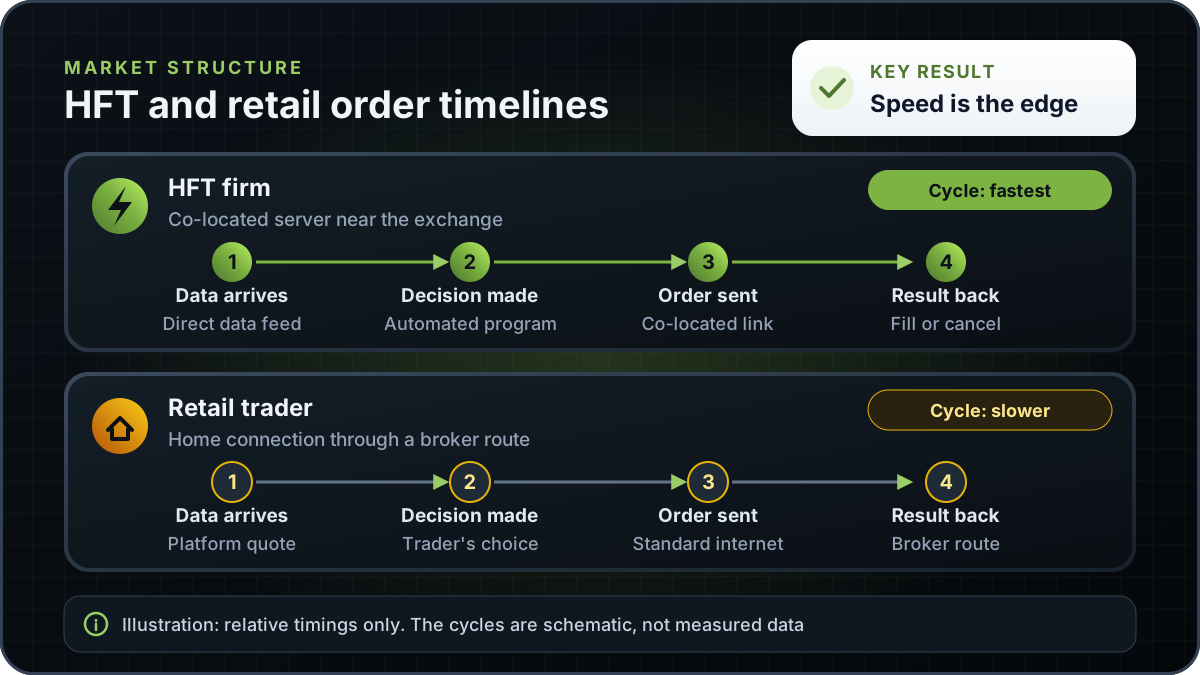
The table below compares the two in general terms. It describes typical structure, not the behaviour of any firm or account, and it does not imply any speed, return or cost figure.
| Feature | HFT firm | Retail trader |
|---|---|---|
| Speed | Competes on being faster than other firms, even if only by a microsecond | Set by the home connection, the platform and the broker's route |
| Holding period | Very short time-frames; aims to end the trading day close to flat | Set by the trader, from minutes to months |
| Infrastructure | Co-location, individual data feeds and high-speed, sophisticated software | Standard internet connection and a broker or retail platform |
| Order behaviour | Numerous orders, many cancelled shortly after submission | Depends on the strategy and the platform |
| Purpose | Market making, arbitrage and other proprietary strategies | Investing, hedging or speculating over a chosen timeframe |
| Regulation | Subject to venue and regulator rules; in the EU, MiFID II defines a high-frequency algorithmic trading technique | Subject to broker, venue and national rules, including retail client protections where they apply |
Qualitative comparison based on SEC Release No. 34-61358 (2010) and MiFID II Article 4 as published in ESMA's Interactive Single Rulebook. It does not measure any firm or account.
In 2010 the SEC called HFT "a dominant component of the current market structure". It said estimates of HFT volume in the equity markets vary widely, though they typically are 50% of total volume or higher. It added that the lack of a clear definition may contribute to those widely varying estimates. The figures are from 2010, so check current exchange or regulator data before you rely on them.
The SEC also asked whether co-location benefits or harms long-term investors and market quality. It asked whether co-location fees are so high that they create a barrier for smaller firms, and, if co-location creates unfair access, whether the SEC should prohibit or restrict exchanges and other trading centres from offering it. The release sought public comment on these questions and did not settle them.
European Union. MiFID II gives a legal definition. Article 4(1)(40) defines a "high-frequency algorithmic trading technique" as an algorithmic trading technique characterised by three features: infrastructure intended to minimise network and other types of latencies, including at least one of co-location, proximity hosting or high-speed direct electronic access; system-determination of order initiation, generation, routing or execution without human intervention for individual trades or orders; and high message intraday rates which constitute orders, quotes or cancellations. ESMA states that the MiFID II and MiFIR package introduced the rules governing high-frequency trading.
United States. The SEC's 2010 document is a concept release that requested public comment. It did not itself adopt rules on HFT. Check the SEC's current rules and the rules of the venue you use before relying on any statement about how HFT is regulated in the US.
Other countries. Rules for automated and high-speed trading differ between exchanges and regulators. Check your regulator's current guidance for the market you trade.
Knowing what HFT is helps you judge claims about speed. A retail trader cannot match co-located servers and individual exchange data feeds with a home connection, so speed is not something a retail trader can buy by changing a setting.
HFT and scalping are different things. HFT describes firms and their infrastructure, while scalping is a trading style with short holding periods. For the basics of short-term trading, see day trading explained.
If you want to measure execution speed on your own platform, the guide to order-to-acknowledgment and order-to-fill latency explains what to record. Next step: read what is a limit order to see how the order type you choose affects execution.
RTX5 is Orrnn's trading terminal and broker-technology product. Its Windows desktop client is in preview, and the web and mobile clients are planned. A Google Play listing for Android is published, but the mobile client has no approved release record yet; check the product-availability record before relying on any RTX5 feature. RTX5 is not a broker and does not hold client money. RTX5 makes no high-frequency or low-latency trading claims, and this page does not describe any RTX5 feature for HFT.
Check RTX5 product availabilityTrust and methodology
We want you to be able to identify who owns the page, inspect the evidence, understand how tools were used, and challenge anything that looks wrong or out of date.
Published under the RTX5 Editorial Team byline. It identifies the responsible publishing organization; it does not imply that a named lawyer, regulator, financial adviser, or licensed expert approved this page.
5 primary references are listed on this page with context about what each one supports. The source set was checked on .
Automation and AI may help organize research, outline a page, or edit language. They are not treated as sources, are not presented as human experts, and do not remove the publisher's responsibility for the final page.
If a statement is incomplete, unsupported, or outdated, send the exact URL, sentence, and supporting evidence through our contact route. Read the full editorial and corrections policy.
Sources were checked on 9 November 2026. They explain market rules and concepts; they do not certify RTX5 or provide individual financial advice.
HFT stands for high-frequency trading. It is automated trading by professional firms that use very fast computer programs and often co-located servers to send and cancel large numbers of orders, usually over very short time-frames. In 2010 the SEC said the term was not yet clearly defined and described HFT through its typical characteristics.
Not exactly. HFT is a form of algorithmic trading, but not all algorithmic trading is high-frequency. MiFID II defines algorithmic trading as trading where a computer algorithm automatically determines individual order parameters with limited or no human intervention. A high-frequency algorithmic trading technique adds latency-minimising infrastructure, such as co-location, and high message intraday rates.
The SEC's 2010 concept release did not prohibit HFT. It invited public comment on HFT strategies, saying some may benefit market quality and long-term investors while others could be harmful. In the EU, MiFID II defines HFT techniques, and ESMA says the MiFID II and MiFIR package introduced rules governing HFT. Rules differ by market and change over time, so check the current rules where you trade.
Not in the sense regulators describe. HFT relies on co-located servers, individual data feeds and high-speed software, which most retail traders do not have. A retail trader's speed is set by their connection, platform and broker route. Short-term styles such as scalping are different from HFT and are covered in their own guide.
In its 2010 review of US equity market structure, the SEC said estimates of HFT volume in the equity markets vary widely, though they typically are 50% of total volume or higher. It said the lack of a clear definition may contribute to that wide range. Check current exchange or regulator data before you use any figure.