Accountable publisher
Published under the RTX5 Editorial Team byline. It identifies the responsible publishing organization; it does not imply that a named lawyer, regulator, financial adviser, or licensed expert approved this page.
Trading basics
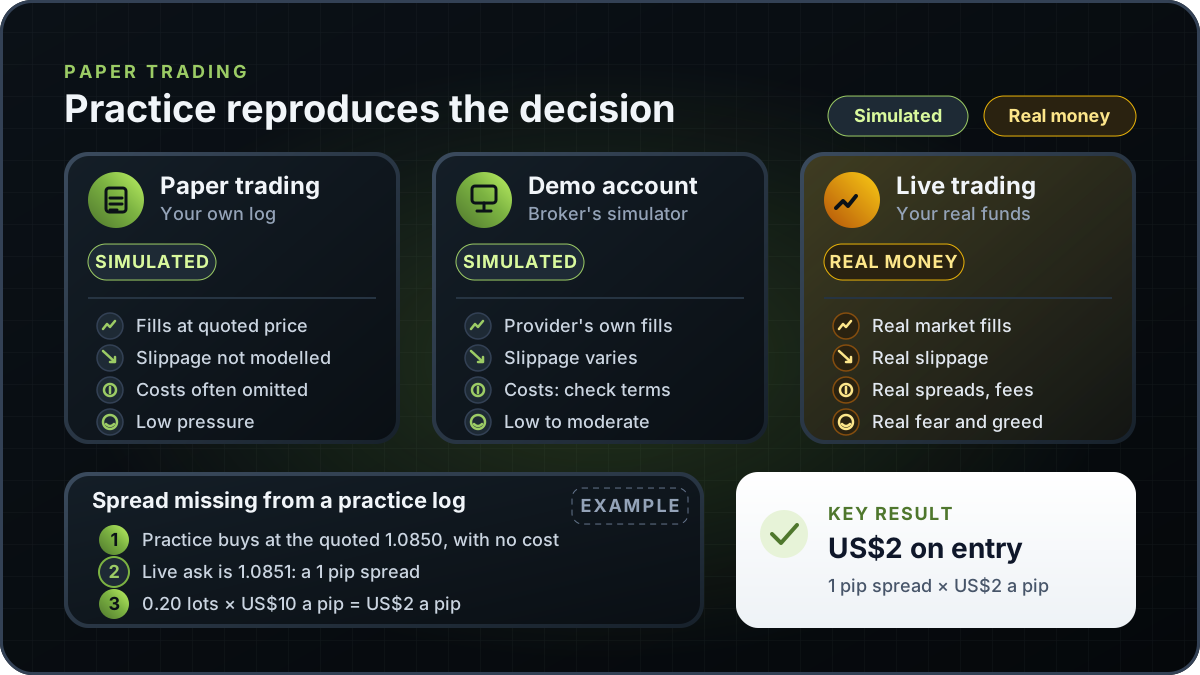
Paper trading is practising with simulated orders and simulated money, so no real capital is at risk. It lets you test a trading idea and learn how an order ticket works. It does not reproduce real fills, slippage, trading costs or the emotional pressure of live money, so results should be read with care.
In brief
Paper trading lets you rehearse decisions without real money. Here is what it reproduces, what it leaves out, and how to make practice results more useful before you trade live.
Paper trading means placing trades on paper, or in a simulator, instead of with real funds. You decide what to buy or sell, when, and at what size, then record the result as if the trade had been live. The point is to practise the decisions and the process, not to earn money from the practice itself.
Paper trading can be done with a manual log, a spreadsheet or a practice account that some platforms provide. Each method differs in how much of the market it simulates. For the wider background on what trading involves, read what is trading.
The three lanes below differ in what they reproduce. A manual paper log reproduces the decision and little else. A broker demo account can reproduce more of the platform, but its fills and costs depend on the provider. Live trading uses real funds in the real market.
| Feature | Paper trading | Broker demo account | Live trading |
|---|---|---|---|
| Money used | Simulated, with no link to a bank or broker account | Usually simulated funds on the broker's own platform | Your real funds, which can be lost |
| Order fills | Often assumed at the quoted price, or recorded by hand | Filled by the provider's simulated engine, which may differ from live execution | Filled in the live market, which can differ from the quoted price |
| Slippage | Usually absent or not modelled | Varies by provider; check whether it is modelled | Real, and the fill can be worse than expected in fast markets |
| Market data | May be delayed or taken from another source | Depends on the provider; may be delayed | Live feed, subject to your data subscription |
| Costs | Often not charged or not modelled | May model spreads, commissions or financing; check the terms | Real spreads, commissions, financing and fees |
| Emotional pressure | Low, because no money is lost | Low to moderate, depending on how you use it | Real; fear, greed and the wish to recover losses affect decisions |
A descriptive comparison of typical differences, not a statement about any named provider. Check each provider's documentation for how its fills, data and costs are modelled.
Demo accounts and live accounts are compared in more depth in demo vs live trading: when are you ready to go live. This page does not compare or rank practice apps.
Practice results are useful, but they are shaped by what the practice tool leaves out. The four limits below can appear in practice tools. Each one can make a practice record look cleaner than the same process would look with real money.
Costs are a fifth gap. A practice record can omit spreads, commissions and financing, and those costs reduce the result in live trading. For the basics, see what is a spread in trading.
This is an illustrative example, not a recommendation, and its contract sizes are assumptions chosen for the arithmetic. A practice tool records a buy of EUR/USD at the quoted price of 1.0850 and treats the entry as free. A live broker quotes a spread of 1 pip, so the same buy fills at the ask price of 1.0851. For this example, assume that one pip is 0.0001.
Also assume that one lot is 100,000 units of the base currency. Check your broker's contract specifications for the lot size and pip value it uses before you copy the arithmetic. On those assumptions, one pip on one lot of EUR/USD is 100,000 x 0.0001 = US$10, because the US dollar is the quote currency. Assume a US dollar account and a position of 0.20 lots. That makes each pip worth 0.20 x US$10 = US$2. The one pip spread costs 1 x US$2 = US$2 on entry, before any commission or exit cost. A practice record that ignores the spread would overstate the result by that amount on every trade.
Set a risk amount per trade in your account currency, then size each position to match. Practice at an unrealistically large size, or a size you would never use live, teaches habits you will not be able to keep. The position size calculator runs the arithmetic.
Subtract an estimate of the spread, commission and financing from each simulated result. If the tool does not model costs, record them yourself so the journal shows what live trading would cost.
For each trade, record the date, the instrument, the reason, the entry, the planned exit and stop, the size, the result and whether you followed your rules. The journal shows where the process breaks, which the profit and loss figure alone does not.
Decide how many trades or weeks you will practise and what you will review at the end. Setting the period in advance reduces the temptation to stop after a good run or keep going after a bad one.
If your live plan uses a stop loss, use one in practice and record the trigger price. Remember that a practice fill may differ from a live fill. For the mechanics, read what is a stop loss order.
Practice setups can leave out what margin does to a live account. FINRA's investor guidance says that when you trade on margin during the day, intraday margin requirements apply. It says your firm will expect you to satisfy an intraday margin deficit as promptly as possible, by depositing funds or liquidating positions, and that margin trading carries the potential to lose more than your original investment. A practice log that never records a deficit does not show how a live account would respond.
If you plan to use margin, ask your broker how its intraday requirements work on your account. In the US, FINRA replaced the pattern day trader rule and its US$25,000 minimum with intraday margin standards, effective 4 June 2026. Member firms that need more time may phase in the change until 20 October 2027 (FINRA Regulatory Notice 26-10). Brokers may also set stricter house rules, so check your broker's current requirements.
RTX5 is Orrnn's trading terminal and broker-technology product. Its Windows desktop client is in preview, and the web and mobile clients are planned. A Google Play listing for Android is published, but the mobile client has no approved release record yet; check the product-availability record before relying on any RTX5 feature. This guide does not describe an RTX5 paper trading feature, and the worked examples on this page are illustrative.
Check RTX5 product availabilityTrust and methodology
We want you to be able to identify who owns the page, inspect the evidence, understand how tools were used, and challenge anything that looks wrong or out of date.
Published under the RTX5 Editorial Team byline. It identifies the responsible publishing organization; it does not imply that a named lawyer, regulator, financial adviser, or licensed expert approved this page.
4 primary references are listed on this page with context about what each one supports. The source set was checked on .
Automation and AI may help organize research, outline a page, or edit language. They are not treated as sources, are not presented as human experts, and do not remove the publisher's responsibility for the final page.
If a statement is incomplete, unsupported, or outdated, send the exact URL, sentence, and supporting evidence through our contact route. Read the full editorial and corrections policy.
Sources were checked on 9 November 2026. They explain market rules and concepts; they do not certify RTX5 or provide individual financial advice.
Not always. Paper trading is the general practice of recording simulated trades, whether by hand, in a spreadsheet or in a practice tool. A broker demo account is a practice account the broker provides, usually with simulated funds on its own platform. Both use no real money, but their fills, data and costs can differ. Read the provider's description of how its practice account works before you rely on the results.
Not reliably. Practice results can look better than live results because a simulator may fill at the quoted price, skip slippage and omit costs, and because no money is at stake. Use practice to learn a process and check that your rules work as written. Treat the results as a rough guide to the process, not a forecast of live results.
This guide does not set a period. Some people fix a number of trades or weeks in advance and review their journal before deciding. Whatever period you choose, the decision should rest on your written rules, your records and whether you can follow the plan when real losses occur. The article on demo versus live trading covers readiness in more detail.
Yes. Check who operates the platform and whether the firm is registered. A joint SEC and CFTC investor alert on binary options advises checking firms with FINRA's BrokerCheck and describes complaints alleging that certain internet-based binary options platforms refused to credit customer accounts. Do not hand over identity documents or card details to a practice site that does not need them, and do not assume that a practice site is regulated.
It can, if you use the same risk rules you would use live. Set the amount you would risk per trade in your account currency, then size each position to match, using the position size calculator if it helps. Practice at a size you would never trade live teaches habits that do not carry over, so keep the size realistic.