Accountable publisher
Published under the RTX5 Editorial Team byline. It identifies the responsible publishing organization; it does not imply that a named lawyer, regulator, financial adviser, or licensed expert approved this page.
Trading basics
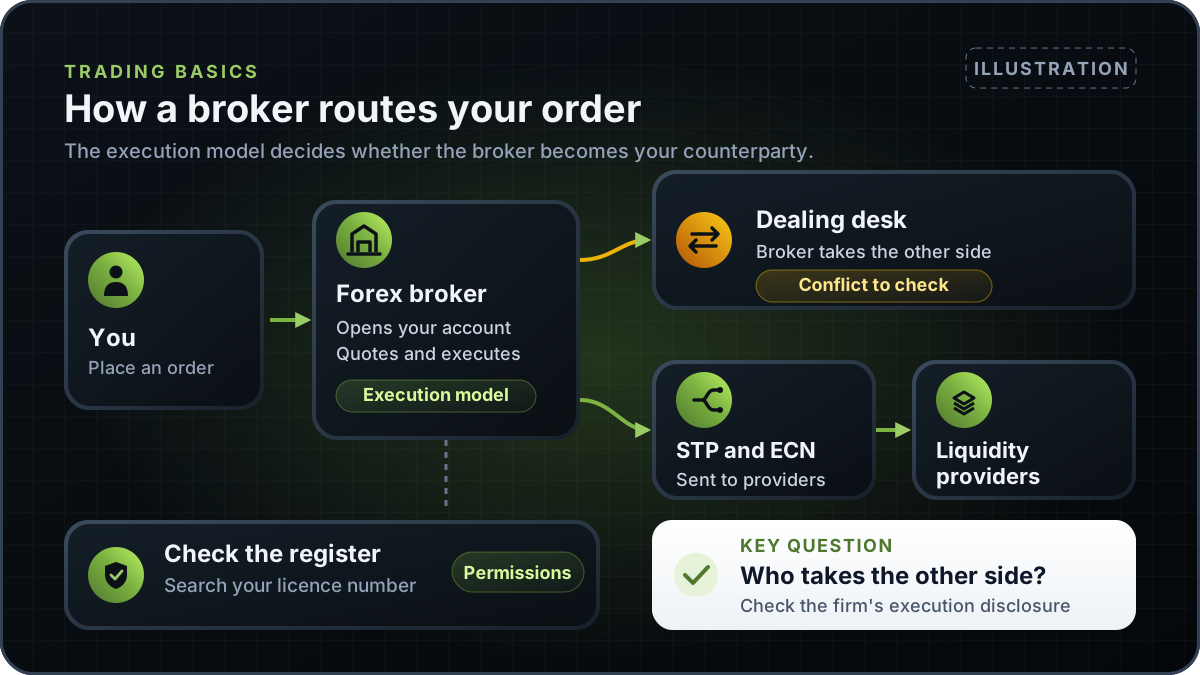
What is a forex broker? It is a firm that gives you access to the foreign exchange market. It opens your trading account, quotes prices, executes your orders and, where it holds client money, must follow its regulator's rules. How it handles each order depends on its execution model.
In brief
What is a forex broker? It is the firm that connects you to the currency market. Here is what it does, how its execution model changes your trade, and how to check it before you deposit.
A forex broker sits between you and the currency market. It opens and maintains your trading account, shows you prices, accepts and executes your orders, and reports your positions. Some brokers also hold the money you deposit. Each of these jobs carries its own risk, so it helps to look at them one at a time.
Start with the account and pricing. The broker sets the terms on which you deal: the currency pairs and other instruments offered, the spread or commission charged, the margin it requires and the financing it applies to positions held overnight. Margin is the deposit set aside against an open position, so the margin rules are part of the broker's terms as well as the market's.
Execution decides who takes the other side of your trade, and it is covered in the next section. The platform shows the prices you see and sends your orders. The CFTC's customer advisory on forex notes that the dealer controls the platform and the prices you see, and advises comparing prices with third-party sources.
The table below sets out the four execution models you are most likely to meet. The labels are common industry usage, not regulator definitions, so treat the descriptions as a guide to the questions to ask, and read the firm's own execution disclosure for its exact arrangement.
| Model | How your order is handled | How the broker typically earns | What to check |
|---|---|---|---|
| Market maker (dealing desk) | The broker is your counterparty. It quotes its own prices and takes the opposite side of your trade, and may hedge or internalise the risk. | Typically the spread it quotes, and in some cases the result of client losses. The CFTC advisory lists these sources for dealers. | Whether the broker can be your counterparty, how it sets its quotes, and how it discloses conflicts. |
| STP (straight-through processing) | Orders are passed on to one or more liquidity providers, without the broker dealing against them as a matter of model design. | Typically a mark-up on the provider's price, a commission, or both, as set in the broker's terms. | Which providers receive your orders, the size of any mark-up, and whether the broker is paid on your trading or on its own profit. |
| ECN (electronic communication network) | Orders are matched on an electronic network with other participants, such as banks, brokers and funds. | Typically a commission per trade, alongside the raw market spread shown on the network. | The commission per trade, the depth of liquidity, and what the broker charges on top of the network price. |
| Hybrid | The broker combines methods, so some orders may be internalised and others routed to the market. | Varies by instrument, order type and conditions, often a mix of spread and commission. | Which orders go where, and how the firm discloses the switch between methods. |
Model descriptions are general industry usage, not regulator definitions. Costs and routing vary by firm, so check each firm's own terms.
The label matters less than the facts behind it. Ask how the broker earns from each order, whether it can be your counterparty, and where its prices come from. If a firm is paid when clients lose, its incentives differ from a firm paid mainly on volume. ECN vs STP commission structure goes deeper on how the two common routing models price their trades.
Whatever the model, a broker's charges fall into a few groups. The main one is the spread, the gap between the buy and sell price. The mechanics are set out in what is spread in trading. Some brokers add a separate commission per trade, and some add a mark-up to the price they receive from a liquidity provider.
Holding a position overnight usually brings a financing charge, sometimes called a swap. Currency conversion can also apply where your account currency differs from the instrument's currency. Compare the full cost of a trade, not only the headline spread, and read the leverage explainer alongside it.
Many traders assume that money in a broker account is protected in the same way as a bank deposit. That assumption may not hold. The CFTC's customer advisory on forex says that customer deposits are not protected, and that if a dealer fails you may be unable to recover your money. It advises reading the account agreement for your rights and protections.
Whether a broker must keep client money apart from its own funds depends on the jurisdiction and the licence. The rules, and any compensation scheme, are set by the regulator in that country. Find the rule that applies to your broker in its regulator's guidance and in the firm's terms, rather than relying on a general statement.
A registration check takes a few minutes and is the most useful step before you deposit. Search the licence or registration number on the official register for the regulator that covers the firm, not a link from the broker's website. The table lists four official registers. Other countries have their own registers, so this list is not exhaustive.
| Jurisdiction | Official register | What it lets you check |
|---|---|---|
| United States | NFA BASIC (nfa.futures.org) | Search by firm, NFA ID or individual. The CFTC check page says BASIC shows registration, disciplinary or regulatory history and financial information. |
| United Kingdom | FCA Financial Services Register | A public record of firms, individuals and other bodies that are, or have been, authorised by the FCA or PRA. It also lists firms reported to be operating without the correct authorisation. |
| Cyprus | CySEC register of Cypriot investment firms | Licence number, licence date and status notes such as suspension. Each firm's entry page lists its authorised investment and ancillary services and its approved website domains. |
| Australia | ASIC professional registers search | People and organisations registered or licensed with ASIC to provide a service. Match the licence number in your agreement to the register entry. |
Verified on 9 November 2026. Registers change, so check the live page before relying on any entry.
Confirm the legal entity named in your agreement and its licence or registration number. Read the permissions or services shown, and check they cover what you plan to trade. Look at status notes and disciplinary history. If the firm does not appear at all, ask it why. The CFTC's check page notes that you may need to check other regulatory agencies, depending on the product or service offered.
RTX5 is Orrnn's trading terminal and broker-technology product. Its Windows desktop client is in preview, and the web and mobile clients are planned. A Google Play listing for Android is published, but the mobile client has no approved release record yet; check the product-availability record and release notes before relying on any RTX5 feature. RTX5 is broker technology, not a broker, and does not hold client money. The broker examples and checks on this page do not come from an RTX5 feature.
Check RTX5 product availabilityTrust and methodology
We want you to be able to identify who owns the page, inspect the evidence, understand how tools were used, and challenge anything that looks wrong or out of date.
Published under the RTX5 Editorial Team byline. It identifies the responsible publishing organization; it does not imply that a named lawyer, regulator, financial adviser, or licensed expert approved this page.
6 primary references are listed on this page with context about what each one supports. The source set was checked on .
Automation and AI may help organize research, outline a page, or edit language. They are not treated as sources, are not presented as human experts, and do not remove the publisher's responsibility for the final page.
If a statement is incomplete, unsupported, or outdated, send the exact URL, sentence, and supporting evidence through our contact route. Read the full editorial and corrections policy.
Sources were checked on 9 November 2026. They explain market rules and concepts; they do not certify RTX5 or provide individual financial advice.
Not necessarily. Its legal status depends on the jurisdiction and the licence it holds. Check the regulator register for the entity you contract with, rather than assuming its status from its name or branding.
It can, depending on the model. The CFTC advisory says that when a dealer is your counterparty, it earns when you trade more often, when you lose, or when you pay spreads, fees or commissions. Other models earn mainly from commissions or mark-ups. Read the firm's execution disclosure to see which applies.
The CFTC advisory says customer deposits are not protected, and that you may be unable to recover money if a dealer fails. Protection depends on the jurisdiction, the licence and the account agreement. Read those terms before you deposit, and check the rules set by the regulator in your country.
Find the licence or registration number in your agreement and search it on the official register for the firm's regulator. In the US, use NFA BASIC. In the UK, use the FCA Financial Services Register. Other countries have their own registers. Confirm that the permissions cover what you plan to trade, and check any status notes.
No. The CFTC advisory says registration alone may not protect you from fraud. In the US, it says registration with the CFTC and NFA indicates that principals and associated persons have completed background checks, that the firm meets certain financial requirements, and that the firm or persons must submit to examinations and regulatory supervision. Use the register as one check among several, and read the firm's terms before you deposit.
No. RTX5 is Orrnn's trading terminal and broker-technology product. It is licensed to brokers and does not hold client money. Its Windows desktop client is in preview, and its web and mobile clients are planned. A Google Play listing for Android is published, but the mobile client has no approved release record yet. Check the product availability record before you rely on any RTX5 feature.