Accountable publisher
Published under the RTX5 Editorial Team byline. It identifies the responsible publishing organization; it does not imply that a named lawyer, regulator, financial adviser, or licensed expert approved this page.
Market basics
A stock index, or stock market index, is a single number that tracks the combined price movement of a defined group of shares, such as the largest companies on one exchange. Its value depends on how each share is weighted. An index measures a market; it is not something you can buy directly.
In brief
What is a stock index? It turns the prices of many shares into one number. The method behind that number decides what it really shows, so the weighting matters as much as the list.
An index is a number that summarises the price movement of a group of assets. In stock markets, the group is a list of shares chosen by an index provider. The FTSE 100 follows the largest 100 UK companies, as defined by FTSE Russell. When those shares rise or fall, the index moves, giving one reading for a market or part of one.
An index holds nothing you can own. It has no shares, no cash and no claim on the companies inside it. It is a calculation, published by a provider and updated as prices change. That is why you cannot buy an index directly. You can trade products that follow an index, which are covered below.
Traders and analysts use indices as benchmarks, as a quick read of market direction and as a reference point when they compare a portfolio. An index describes what its members have done. It does not predict where they will go next.
Building an index involves three decisions. The first is membership: which shares qualify, usually judged on size, liquidity, listing venue and free float. The second is selection and review: the provider decides which eligible companies enter and how often the list is checked. The third is the weighting method, which sets how much each member moves the index.
Two indices can cover the same market and still report different numbers, because they differ on at least one of these decisions. The FTSE 100 is a good example of how membership and weighting can use different measures. FTSE Russell's UK Index Series ground rules state that the FTSE 100 consists of the largest 100 UK companies by full market capitalisation, before any investability weighting. Constituents are then adjusted for free float and foreign ownership limits. The index is reviewed quarterly, in March, June, September and December.
Weighting decides what the index is really measuring. Three common methods are set out below, each with one index whose provider documents that method.
| Method | How each share's weight is set | What it means for the index |
|---|---|---|
| Price-weighted | The index is the sum of member prices divided by a divisor, so each share's weight is its price as a proportion of the sum of prices. Nikkei's FAQ says the Nikkei 225 sums adjusted prices and divides by a divisor. | A high-priced share moves the index more than a larger company with a lower share price. |
| Market-value weighted (float-adjusted) | Weight is each member's market value, based on shares available to trade (free float), as a share of the total. The FTSE 100 uses this approach under its published ground rules. | The largest companies by market value drive most of the move. |
| Equal-weighted | Every member carries the same weight. Weights drift as prices move, so the index is reset at each rebalance. Nasdaq's methodology says the Nasdaq-100 Equal Weighted Index is rebalanced quarterly so that each issuer gets an equal index market value. | Smaller companies have as much influence as the largest, and the index needs regular rebalancing. |
Verified on 9 November 2026 against the Nikkei Stock Average FAQ, the FTSE UK Index Series ground rules (v17.4, October 2026) and the Nasdaq-100 Equal Weighted Index methodology. Check each index provider's current methodology before relying on a detail.
Read the table as a set of trade-offs. A price-weighted index is simple, but a share price does not measure company size. Nikkei's FAQ notes that the price-weighted Nikkei 225 tends to be influenced by high-price stocks, while the market-value weighted TOPIX is influenced by stocks with large market value. A market-value index reflects the economic weight of each company, so the largest companies dominate. An equal-weighted index gives each company the same say, which means smaller companies count for more than they would in a market-value index.
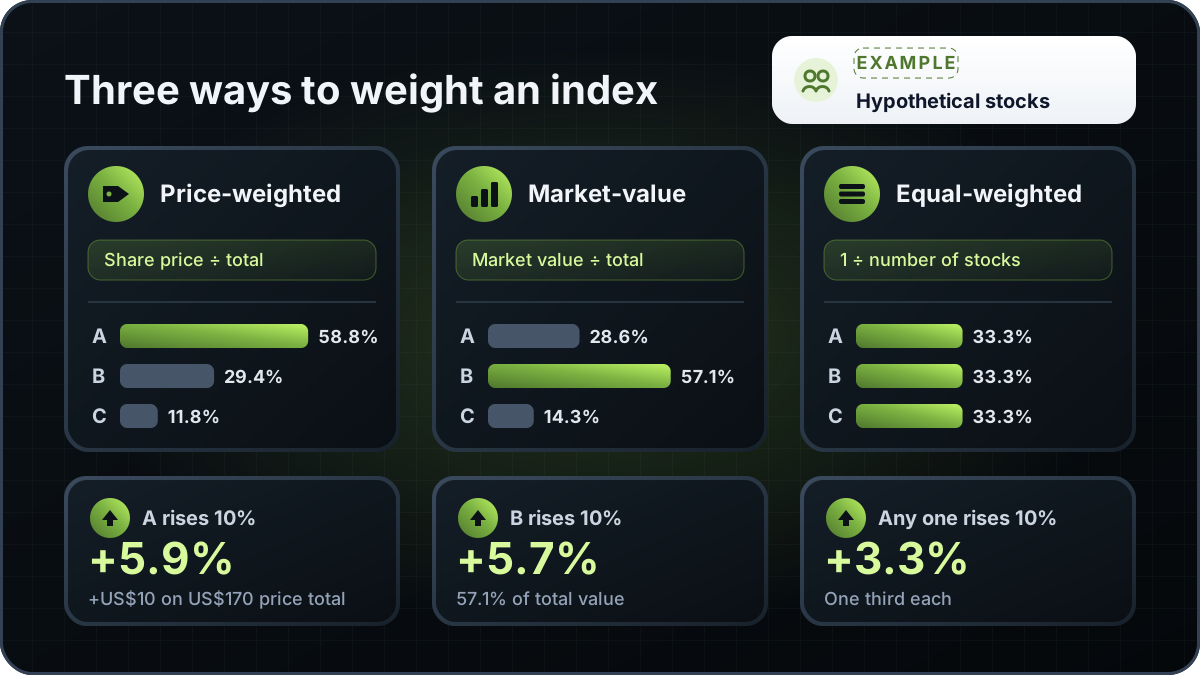
Example: take three hypothetical stocks. Stock A trades at US$100 with 10 million shares, a market value of US$1,000 million. Stock B trades at US$50 with 40 million shares, a market value of US$2,000 million. Stock C trades at US$20 with 25 million shares, a market value of US$500 million. None of these companies is real. The figures are chosen for the arithmetic only.
The table shows each stock's share of the example index under each method. Price weight is the stock's price divided by the total price of US$170. Market-value weight is its market value divided by the total of US$3,500 million. Equal weight is one third for each stock.
| Stock | Price (US$) | Market value (US$m) | Price weight | Market-value weight | Equal weight |
|---|---|---|---|---|---|
| A | 100 | 1,000 | 58.8% | 28.6% | 33.3% |
| B | 50 | 2,000 | 29.4% | 57.1% | 33.3% |
| C | 20 | 500 | 11.8% | 14.3% | 33.3% |
| Total | 170 | 3,500 | 100.0% | 100.0% | 100.0% |
Example only, not market data. Weights rounded to one decimal place. Equal weights are shown as one third each, rounded.
The same stocks produce different effects. Using the weights above, the approximate effect of a 10% rise in one stock on the example index is:
An index is the measurement. An index fund is a fund that aims to follow an index, so you own the fund and not the index. Its results can differ from the index because of fees and trading costs. Read the fund's documents for what it holds and what it charges.
Futures are standardised contracts to buy or sell an asset at a set price on a future date. Stock index futures are linked to an index. For how those contracts work, read what are stock futures. Some contracts for difference are also linked to an index, as explained in what is a CFD. Each of these products has its own rules, costs and risks.
An index answers one narrow question well: how a defined group of shares moved over a period. It cannot tell you about companies it leaves out, about the wider economy or about future direction. Before you use an index as a signal, check three things: the membership rules, the weighting method and whether the figure is a price return or a total return that includes dividends.
For the broader picture of how the stock and currency markets relate, see forex and stock markets. For a general introduction to how trading works, start with what is trading. Check the exchange's official calendar for trading hours rather than relying on a third-party figure.
RTX5 is Orrnn's trading terminal and broker-technology product. Its Windows desktop client is in preview, and the web and mobile clients are planned. A Google Play listing for Android is published, but the mobile client has no approved release record yet; check the product-availability record before relying on any RTX5 feature. This guide is educational and does not describe index data or index-linked products in RTX5.
Check RTX5 product availabilityTrust and methodology
We want you to be able to identify who owns the page, inspect the evidence, understand how tools were used, and challenge anything that looks wrong or out of date.
Published under the RTX5 Editorial Team byline. It identifies the responsible publishing organization; it does not imply that a named lawyer, regulator, financial adviser, or licensed expert approved this page.
5 primary references are listed on this page with context about what each one supports. The source set was checked on .
Automation and AI may help organize research, outline a page, or edit language. They are not treated as sources, are not presented as human experts, and do not remove the publisher's responsibility for the final page.
If a statement is incomplete, unsupported, or outdated, send the exact URL, sentence, and supporting evidence through our contact route. Read the full editorial and corrections policy.
Sources were checked on 9 November 2026. They explain market rules and concepts; they do not certify RTX5 or provide individual financial advice.
An index is a single number that summarises how a group of assets has moved, such as the largest companies in a country. It is calculated from member prices under a published method. Because it is only a calculation, you cannot hold it directly. Funds and futures can follow it, and each has its own costs and risks.
No. An index is a calculated measure with no shares, cash or claim on the companies inside it. To gain exposure, people use funds that aim to track it, futures linked to it, or derivatives such as CFDs. Each is a separate product with its own costs, rules and risks, so read the product's terms before you trade.
Their membership and weighting usually differ. One index may include more companies, apply a different free-float rule, or weight by price rather than market value. The largest members then move each index by different amounts. Compare the methodology, not just the name, before drawing conclusions from either one.
A price-weighted index gives each member a weight based on its share price. A high-priced share moves the index more than a larger company with a lower price. Because weight follows price rather than company size, the index can overstate a high-priced share's importance. Read the provider's methodology for how the index is calculated.
No. An index is the measurement. An index fund is a fund that holds shares, or a sample of them, to follow an index. Its results can differ from the index because of fees and trading costs. Read the fund's documents to see what it holds and what it charges.
No. An index describes the past and present moves of its members and does not predict prices. Any use of an index in a trading plan is your decision and should be tested against your own risk limits. This guide is educational and is not personal financial advice.