Accountable publisher
Published under the RTX5 Editorial Team byline. It identifies the responsible publishing organization; it does not imply that a named lawyer, regulator, financial adviser, or licensed expert approved this page.
Trading rules
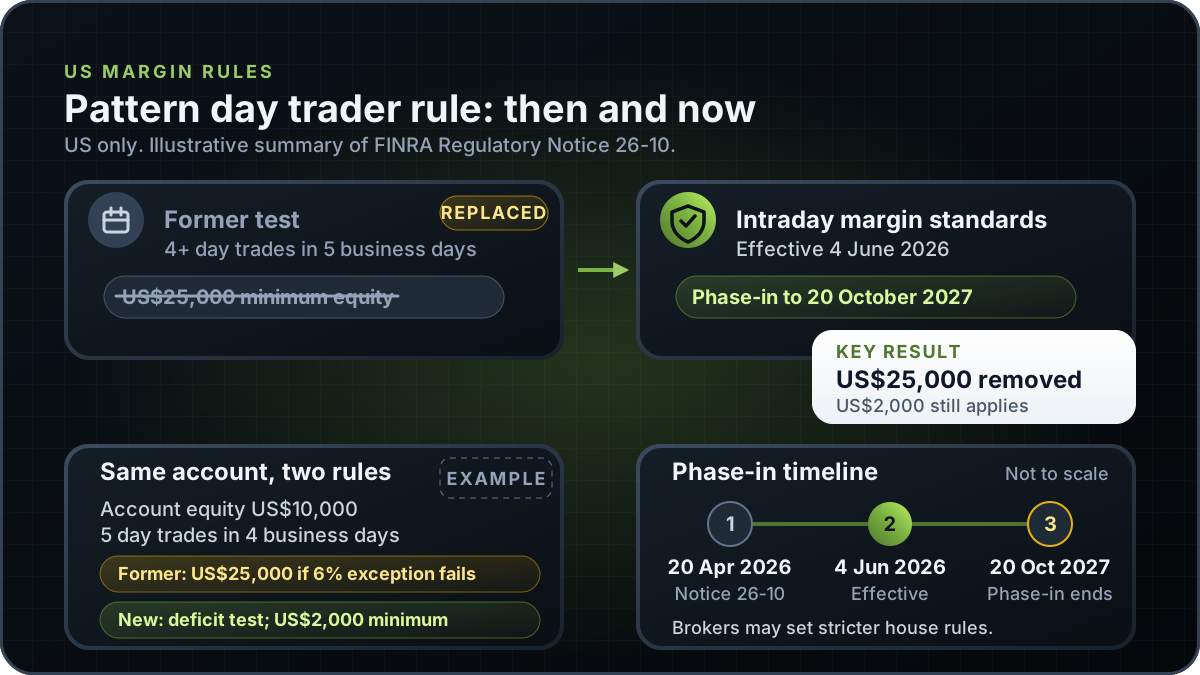
The pattern day trader rule was a US margin rule. Under FINRA's former Rule 4210, a customer who made four or more day trades within five business days was designated a pattern day trader and needed US$25,000 minimum equity. FINRA replaced that with intraday margin standards effective 4 June 2026, with phase-in to 20 October 2027.
In brief
The pattern day trader rule is a US margin rule that FINRA has now replaced. Here is the former test, what took its place, and what still applies to a margin account.
The pattern day trader rule was part of FINRA Rule 4210, which governs margin requirements for member firms. FINRA's interpretations page for Rule 4210, which is marked as valid through 3 June 2026, sets out the former text. It defines a pattern day trader as any customer who executes four or more day trades within five business days.
The same text added an exception. If the number of day trades was 6 percent or less of total trades for the five business day period, the customer was not treated as a pattern day trader. Where the designation applied, the rule set a minimum equity requirement of US$25,000. Regulatory Notice 26-10 describes these requirements as the day trade count test and the US$25,000 minimum applied to customer margin accounts.
For the definition of day trading itself, read day trading explained. This page is about the rule that sat on top of it.
FINRA's Regulatory Notice 26-10, published on 20 April 2026, says the intraday margin standards replace the day trading margin requirements in their entirety, including the day trade count designation and the US$25,000 minimum equity requirement; the day trading explained page summarises the change.
The effective date is 4 June 2026, and members that need more time may phase in their implementation until 20 October 2027. The notice also says the new rule supplements, rather than changes, regular maintenance margin requirements.
The new rule works through an intraday margin deficit. A firm checks a margin account on each day when there is an intraday margin level reducing transaction, such as a short sale or a purchase that does not cover a short position. A deficit must be satisfied as promptly as possible. It remains outstanding until it is satisfied or until the close of business on the 15th business day after it arose.
The notice also sets a 90 day freeze that can apply to a customer who makes a practice of failing to satisfy intraday margin deficits, if a deficit is not satisfied by the close of business on the fifth business day. Small deficits that do not exceed the lesser of 5 percent of account equity or US$1,000 are excluded from that practice, as are deficits reasonably determined to arise from extraordinary circumstances.
| Item | Former pattern day trader rule | Intraday margin standards (from 4 June 2026) |
|---|---|---|
| Status | Replaced by FINRA | Effective 4 June 2026; firms may phase in until 20 October 2027 |
| Trigger | Four or more day trades within five business days | Intraday margin deficit tested on days with an intraday margin level reducing transaction |
| Trade-count designation | Pattern day trader, with an exception where day trades were 6 percent or less of total trades | Replaced in their entirety (FINRA Regulatory Notice 26-10) |
| Minimum equity for day trading | US$25,000 for a pattern day trader | Removed; members that need more time may phase in implementation until 20 October 2027 |
| General margin minimum | US$2,000 in equity for margin trading (FINRA investor page) | US$2,000 still applies (FINRA investor page) |
| Firm-set requirements | Firms may set higher house requirements | Firms may still set higher house requirements |
Verified on 9 November 2026 from FINRA Regulatory Notice 26-10 (20 April 2026), the FINRA Rule 4210 interpretations page and the FINRA day trading investor page. Members that need more time may phase in their implementation until 20 October 2027, so ask your broker which requirements it applies.
The table simplifies the notice. For the full mechanics, including sweep programmes, portfolio margin and the treatment of deposits, read the notice itself.
This is an illustrative example, not a recommendation. Suppose a US margin account holds US$10,000 in equity and makes five day trades within four business days.
Under the former rule, five day trades within four business days met the four-trade test. The 6 percent exception would help only if day trades were 6 percent or less of total trades in that five business day period. If it did not apply, the account would be a pattern day trader, and the US$25,000 minimum would apply to it.
Under the intraday margin standards, the trade count alone does not designate the account. The question becomes whether the equity covers any intraday margin deficit created by its positions during the day, measured against the rules and the broker's own requirements. The US$2,000 margin minimum still applies to the account.
Margin trading in the US still requires equity in the margin account. FINRA's investor page on day trading says a margin account must keep at least US$2,000 in equity, and that firms may set higher house requirements. The page also says intraday margin calculations are based on positions held during the trading day, not just at the end of the day.
For a broader view of how borrowed funds work, read what is margin in trading. Leverage is a related but separate idea, covered in what is leverage in trading.
Your next step is to get the broker's current margin rules in writing before you trade on margin. That is the document that governs your account.
This page covers the US only. Other countries set their own rules for day trading, margin and leverage, and the US change does not apply automatically elsewhere. The rule that applies to you depends on where your broker is regulated and where you live.
Check the current rules with your local regulator and with your broker's terms. Do not assume that a rule described for one market applies in another.
RTX5 is Orrnn's trading terminal and broker-technology product. Its Windows desktop client is in preview, and the web and mobile clients are planned. A Google Play listing for Android is published, but the mobile client has no approved release record yet; check the product-availability record before relying on any RTX5 feature. RTX5 is not a broker and does not hold client money, so margin and day-trading rules are set by your own broker. The rule details on this page do not come from an RTX5 feature.
Check RTX5 product availabilityTrust and methodology
We want you to be able to identify who owns the page, inspect the evidence, understand how tools were used, and challenge anything that looks wrong or out of date.
Published under the RTX5 Editorial Team byline. It identifies the responsible publishing organization; it does not imply that a named lawyer, regulator, financial adviser, or licensed expert approved this page.
4 primary references are listed on this page with context about what each one supports. The source set was checked on .
Automation and AI may help organize research, outline a page, or edit language. They are not treated as sources, are not presented as human experts, and do not remove the publisher's responsibility for the final page.
If a statement is incomplete, unsupported, or outdated, send the exact URL, sentence, and supporting evidence through our contact route. Read the full editorial and corrections policy.
Sources were checked on 9 November 2026. They explain market rules and concepts; they do not certify RTX5 or provide individual financial advice.
Not in its former form. FINRA Regulatory Notice 26-10 replaced the day trading margin requirements, including the pattern day trader designation and the US$25,000 minimum equity requirement, with intraday margin standards. The new standards took effect on 4 June 2026, and firms that need more time can phase them in until 20 October 2027. Check your broker for the rules it applies to your account.
Under FINRA's former Rule 4210, a customer who executed four or more day trades within five business days was a pattern day trader. An exception applied when day trades were 6 percent or less of total trades for that period. A pattern day trader then needed a minimum of US$25,000 in equity in the account.
No. Other countries have their own rules for day trading, margin and leverage, and this page does not cover them. The US change does not apply automatically elsewhere. Check your local regulator and your broker's terms for the rules where you trade.
No. The intraday standards change how margin deficits are measured and when they must be cleared, but they do not remove market risk. Prices can move sharply during the day, and borrowed funds can make a loss larger than your deposit. Read the broker's margin disclosure before trading on margin.
Ask which rule set applies to your margin account now, whether its phase-in is complete, what house requirements it sets, how it calculates intraday margin deficits, and what happens if a deficit is not cleared promptly. Get the answers in writing where you can.